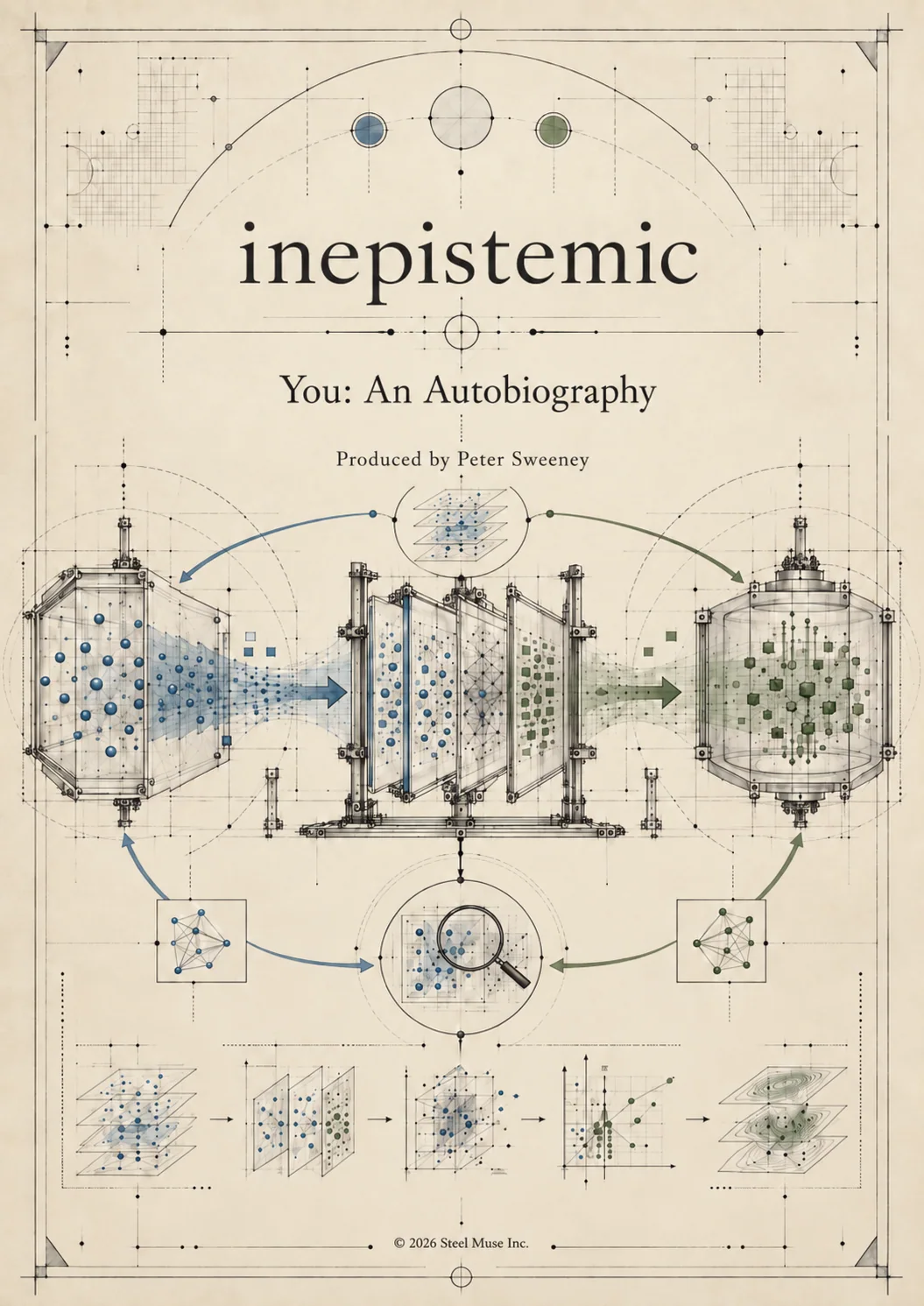
Most accounts of people begin by asking which categories describe us. inepistemic asks a different question: what happens when epistemology—the explanation of how knowledge grows—is allowed to reach all the way into the singular person, to the singular you? That change of direction has unexpected consequences.
You can be measured, classified, predicted, genetically described, socially situated, and increasingly modeled by machines. Such descriptions can be useful. But applying them to you does not, by itself, explain your particular epistemic history: the problems that matter to you, the knowledge you reconstruct, the criticisms that change you, and the possibilities you have yet to recognize.
Following that problem through genetics, psychology, institutions, authority, morality, freedom, consciousness, technology, and artificial intelligence, inepistemic develops a picture of you as neither autonomous from the world nor reducible to its descriptions. You are evolved, physical, socially embedded, computationally constrained, and dependent upon knowledge created by others. Yet you can create new problems, new evaluative criteria, and explanations that did not previously exist.
Those creations have causes; they do not escape reality. But once made objective, they can change it. They can become arguments, instruments, institutions, and technologies that enlarge what others—and you—can do.
The future is open in this strong sense: some of its causes will be explanations not yet created. We can reconstruct an idea's ancestry after it appears, but we cannot derive the next genuinely new explanation from the knowledge that preceded it. Nor can we yet explain how you create the problems and criteria that give such explanations meaning.
inepistemic follows those consequences into the vast solitary universe of you, a person who is not explained—and is not finished explaining.