The Unfinished Explainer
XV. The Recursive Universal Explainer
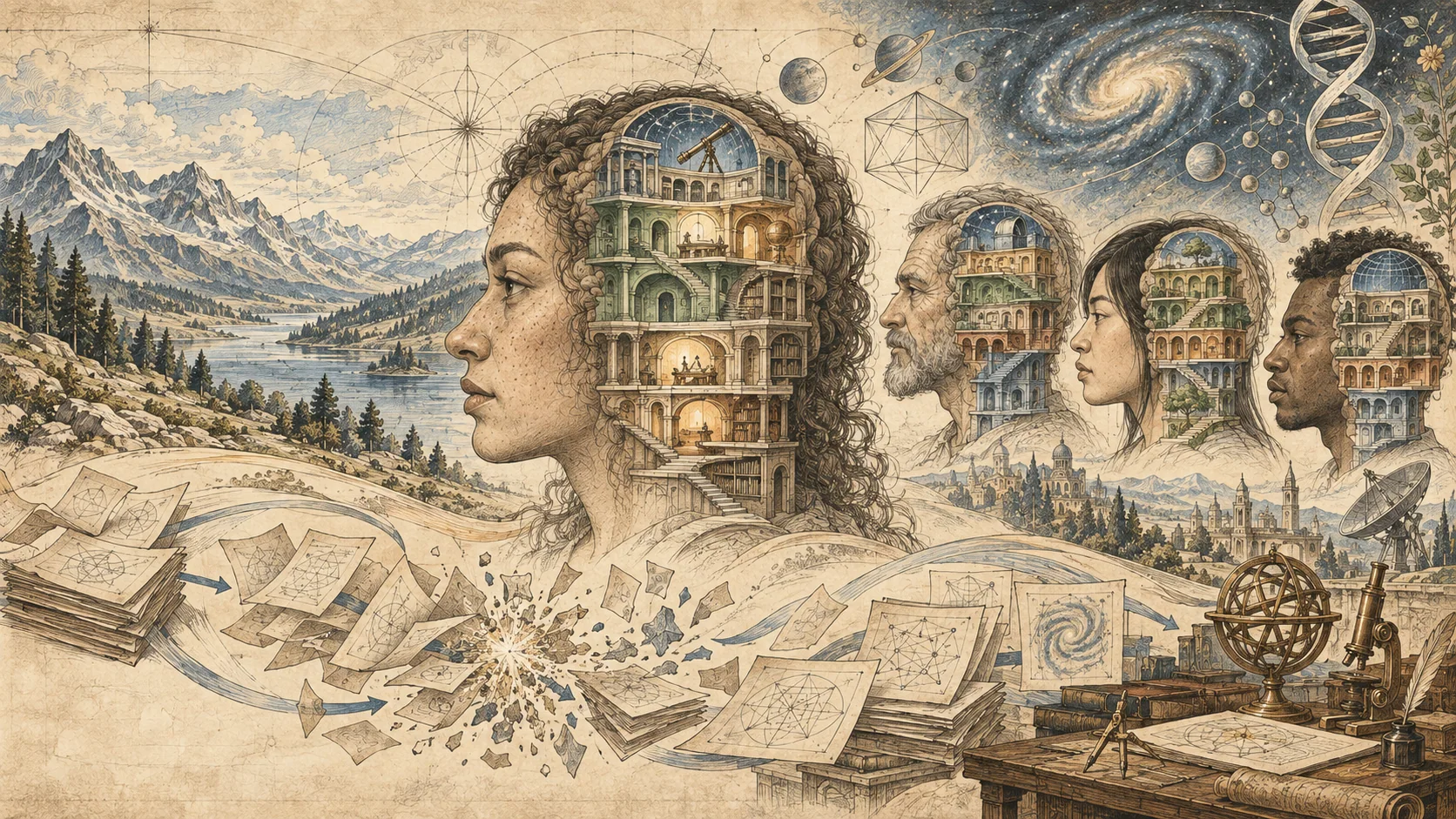
Taking explanations personally means allowing what you think you know to disturb what else you think you know. When that disturbance creates a new problem, it reinstantiates what knowledge-creating people have been doing all along: recursively explaining.
One compression has done enormous work:
the universal explainer.
It has distinguished people from genes, traits, populations, institutions, technologies, and other animals. It has advanced the argument that you cannot be reduced to the classifications applied to you. It has helped explain why freedom matters, why criticism matters, why objective knowledge matters, and why your future cannot be inferred from your present state.
But the phrase has become a meme. That does not make it false. Some memes are merely compressed slogans. Others represent an explanation so effectively that the compression begins to look like the explanation itself.
Universal explainer may stand close to the truth, entailed by our best explanations. But if we take it personally, we now have to decompress it and let it run. Understanding explanatory universality as a consequence of computation and physics is to take it seriously. Exploring it as instantiated in an epistemic mind is to take it personally.
What kind of thing is capable of universal explanation? What must be true of you for that capacity to exist? How can an evolved biological organism create explanations about domains that had nothing to do with the environment in which it evolved? How can a finite physical system possess no known domain-specific ceiling on what it can understand? What roles do computation, abstraction, objective knowledge, and tools play in making that universality practical today, and what might it suggest about the machines we could build tomorrow?
This is not an attempt to define personhood once and for all. It is an attempt to let those explanations reach the person doing the explaining.
1. The Universal Explainer
Humans are small animals on one planet in an enormous universe. We are fragile and frequently wrong. Yet the same organism can explain stellar evolution, the structure of DNA, and mathematical structures no one can perceive directly. It can build instruments that operate beyond unaided sensation and then criticize the epistemology by which those instruments are understood.
The unusual capacity is not merely difficult problem-solving, adaptation, or learning. It is the creation of explanations whose reach is not confined to the environment in which the organism evolved. That is the claim compressed by universal explainer.
Universality does not mean that you already know every domain, or that every problem is practically solvable. It means that no known domain-specific boundary follows merely from the fact that you are a person. Given sufficient knowledge, criticism, tools, time, and physical resources, your explanatory reach is not restricted to some preassigned domain of problems.
Among the animals we know, nothing else appears to possess this open-ended capacity. Other animals learn, solve problems, communicate, remember, navigate, use tools, and coordinate socially. But we do not presently know of another animal that creates open-ended explanatory knowledge. So universal explainer is not an empty honorific. It identifies something objectively exceptional.
The danger is to let that unusual property become the whole ontology of the person. That would repeat the categorical error: a property of you, however important, is not a complete explanation of you.
The phrase therefore suggests a problem. If universal explanation is a real capacity of people, then explanations that apply everywhere else, including epistemology, must also be allowed to reach the entity doing the explaining.
Evolution reaches you. Physics reaches you. Computation reaches you. History, embodiment, and error reach you. Being able to explain them does not place you outside them.
2. Evolved, and Still Evolving
Begin with the obvious consequence. Human beings evolved.
No explanation of personhood can require otherwise. Yet you can understand evolution perfectly well in the abstract while preserving an inexplicit picture of yourself as something fundamentally outside it. In that case the explanation has not yet travelled all the way to you personally.
You are an animal. Your body is constructed through biological processes. The brain in which explanatory knowledge becomes physically instantiated is an evolved organ, and the sensory systems through which you encounter reality are evolved systems. Memory, affect, attention, perception, pain, pleasure, attachment, motor control, sleep, and development all arise within that evolved architecture.
Nothing about explanatory creativity requires an exemption from this history. The striking fact is the opposite: evolution produced an organism capable of explaining evolution.
But evolved points backward. It names the history that produced the present organism. The epistemology explored here has never treated you as complete. Knowledge changes what becomes salient. A new explanation creates new problems. A criticism makes an old abstraction visible. A skill changes what you can notice. A relationship changes the problem space. A technology makes previously unavailable forms of action possible.
So you are not only evolved. You are evolving. Not only genetically, but also epistemically.
Variation, criticism, retention, and path dependence remain active. Your existing knowledge becomes part of the environment in which your future knowledge develops. This matters because creativity can look like the opposite of continuity. You can suddenly see a problem differently. A scientific explanation can reorganize a field. A work of art can alter what later creators perceive as possible. A moral insight can make an inherited practice intolerable.
The explicit change may be discontinuous. The causal system in which it occurs is not without history. Your mind depends on biological architecture, memory, language, skill, social knowledge, tools, habits, institutions, and objective knowledge. A new explanation enters that already complex structure. Some existing knowledge survives. Some becomes contradictory. Some tools or institutions can absorb the change; others have to reconstruct around it. Some habits outlive the explanation that once supported them.
Compare it.
The relevant distinction is not:
It is:
within
This is why piecemeal improvement can be more corrigible than wholesale reconstruction. When many dependencies change at once, the causal source of failure becomes harder to identify. Radical change remains possible, but error is easier to localize when reconstruction proceeds through sequences whose dependencies can still be criticized.
The same applies to you. Open-ended evolution is not instantaneous. Bodies, skills, relationships, concepts, and inexplicit knowledge all have histories. You can become radically different without being able to discard every inherited structure by choice. Your future is open and causally contingent.
3. Computation, Abstraction, and Tools
The next consequence begins with physical instantiation. Whatever happens when you remember, imagine, explain, criticize, love, compose, suffer, calculate, recognize a problem, or change your mind is realized through physical processes. If your explanation of computation correctly constrains the transformations physical systems can perform, then personhood cannot depend on a transformation that simply escapes those constraints.
That is where computation reaches the person. Calling a person computational can sound reductive because the word evokes machinery, automation, determinism, and lifeless symbol manipulation. But the explanatory claim is narrower: If human explanatory creativity requires a non-computational physical process, then that process itself requires an explanation under the physics that permits the person to exist. The discomfort does not remove the problem.
Computational universality has a further consequence. If a physical process can in principle be simulated by a universal computer, then some program can perform that simulation. That program is objective knowledge. The program in question may be enormous. It may require impractical hardware, more time than a human lifetime, or more energy than can realistically be supplied. Those limits matter, but they are engineering limits rather than principled boundaries on what can be represented or computed.
Compare it.
The distinction is:
No finite person can perform every possible computation unaided. Neither can any particular computer. Universality means that a change of domain does not by itself require a fundamentally different kind of computing machine. Given the right program, time, and resources, the universal machine can perform the relevant computation.
That matters because explanatory universality has never been realized through biological memory alone. People create objective knowledge and embody it in symbol systems, instruments, and technologies. Writing and mathematical notation preserve structure outside biological memory. Instruments extend perception. Computers, networks, and artificial intelligence make new transformations of objective knowledge practically available.
The finite biological person is therefore not the same explanatory unit as the unaided biological processor. Abstraction is part of what makes that extension possible.
A finite system rarely needs a complete microscopic simulation in order to explain or manipulate a higher-level structure. Software engineering makes the relation ordinary. A programmer can work with a string without continuously reasoning about transistor physics. An operating system hides much of the hardware. A runtime or language hides lower-level operations, while libraries and applications hide repeated operations again. The higher level is not independent of the lower one. It depends on it while suppressing detail that does not matter to the current problem.
A useful abstraction can therefore be represented roughly as:
The compression can fail. A timing bug can make concurrency relevant. A memory problem can expose an assumption hidden by a runtime. A hardware fault can propagate upward through every software layer. The abstraction was not unreal. It was locally adequate until an ignored detail became causally relevant.
Human explanation may work the same way. We do not calculate quantum states to explain why a bridge carries a truck. We do not simulate every neuron to understand why a criticism changed your mind. We do not reconstruct molecular dynamics to reason about a contract. Different explanatory levels preserve different causal dependencies. That is one reason you can reach so far: explanation need not contain every lower-level detail in order to preserve the structure relevant to the problem at hand.
Now the problem sharpens. Physical processes may be computationally simulated in principle, while abstractions let finite systems manipulate progressively deeper structures without reproducing every detail.
Given both claims, what establishes a principled upper boundary on explanatory reach? Resource limits establish practical boundaries. A person has finite time. Civilizations have finite energy. Computers have finite memory. Some computations may remain impossibly expensive for any realistic purpose. But those constraints do not by themselves explain why some domain of reality would be forever beyond explanation in kind.
The stronger boundary claim needs its own explanation. Saying that people did not evolve for some domain does not establish that boundary; humans did not evolve specifically for general relativity either. Saying that the unaided brain cannot directly perform a computation does not establish it; much modern calculation already occurs in machines whose operations exceed what biological cognition can perform directly.
You create tools. The tools carry objective knowledge. That objective knowledge makes new transformations practically available.
Abstract it.
A more realistic unit is therefore:
The nesting matters. You create objective knowledge. Some of that knowledge becomes technology. The technology enlarges your problem situation. The enlarged problem situation permits new explanations, which become new objective knowledge and can be embodied in further tools.
The process loops. That lets the existing phrase travel. You are a universal explainer. The noun names a capacity made possible by a history of incremental changes. You do not possess universal knowledge. No person has completed explanation or contains the content of every science, art, language, history, or possible future theory. So the verb matters too. You are universally explaining.
The parallel with evolution is useful:
and
The noun names the capacity. The verb names its continuing and evolving realization.
Universality is therefore not omniscience. It is the absence of a domain-specific ceiling on explanatory creation, given sufficient knowledge, tools, criticism, time, and physical resources.
The finite animal is remarkable precisely because no supernatural exemption is required. A natural organism can explain processes billions of light-years away, build instruments that reveal structures no unaided sense could detect, and use machines to create further explanations. The discovery of the universal explainer is itself a product of nature capable of explaining nature.
4. Physics Reaches the Explainer
The same standard travels farther. Whatever our best physics says about reality applies to people too. At ordinary human scales, you appear simple enough as an object: one body, one location, one continuous self, one reality. Deeper physical explanations need not preserve those ordinary intuitions unchanged.
Biologically, you are composed of cells. While some cells are replaced over time, several types are never replaced. Biological continuity and discontinuity coexist. That is strange when you think about it, but not a problem when you don't.
Similarly, quantum theory describes reality under conditions remote from everyday experience. Serious explanations of quantum reality entail an ontology very different from the classical objects through which ordinary life becomes intelligible.
We do not need to travel to quantum theory here. One consequence is enough. Mutually incompatible theories do not become consilient merely because they are called interpretations. If they make different claims about what exists or how physical reality behaves, then the conflict remains explanatory, not interpretative.
You receive no exemption. Our best physical explanation entails that the everyday object called you is only a dynamically stable classical approximation to a deeper physical reality. If so, that consequence belongs to the explanation of personhood too. Explanation does not abolish mystery. It moves it as it travels. The mystery is no longer that people belong to a realm beyond explanation.
Our unresolved problem remains how an evolved physical system creates genuinely new explanatory knowledge. We observe the phenomenon. You can notice a problem no one else noticed and create a conjecture that did not previously exist. You can invent a criterion by which earlier solutions become inadequate. You can criticize an explanation you previously used and thereby change the problem itself.
We can describe many conditions surrounding these events. We can explain neural systems, model learning, describe biological development, and build technologies that retrieve, recombine, transform, and extend enormous bodies of objective knowledge.
But the causal bridge to explanatory creativity remains incomplete. That is an open problem, not evidence of a fixed limit.
Artificial intelligence sits downstream of that gap. Current AI can manipulate objective knowledge at scales inaccessible to unaided human attention. It can retrieve, transform, compare, summarize, generate, calculate, simulate, and operationalize. But capability alone does not settle personhood.
The unresolved questions concern explanatory origination. Does the system create genuinely new problems? Does it create the evaluative structure by which those problems matter? Does it criticize and reorganize its own explanations as a continuing epistemic subject? Those questions remain downstream of the mechanism we do not yet understand.
If explanatory creativity is eventually explained, that explanation would itself become objective knowledge. If the relevant causal structure could then be instantiated in another physical substrate, artificial personhood would become physically possible. AGI would not require magic; it would require a previously unexplained property of people to become understood well enough to instantiate technologically.
The boundary between tool and person would then move. The possibility of that movement does not establish that the boundary has already disappeared.
Now turn the comparison around. Much discussion compares the biological human with the artificial system: which is smarter, which will surpass the other, which tasks belong to which. But people have never realized explanatory universality through biological cognition alone. Language and writing, mathematics and instruments, computers and networks already extend what a biological person can practically explain and do. AI belongs to that lineage of tools.
AI can enlarge the practical region of explanatory space available to a person. It can bring distant fields into one problem situation. It can preserve and transform more explicit structure than biological memory can comfortably retain. It can rapidly generate candidate transformations or expose contradictions across large bodies of objective knowledge.
That does not make the tool the universal explainer. It can make universal explaining more practically realizable for the universal explainer (that is you). This is more than a productivity change. It changes the epistemic possibility space in which explanation occurs.
And that creates the decisive turn. Everything so far has described structures that apply to the class of people. You are an instance of that class. But the class does not contain your explanation.
5. The Class Does Not Explain You
Collect the universal result first. A person is:
- an evolved organism;
- an evolving epistemic system;
- a physically instantiated process;
- computationally constrained;
- capable of constructing abstractions;
- capable of creating explanatory knowledge;
- capable of extending that activity through objective knowledge and tools;
- a subjective locus whose inner world remains unavailable to other people directly;
- a fallible entity capable of criticizing inherited explanations and constructing new ones.
These explanations operate at different levels. None replaces the others or possesses jurisdiction over the whole person, yet they must remain mutually possible because they describe one reality. That is already richer than the phrase universal explainer alone.
It also creates a new danger. We now possess an explanation of the class of persons and can mistake it for an explanation of the instance. You are not the class.
Suppose every universal claim above is correct. We know that you evolved and that your cognition is physically instantiated. We know that you can in principle create explanations, that your mind contains explicit and inexplicit knowledge, and that your history is path-dependent. We also know that you inhabit a world of objective knowledge while your inner experience remains accessible only from your own locus.
We still do not know what problems organize your life, which abstractions have disappeared into familiarity, or which inherited explanations are under tension. We do not know which experiences changed your evaluative criteria, which skills let you notice distinctions that remain invisible to others, or which explanation of yourself you are currently revising.
The explanation of the class therefore enlarges the mystery of the instance. It does not shrink it. The more we understand about people generally, the more causal depth becomes visible in an individual person.
And the instance is stranger still because you participate in your own explanation. A rock does not construct an explanation of itself. A tree does not write an autobiography and then alter its future because the autobiography exposed a contradiction. You can.
You are therefore both an object to be explained and an explainer participating in the construction of the explanation. To understand the breadth is to recursively operate that universal explainer.
That participation gives self-explanation creative latitude without making it arbitrary. A label such as shy can lose explanatory force; what seemed like a personal defect can be reformulated as a badly posed problem. An inherited religion or national identity can be reinterpreted, and the criteria by which vocation or success were once judged can change. Experiences that remained inexplicit can acquire names, and a social category can be reconstructed into a different personal abstraction.
The creativity is real because the explanation can change what happens next. The constraint is real because the world does not change merely because the explanation does. Your body still exists. History still happened. Other people remain independent people. Physical constraints remain physical constraints.
Reality constrains the space in which self-explanation occurs without dictating one permissible self-explanation. That changes the relation between constraint and freedom.
Physics removes impossible transformations and thereby reveals possible ones. Evolution constrains stories about biological origins while revealing the plasticity produced by evolutionary history. Computation constrains physically realizable transformations while showing how the same general machine can perform radically different informational transformations. Epistemology constrains appeals to authority and finality while leaving inherited explanations open to criticism.
Constraint is therefore not merely the opposite of freedom. Better knowledge of a constraint can enlarge the space of possibilities that becomes visible.
Abstract it.
You are not free because you are unconstrained. You are clearly constrained. A deeper form of freedom becomes possible because you can create knowledge about constraints and use that knowledge to discover possibilities that were previously invisible.
That result creates a test. If self-explanation is open-ended without being arbitrary, what happens when a personal abstraction and a universal explanation both make claims about the same reality?
6. One Reality, Open-Ended Self-Explanation
Consider a contemporary collision. Humans are a sexually reproducing species with a biologically structured reproductive system. That derives from a biological explanation.
Humans are also explanatory persons capable of creating open-ended abstractions about themselves, their roles, their bodies, their relationships, and their social worlds. That derives from an epistemic explanation.
The two claims need not be rivals. A biological account of sex does not, by itself, contain a theory of gendered identity, role, symbolism, presentation, or self-understanding.
Abstract it.
The inference
requires additional explanatory premises hidden in the relation.
Likewise, the creative construction of gendered meanings does not make biological reproduction unreal. The inference
also hides the relation.
Consilience preserves what is true in both domains while exposing the incompatible overreach. The result is not a political compromise. It is an opportunity for explanatory consilience.
A biologically constrained animal can also be an epistemically open-ended person. Reproductive structure does not specify the number of abstractions people can create about gendered meaning, and open-ended gendered meaning does not rewrite the biological processes that made the organism possible.
The two explanations meet in the same person. Because they meet in you, the case makes the earlier distinction concrete. Your ability to construct explanations of yourself does not imply that anything goes. A self-explanation can conflict with physical reality or another person's independence, reproduce inherited error, become self-sealing, or fail to explain the experience it was created to organize.
Your explanatory freedom is open-ended, but the explanations remain criticizable.
That is where realism and freedom meet. You may create an unbounded set of candidate explanations of yourself; reality does not guarantee that every candidate is equally good.
Relativism can appear attractive here because individual minds really do differ. People occupy different loci, inherit different knowledge, and reconstruct the same reality through different histories. But different perspectives do not entail different realities. There is only one reality.
If one person's truth and another person's truth are insulated whenever they conflict, the contradiction disappears only because criticism has been disabled. That repeats the jurisdictional error at the level of reality itself. One field has its truth and another field another; one identity has its truth and another identity another. The conflict is partitioned rather than explained.
Different perspectives can contain different knowledge while remaining answerable to the same reality. Their explanations may concern different problems or operate at different levels. They may expose errors in one another. But when they make incompatible claims about the same structure, the conflict remains a problem. Relativism does not solve that problem. It hides it. Returning to one reality does not erase subjective locality.
Universal explanations connect you outward. Evolution places you inside the history of life. Physics places you inside the same reality as every other physical process. Computation places your transformations inside the general space of physical possibility. Objective knowledge connects you to explanations created by people long dead and far away. Technology extends your reach, while society surrounds you with language, norms, artifacts, institutions, and criticism.
Yet your mind remains solitary and local. Other people can communicate with you, model you, know you intimately, and reconstruct parts of your explanations. They do not occupy this locus.
You are therefore both radically connected and radically alone. Your body belongs to the same reality as everything else. Your knowledge is saturated with other people's knowledge. Your tools embody civilization, and your concepts arrive through histories you did not create. Yet experience, problem formation, reconstruction, and self-explanation occur from this locus.
Personhood contains both structures. Neither eliminates the other. The universal explanation has now returned to the singular person without dissolving either reality or individuality. And that changes what can be said about differences among people.
7. From Personhood to Equality and Rights
Differences in present knowledge do not establish differences in epistemic kind. A child may know less than an adult, a patient less medicine than a physician, a passenger less about aviation than a pilot. One person may also be stronger, wealthier, more educated, more articulate, more experienced, or more technically capable than another.
Those differences are real. But if each remains a person in the same explanatory sense, difference does not by itself establish a hierarchy of personhood.
Historically, structures of domination have often depended on explanations that converted difference into rank. Women and children were cast as naturally fit for subordinate or incomplete status. Racial categories were promoted into explanations of intelligence, character, or civilizational capacity. Strength or power could be treated as evidence of a natural entitlement to rule or of a different kind of mind.
The universal account of personhood makes those transitions impossible to sustain. A population difference is not a person. A biological difference is not an explanation. A developmental difference does not establish a lesser explanatory kind. A difference in present capability does not reveal a fixed ceiling on future knowledge.
Anyone who would derive lesser personhood from such differences needs an explanation of the mechanism. The category alone no longer does the work. That changes the epistemic landscape in which rights can be considered.
Rights can then be approached not only as declarations issued by authority but as tentative solutions to recurring problems created by the existence of fallible, corrigible, mutually independent people. Freedom of thought and speech protect problem formation and criticism. Freedom of association enlarges possible cooperation. Bodily protections and equal legal standing resist the conversion of one person into another person's instrument or of social category into ontological rank. These are the signals of explanatory reach.
The question becomes less:
Which authority granted this person a right?
and more:
What explanation permits one person to deny another the conditions under which a person can remain a corrigible epistemic agent?
That question is harder because personhood no longer supplies a shortcut from difference to rank. Personhood does not produce a finished political program or settle every moral problem. It changes which explanations remain available.
8. Personhood Remains a Mysterious Explanation
There is an old fear that explanation diminishes its object. If evolution explains us, perhaps we become merely animals; if computation applies to us, merely machines; if physics applies to us, merely matter; if psychology or cognitive science explains experience, perhaps mystery disappears. But explanation need not make the person smaller. It can make the structure deeper.
What disappears is not mystery but the insulation of mystery: this is beyond explanation. In its place appears a larger field of wonderful problems.
We can contemplate, What is a person?
There is no final explanation; the explanations will continue to travel. Personhood is an explanation constrained by several universal structures. These explanations do not collapse into one another. They describe different aspects and levels of the same reality, so they must remain mutually possible without any one of them claiming the whole person.
A new universal explanation may change the picture dramatically. If it does, personhood changes with it. That is what follows from letting explanations reach you rather than protecting the concept of the human from criticism.
We began by resisting explanations that made you smaller. Again and again, the correction was to return to you, the vast and solitary individual.
But returning to you can't be the final move. Eventually you have to become the problem.
The deepest epistemic problem now resides inside the explainer. You create explanations, recognize problems no one has noticed, and invent criteria by which earlier solutions become inadequate. Yet we still lack an explanation of how you do it.
Does the absence of an explanation tell us anything about whether the process itself can be explained?
That is where the mystery moves and mystery suggests its own next problem.