Where Knowledge Becomes
XXVII. What Knowledge Powers
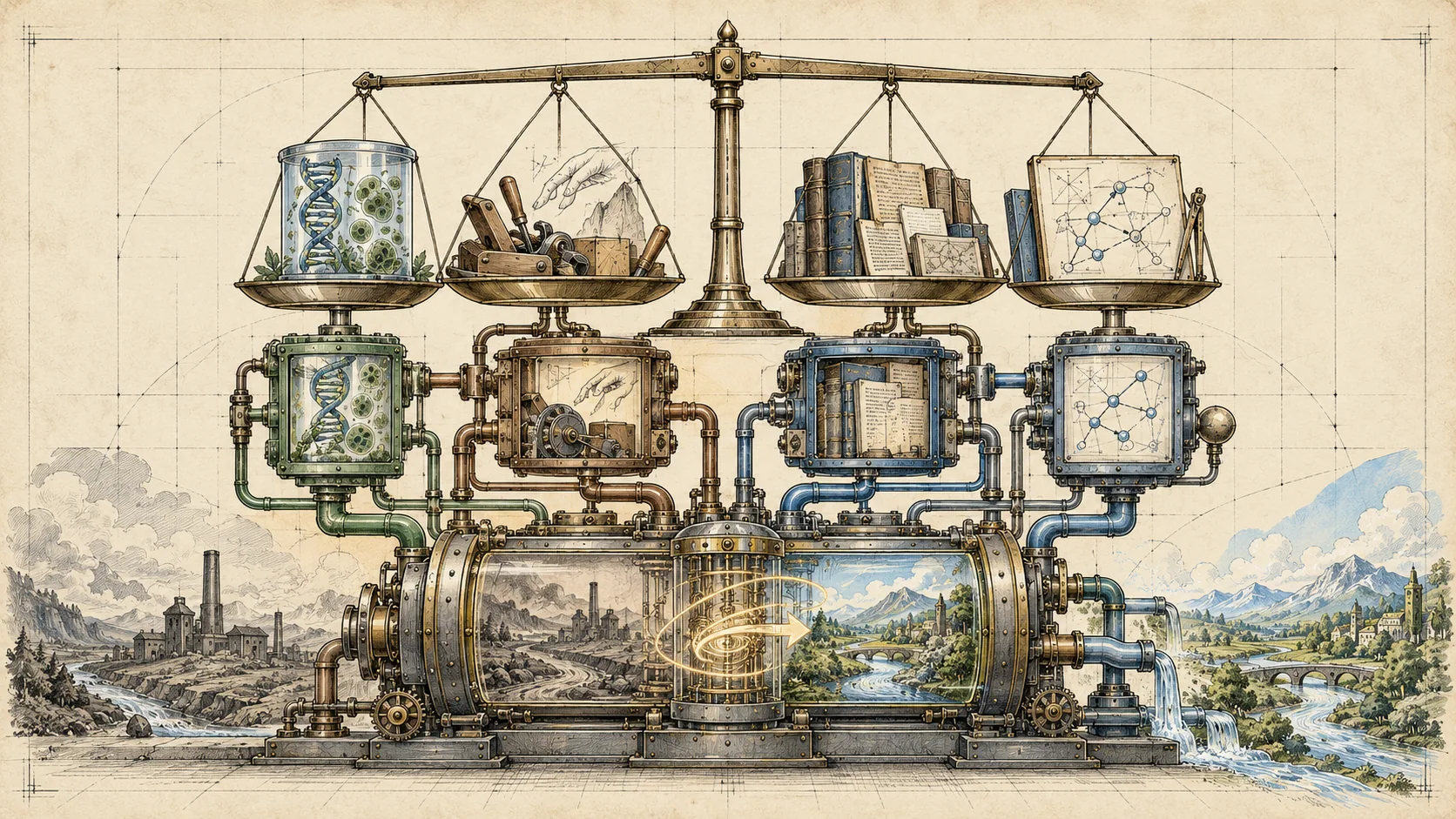
Suppose we take everything explored so far seriously. Genes contain biological knowledge. You inherit a body shaped by evolution. Much of what you know remains inexplicit. You enter a world saturated with objective knowledge: language, norms, institutions, technologies, scientific explanations, moral explanations, stories, categories, laws, and interfaces. And you can create explanatory knowledge that did not previously exist.
You can concede all of this and still reach a radically different conclusion about what you are. You may still feel mediocre. You need only change the weights.
Perhaps biology does most of the work. Perhaps culture does. Perhaps inexplicit knowledge does. Perhaps explanatory creativity is real but comparatively minor, a thin surface floating on a much larger inherited structure. Perhaps the explanatory you has been given a superordinate place only because this inquiry happens to value explanation. Perhaps you are mostly genes and society, with creativity contributing the last few percentage points.
Nothing in that objection requires denying any of the categories. It accepts them, then rearranges them. That makes the objection more serious, because it exposes another abstraction we have not yet criticized.
What could those allocations possibly mean?
1. More of What?
The language arrives easily. Biology matters more. Culture matters less. Social conditions overwhelm individual creativity. Explanatory knowledge is important, but only at the margin. Most of what you know was not created by you. Most of what you do depends on knowledge you cannot explain. Most people do not create scientific theories, new technologies, political institutions, or philosophical systems. So perhaps explanatory creativity is real but small.
The intuition is powerful because ordinary comparison often works this way. One object is heavier than another. One road is longer. One population is larger. One source explains more variance in a statistical model. One expense occupies a larger share of a budget. In each case, an abstraction supplies a common dimension and makes comparison possible.
But before asking whether biology or explanatory creativity contributes more to you, a prior question appears:
More of what?
Mass has kilograms. Distance has meters. Variance has a defined statistical structure. Money supplies a common economic abstraction for some otherwise heterogeneous things. What common unit could assign shares of you to a genome, a language, a motor skill, a social norm, a scientific explanation, a memory, and a newly created moral criticism? No such unit has been supplied.
Perhaps one can be created. But creating it would itself require an explanation. We cannot smuggle the unit into the question and then treat the answer as measurement.
A population statistic can be real. A variance component can be real. A trait score can be useful. None of that establishes that you are internally composed in the same proportions as the representation. The decomposition belongs first to the model. Reality does not owe the model matching seams.
2. What Knowledge Does
Part of the confusion comes from grammar. We speak of knowledge as though it were something accumulated in a container. You have knowledge. A civilization stores knowledge. A genome contains knowledge. A book preserves knowledge. A skill embodies knowledge.
The noun is useful, but it can mislead. Knowledge is not a substance poured into different reservoirs. It has no mass, and there is no balance on which biological knowledge can be placed on one side and explanatory knowledge on the other. Yet knowledge is not merely an abstraction invented for convenience. It does something. That is why the concept matters.
Knowledge is roughly physically-instantiated information with causal properties. The phrase can be made less mysterious by separating its parts.
Information means that some physical structure carries a difference. Different nucleotide sequences are different. Different sentences are different. Different neural states are different. Different arrangements of a tool are different.
Causality means that the difference can participate in producing another difference. A genetic sequence participates in constructing and regulating an organism. A learned skill changes what you can do. A traffic rule changes how people coordinate movement. An explanation of infection changes which actions a surgeon takes. A mathematical notation changes which relationships become tractable.
The information matters because it participates in change. That causal property distinguishes knowledge here from information in the broadest sense. A random arrangement may contain information. It does not follow that the arrangement solves a problem, guides a transformation, or participates in a knowledge-bearing structure.
Knowledge does causal work. That gives us a better question than how much it weighs:
What changed because this knowledge was present?
The answer need not be enormous. Knowledge often works incrementally. Before a distinction exists, two things are treated as one; afterward, they can be criticized separately. Before you learn a skill, an action cannot be performed reliably; afterward, it can. Before a notation is invented, a relationship may be difficult to manipulate; afterward, it becomes available to thought. Before you understand that an inherited rule can be questioned, the rule may appear as part of reality; afterward, it can become a problem.
These are increments, but increment is not a universal unit or an atom of knowledge. It names a local analytical cut in a problem situation: something was possible before, and something else is possible now.
The change may be small while its consequences are not. This is another appearance of the Fallacy of Mediocrity. A tiny physical intervention can redirect an enormous system. A few lines of code can alter what millions of people encounter. A short proof can reorganize a mathematical field. A new distinction can make an inherited moral category unstable.
Visible amount does not determine explanatory significance. Neither do age, frequency, the number of people already carrying the knowledge, or the size of the institution in which it is embedded.
The useful question is local:
What work is this knowledge doing in this problem?
That question does not solve the problem. It gives criticism somewhere to begin.
3. Knowledge Changes Form
Biological knowledge is old. Some of it is unimaginably old. The structures involved in metabolism, perception, movement, reproduction, immune response, and neural development did not appear with language or science. They are products of evolutionary histories extending far beyond your life.
Objective human knowledge in the epistemic sense is younger. Writing is younger still. Formal science younger again. Modern computation younger again. A new idea may be seconds old.
It is tempting to turn chronology into hierarchy. Ancient knowledge appears deeper, more fundamental, more causally important. Sometimes it is. But age is not a measure of epistemic significance, and causation does not run only from ancient biology toward newer culture. People remain evolving animals, while the knowledge people create changes the environment in which later biological evolution occurs.
Fire makes the interaction vivid. Humans inherited biological digestive systems. At some point, humans also acquired and retained knowledge of controlling fire. Cooking became objective knowledge embodied in practices, tools, social transmission, hearths, and food preparation. Part of food processing moved outside the body, changing the environment in which human digestion operated.
Over sufficiently long periods, objective knowledge created by people participated in changing the conditions under which later biological knowledge was selected. The change required no foresight, and we do not possess a complete account of every mechanism involved.
The important relation is simpler: the categories interact. Biological knowledge participates in producing organisms capable of creating objective knowledge. Objective knowledge changes the environment in which biological knowledge is selected. The causal history loops.
Language exhibits the same general pattern. Biology makes language possible. Language becomes objective knowledge. Language changes which ideas can be expressed, preserved, criticized, and transmitted. Those changes alter institutions, social coordination, reproductive patterns, survival, education, technology, and environments. The new environment becomes part of the conditions under which later biological and cultural variation occurs. There is no clean boundary where one source finishes and another begins.
The interaction also happens inside your life. You learn something explicitly and practice it until the knowledge changes form. The musician no longer needs to state every movement. The driver stops calculating every steering adjustment. The speaker stops consciously reconstructing every grammatical rule. The explicit can become inexplicit.
The reverse movement happens too. Something feels wrong. A skill fails. An expectation is violated. You become uncomfortable with a norm you once enacted automatically. Something that was operating inexplicitly becomes available for explication.
But explicitation is not the discovery of a hidden sentence waiting fully formed inside your mind. You create an explicit representation of what may have been guiding you. That representation can be wrong. It can be criticized. The criticism can then alter future inexplicit knowledge.
Explicit knowledge can become inexplicit; inexplicit knowledge can become a problem for explicit thought; objective knowledge can reorganize both; biological and social structures continue to participate throughout. The forms remain distinguishable without becoming independent.
It is easy to draw these transformations too neatly:
Biology produces a person. The person creates an explanation. The explanation becomes objective knowledge. Objective knowledge changes society. Society changes later persons.
The arrows make the story intelligible. They can also create an illusion. To write
is not to explain how relates to .
Why does one observation become interesting? Why does one tension become a problem? Why does one problem produce this conjecture rather than another? Why does a criticism that was available yesterday reorganize your mind today? Why can a creative leap feel discontinuous even when many explicit and inexplicit dimensions have been changing incrementally?
The arrow names a change. It does not necessarily explain the machinery of the change. That ignorance matters. If we cannot completely explain many of the transitions among forms of knowledge, assigning precise relative causal weights becomes stranger still. We would be quantifying a decomposition whose internal transformations remain partly unexplained.
This does not weaken the causal problem. It expands it. We know something changed. We know knowledge participated. We can sometimes isolate enough of the change to criticize an explanation of it. But much of the machinery remains unresolved.
The swamp remains swampy.
4. The Swamp and the Model
The metaphor of solid epistemic ground is attractive. You discover facts, place them on a foundation, add more, and build upward. Some claims receive more support than others. Some sources become stronger. Eventually the structure stands. That is not our epistemic reality.
Your epistemic mind is shifting. Biological dispositions coexist with social norms. Explicit explanations coexist with inexplicit expectations. Old categories remain active after you have criticized them. You may explicitly reject tribalism and still experience tribal intuitions. You may understand the asymmetry of criticism and still search for confirmation. You may know that a trait category compresses individual causal histories and still use the category automatically. You may value freedom and still become uncomfortable when another person's freedom generates outcomes you dislike.
The old knowledge has not vanished, and the new knowledge has not simply replaced it. They can coexist, conflict, recombine, become more or less salient, reach temporary equilibrium, and disturb it again.
The swamp names this movement. A perfectly static epistemic landscape would be more troubling. No contradiction would become a problem. No variation would survive long enough to become a conjecture. No old expectation would collide with a new explanation. No criticism would reorganize anything.
Knowledge evolves because structures can vary and because some variations can be eliminated. Externally, this occurs across people, institutions, theories, technologies, and generations. Internally, it occurs across explicit and inexplicit structures inside you. The swamp is not the bane of knowledge. It is one of the conditions of knowledge becoming.
Earlier we distinguished reality from the epistemic mind through which you encounter it. Call reality . Call your evolving epistemic mind . The distinction is easy to state:
Living that distinction is harder. You do not ordinarily experience a model hovering between you and the world. You do not look at a stranger and experience, my current compressed representation of this person, constructed through biological, cultural, perceptual, linguistic, and inexplicit knowledge, suggests danger. You experience danger. You do not encounter a social rule and experience, an inherited abstraction is currently organizing my expectations. You experience what people are supposed to do. You do not experience gravity as a theory. You experience the cup falling.
Your epistemic mind feels like reality because it is the interface through which reality becomes available to you. That interface includes language, memory, skills, expectations, social categories, scientific explanations, moral explanations, inexplicit reactions: everything that makes the world intelligible enough to act within it.
The compression is necessary. Without it, finite cognition would drown in detail. But the same necessity creates a danger: a new explanation can fit your existing compression so well that the fit itself feels like truth.
5. The Truck
Imagine that you feel territorial. The feeling may concern property, family, a neighborhood, a nation, a social group, or a relationship. Perhaps it is strong. Perhaps it has always seemed obvious.
Then an explanation arrives: humans evolved territorial and coalitional tendencies because those tendencies solved recurring problems of survival and reproduction in ancestral environments. The explanation may come with measurements, cross-cultural patterns, behavioral experiments, genetic associations, neural correlates, and evolutionary models.
You feel a sudden compression. Of course I feel this way. My ancestors evolved these tendencies. Science has measured them.
The explanation lands inside an epistemic mind already prepared to receive it. The feeling was there. The social categories were there. The common sense was there. The language was there. Now a scientific explanation appears to bind them together. A truck has just driven through your epistemic mind.
Nothing developed so far automatically stops it. You may let the truck through, or you may stop it and inspect the cargo. The difference need not be intelligence, education, or skepticism as a personality trait. It may be your problem situation.
If your problem is Why does this feeling exist?, the evolutionary explanation may suffice. But does its origin make the feeling a good moral guide? Does a population regularity explain this particular person? What was measured, and could different mechanisms produce the same result? Does an evolved disposition justify a legal rule? Now the truck is open.
You cannot inspect every truck. A finite person depends on compression. You board a train without reconstructing its engineering, speak without tracing every word's history, and cross a bridge without recalculating its loads. Life depends on knowledge remaining compressed until a problem gives you reason to inspect it.
So the implication cannot be inspect everything. The problem is to identify when the compression itself has become part of what you are trying to understand.
If the evolutionary explanation helps explain a passing feeling and nothing important turns on it, perhaps no further decomposition is needed. If the explanation is being used to classify a child, write a law, condemn a group, design an institution, excuse violence, define a gender, or predict a person's limits, the problem has changed. Now the contents of the truck matter.
The same objective knowledge can therefore require different degrees of inspection in different problem situations. The problem situation changes what needs to be criticized. It does not change reality.
6. Better Explanations Without a Scale
If we cannot weigh different forms of knowledge, and if the significance of a piece of knowledge depends partly on the problem situation, are we left with arbitrary preference?
No. Two explanations can address overlapping problems and still differ radically in quality.
Evolution and creationism both speak to the history and diversity of living things. That overlap does not make them epistemic equals. One invokes mechanisms whose consequences constrain what can happen: variation, selection, inheritance, retention. Those mechanisms can collide with observation and with other explanations. The other can vary its central cause to accommodate almost any possible outcome. Whatever happened can be said to have been intended, allowing the explanation to absorb criticism rather than be changed by it.
The problem situation is shared. The explanations are not equally good by epistemic standards.
Comparison therefore does not require a numerical scale of truth. It requires criticism. One explanation may solve problems that another merely renames. One may require arbitrary changes whenever criticism appears. One may contradict other explanations we have better reason to retain or create new problems with greater reach.
A useful word for the direction of this improvement is verisimilitude. The term need not carry more substance than the present problem requires. We cannot measure how much truth an explanation contains. We can still move toward better explanations by discovering and eliminating errors.
The same caution applies to reach. A good explanation developed for one problem can constrain many others. Evolution reaches beyond one species. Computation reaches beyond one machine. An explanation of abstraction can change how we think about psychology, law, technology, morality, and personhood.
The reach can be enormous while the physical expression is tiny. A sentence can have more reach than a library of unrelated descriptions. That does not mean the sentence contains more kilograms of knowledge. Reach tells us something about the structure of an explanation; it does not convert heterogeneous knowledge into shares of you.
The Fallacy of Mediocrity appears again. Visible volume is not explanatory significance. Frequency is not explanatory significance. Historical duration is not explanatory significance.
A forest and a match make the asymmetry vivid. The forest may have grown over millennia. The match is tiny. Yet the match can burn the forest.
The image has limits. Knowledge is not combustible matter. An explanation does not contain more energy because it has greater epistemic reach. Common sense is not literally destroyed when a criticism appears. The relation worth preserving is narrower:
Causal consequence need not track apparent quantity.
Suppose people possess some evolved tendency toward forming in-groups and distrusting outsiders. The exact biology is not the point. The tendency may exist inexplicitly, participate in common sense, become encoded in language, be reinforced by norms, formalized by institutions, preserved in laws, and celebrated in stories. A child may therefore inherit biological knowledge and enter an objective environment that appears to say the same thing.
Then someone creates an explicit criticism:
Perhaps the distinction between our kind and the others is not a reliable guide to moral standing.
The criticism is physically small: perhaps a sentence, a conversation, a book, a legal argument, or a protest sign. Its size tells us almost nothing about what it can do. It can make a previously invisible structure available to criticism. Other minds can reconstruct it. Some reject it. Some change. Institutions and language may change. The social environment of later children may change. Over enough time, even the biological selection environment may change.
The match did not outweigh the forest. It introduced a transformation. Nor does the forest disappear. Old knowledge remains active. You may endorse equality and still feel tribal pull. An institution may abolish one discriminatory rule and preserve another. Old common sense can regrow. The metaphor works only if the burning remains incomplete: knowledge does not become clean. It becomes different.
7. What Explanatory Knowledge Changes
The deeper version of that transformation sits inside the epistemology itself. Evolution creates knowledge through variation and selection. Variants arise. Some disappear. Some persist. What persists changes the conditions under which later variation occurs. Long before explanatory people existed, biological knowledge grew this way.
Epistemology inherits that evolutionary structure and changes something within it. You can conjecture, then deliberately seek error. Selection can retain what survives. Criticism can ask what is wrong with what survived. The orientation changes. A successful explanation is not protected because it succeeded. Its success can instead expose it to harder criticism.
This is not psychologically automatic. We like confirmation. We search for support. We feel reassurance when an explanation fits. Even if you reject justificationism, you can continue seeking justification inexplicitly. The older tendency can persist beneath the newer explanation.
But the explicit distinction changes what becomes possible. You can notice the justificatory impulse as a problem. That is a small increment with potentially large consequences.
This is where an artificial symmetry among forms of knowledge would mislead.
Inexplicit knowledge can learn, guide action, and solve problems. Biological knowledge can embody solutions no organism understands. Social knowledge can coordinate millions of people. But while a structure remains inexplicit, it can be difficult to criticize as knowledge. You may feel friction, failure, discomfort, or conflict without yet having an explicit object that can be inspected.
Explicit explanatory knowledge changes that architecture. Once enough of a structure becomes explicit, it can be stated, compared, criticized, recombined, taught, externalized, preserved, passed to another mind, and returned later in altered form.
The difference is not epistemic mass. It is access to deliberate error correction. An impulse can become a question: Why do I feel this? A norm can become a problem: What problem was this rule solving? The same operation can reopen a scientific claim: What does this measurement actually establish? It can also reopen a self-description: Is this category explaining me or merely compressing observations about people like me? Explanation creates a surface on which error can work.
Science enlarges that surface deliberately. Its power does not lie simply in accumulating more observations, in special authority, or in an imaginary method that converts data into truth. It lies partly in the systematic creation of explicit explanations that can be made vulnerable to criticism.
Measurements, experiments, statistics, and models matter inside problem situations shaped by explanations. An unexplained regularity remains a regularity. A precise measurement remains a measurement. The scientific achievement becomes deeper when the structure that generated the observations is made explicit enough to criticize.
Science therefore expands the surface of error correction. It takes parts of reality that previously appeared as common sense, mystery, habit, or inexplicit expectation and turns them into problems. The process compounds: one explanation makes another possible, one instrument creates observations unavailable before, one notation makes new relationships visible, and one criticism reorganizes a field. Progress accumulates not as weight but as transformed possibility.
Sometimes bodies of knowledge developed through different problem trajectories begin to fit together. An explanation in biology becomes compatible with one in computation. An explanation of the person stops conflicting with physics. A moral explanation stops requiring a theory of mind incompatible with psychology. An internal conflict between experience and explicit explanation dissolves because a better abstraction reorganizes both.
We call this consilience. The plain-language relation comes first: several structures that were developed separately can become mutually compatible. The name compresses that temporary fit.
Consilience is therefore not merely internal consistency, accumulated evidence, or consensus. It is a provisional equilibration. The equilibrium matters because contradiction has temporarily diminished; the provisionality matters because a new criticism can make one piece impossible and move the landscape again.
Consilience belongs naturally inside the swamp. It is not solid ground. It is temporary structure within movement.
8. When Knowledge Structures Meet
The same process occurs inside you. You are not one coherent model. Many structures can be active in the same epistemic mind: a scientific explanation, an inherited norm, an inexplicit fear, a moral commitment, a practiced skill, a childhood category, a new abstraction, a remembered failure.
Some never meet. Some reinforce one another. Some produce conflict. Some become explicit only because another structure collides with them. The pattern is not a list of independent contents but an internal ecology: interacting knowledge structures whose effects depend partly on what else is already present.
That is why the same explanation can enter two minds differently. You may hear an evolutionary explanation of territoriality and experience consilience because it fits feeling, language, common sense, and prior scientific knowledge. Someone else may experience tension because the same explanation collides with a moral problem, a causal distinction, or a prior criticism.
The explanation has not changed. The problem situation has. No single external description of the explanation therefore tells us what epistemic work it will do inside you. Reconstruction is local, and the consequences are path-dependent.
You cannot leave your epistemic mind. You cannot step outside every abstraction and compare with reality. You cannot inspect every piece of inexplicit knowledge, reconstruct every causal pathway, or eliminate compression.
Yet you can sometimes make the compression itself a problem. Of course can become Why does this feel obvious? Everyone knows that can become What exactly do we know? The same move can reach more elaborate compressions. Science has shown this can become What was observed, what was modeled, and what is being explained? This is just human nature can become a request to separate biological knowledge, social inheritance, interpretation, and any new abstraction built from all three.
You may answer incorrectly. The criticism may fail. The old explanation may survive. But the truck has stopped. Its contents are now available to criticism. That is not omniscience. It is epistemic autonomy: not freedom from inherited knowledge, but the possibility that inherited or compressed knowledge can itself become an object of criticism.
The problem situation supplies the selection pressure for criticism. What are you trying to understand? What are you trying to change? What contradiction has become active? What harm might follow if the compression is wrong? What new possibility appears if the abstraction can be reopened? A choice of sandwich does not require reconstructing nutritional science. A dispute over whether an inherited racial category should determine legal rights presents a different problem. A driver can rely on an interface that an engineer investigating a failure may need to reopen. A patient may reasonably use a medical category that a researcher, asking whether it compresses several different causal structures, may need to decompose.
Criticism is not a ritual. It is work directed at problems. Context changes what requires criticism without changing reality itself. Once a conjecture is available, its origin can become another part of the problem. Sometimes it matters whether an idea arose from biological intuition, social pressure, a scientific paper, an AI system, a dream, a mathematical derivation, or a memory. Origins can expose constraints, inherited assumptions, conflicts of interest, or hidden structures.
But origin does not determine epistemic standing. A biological intuition is not true because it evolved. A social norm is not true because millions of people inherited it. A scientific explanation is not true because a scientist created it. An AI-generated conjecture is not false because a machine produced it. A dream is not true because it felt profound.
Once the conjecture exists, another question becomes central:
What do we do with it?
Can it be made explicit? What problem does it address? What causal work does it claim to describe? What criticisms can reach it? What survives? What changes?
Its ancestry remains available when relevant. But criticism is not genealogy.
9. Knowledge Becomes
Now return to the noun. Knowledge persists. A genome persists across generations. A skill persists across repeated action. A book persists on a shelf. A law persists in an institution. An explanation persists in objective form. Without retention, there is no cumulative evolution.
But retention is only part of the story. Knowledge also varies, combines, becomes explicit, becomes inexplicit, changes environments, creates new problem situations, changes which observations matter, creates new abstractions, generates contradictions, reaches provisional equilibrium, and breaks equilibrium.
The noun hides the motion. Knowledge is not merely something that is. Knowledge becomes. The grammar is imperfect. The claim is not that knowledge ceases to be objective structure. It is that the epistemically important structure is evolutionary: retained knowledge becomes the starting point for further change.
You are therefore not a container holding different shares of knowledge. You are one place where knowledge can become. That changes the moral problem explored through this series. Knowledge is treated conjecturally because it may contain error. Its current success does not entitle it to permanent protection. If persons are knowledge-creating entities, then treating a person as finished would freeze the very process the explanation attributes to personhood.
Your present explanation does not exhaust your future. A type does not contain every explanation you may later create. Your current knowledge need not remain your final knowledge. The relevant moral conditions are therefore those under which you can encounter criticism, create alternatives, reject explanations of you, and become different.
The moral explanation does not come first. It follows from the account of the person as a fallible creator of explanatory knowledge: an open-ended problem world whose future knowledge cannot be completely derived from its present state.
The resulting principle can be compressed as:
Preserve the conditions under which the knowledge-creating process can continue.
The epistemology refuses to freeze an explanation. Applied to a knowledge-creating person, it supplies a reason not to freeze the person either.
Compression now returns in a sharper form. A personality score, diagnosis, demographic category, legal status, résumé, reputation, or self-conception can all solve problems. They can coordinate, predict, simplify decisions, and make institutions possible. The error begins when the compression is allowed to become the person.
Here we add another version. Even this ontology of knowledge can become a compression: biological knowledge, inexplicit knowledge, objective knowledge, explanatory knowledge. The categories are useful because they make distinctions visible. If we turn them into weighted ingredients of personhood, however, the abstraction hardens and reproduces the original error in more sophisticated language.
The categories were created to help explanation. They are not justified.
10. A Different Basis for Comparison
So what remains? We cannot weigh the forms of knowledge. We cannot separate them. We do not fully understand many of the causal transitions among them. We cannot inspect all of them. We cannot escape compression.
That can sound like epistemic defeat. It is not. The failure of a common scale does not remove comparison; it changes what comparison must track.
Take whichever knowledge structure is relevant to the present problem. It might be a biological disposition, an inexplicit expectation, a social norm, a scientific theory, a moral criticism, a mathematical abstraction, or a technical design. Then ask:
What work is this doing?
What changed because it was present? What problem does it solve? What problem does it create? What does it make possible? What does it make invisible? What happens when the explanation of its role is criticized? The unit is not a chunk of knowledge. It is the increment of causal work that can be made sufficiently explicit to criticize.
Now return to the original objection: perhaps explanatory knowledge contributes very little compared with biology or society. What problem is that comparison solving?
If the problem is prediction of variance in a defined population measurement, a statistical decomposition may be exactly the right tool. If the problem is explaining why you experience territoriality, the same decomposition may be inadequate. If the problem is explaining why territoriality became a moral problem for you, another explanation is required. If the problem is explaining how a criticism spread through institutions and changed later environments, another level appears. If the problem is explaining why the criticism was created at all, we reach the creativity gap again.
The answer changes because the problem changes. Reality does not become relative. The explanatory task becomes more precise.
11. The Weight of Explanatory Knowledge
We can now assert something that initially seemed forbidden: explanatory knowledge is more powerful. That claim does not mean it outweighs biological knowledge or constitutes a larger percentage of you. Nor does it mean explanatory knowledge always has greater causal effect or that an explicit idea will defeat an inexplicit disposition. Its power lies elsewhere.
Explanatory knowledge can expose knowledge to error correction. It can make an inherited structure criticizable and create a problem where previously there was only common sense. It can cross minds as objective knowledge, preserve criticism beyond one life, and change the criteria by which later explanations are evaluated.
Because those changes can be retained and criticized again, they can compound. You learn an explanation and criticize it. The criticism is externalized. Another person inherits the problem and creates another explanation. A field, institution, or technology changes. The environment changes. Later persons begin somewhere else.
The power is recursive. That is why explanatory knowledge occupies a special place in this ontology, and why you do too. Biological knowledge does not need to know that it has a problem. A norm can persist without explaining itself. An inexplicit skill can work without becoming known. An institution can preserve a rule long after the problem that created it has disappeared.
You can make such inherited knowledge into problems. You can ask why a reaction feels obvious or what problem a rule was solving. You can ask whether that problem still exists, what an abstraction hides, or what would have to be true for an explanation to fail.
You are not outside biology, society, objective knowledge, or causality. You are physically embodied in all of them. But you are one place where knowledge becomes an object of explanation and criticism. The inherited can become problematic, the obvious strange, the compressed decompressible, and the next problem visible. In that sense, you are one place where knowledge can become a problem for itself.
That is not quantitative superiority. It is an exceptional epistemic function.
12. Preserve the Movement
The impossible question—How much does this knowledge weigh?—can be replaced by a more useful one:
What changed because this knowledge was present in this problem situation?
The change is often incremental even when the explicit experience is not. A new explanation can suddenly reorganize years of inexplicit development. A tiny criticism can expose an error distributed through common sense, language, norms, and institutions. The size of the criticism does not measure the size of the consequence. The Fallacy of Mediocrity applies to knowledge too.
Inside you, the problem becomes harder because your epistemic mind does not feel like a model. It feels like reality. A compelling explanation can align with biological feeling, social expectation, personal history, objective science, and existing abstraction all at once. The fit can produce the most dangerous phrase in epistemology: of course.
Nor can you inspect everything. A problem situation makes some compressions worth reopening and leaves most others in place. When inspection begins, no numerical scale of truth is required. Explanations can be criticized for arbitrariness, contradiction, missing mechanism, inflated scope, or failure to solve the problem they appear to address. Error can be found and eliminated. That is enough verisimilitude for the present problem.
Explanatory knowledge is special because it can make knowledge itself criticizable. It can turn the obvious into a problem, externalize criticism, cross minds, and compound. Science enlarges this surface deliberately. Objective knowledge preserves it. Tools extend it. Persons create within it.
The way knowledge is treated and the way people are treated are not separate stories once people are understood as the exceptional creators of explanatory knowledge.
The corresponding moral implication is not to mistake a current compression for the whole person or a present explanation for a final identity. The conditions under which you can criticize, reject, revise, create, and become otherwise are conditions under which the knowledge-creating process can continue.
Perhaps the deeper error was not that we tried to weigh things. Weighing made knowledge look still and justified. Knowledge is not only what has become. Knowledge is becoming; you are one of the exceptional places where it becomes.
Knowledge is not only what has become. Knowledge is becoming, and you are one of the places where it becomes.
But if knowledge changes what other knowledge can do, then its development cannot be represented merely by adding another item to an inventory. The relations change. The problem changes. What becomes possible changes.
What does knowledge look like while it is moving?