
One Reality, Many Worlds
VIII. Your Creative Critic
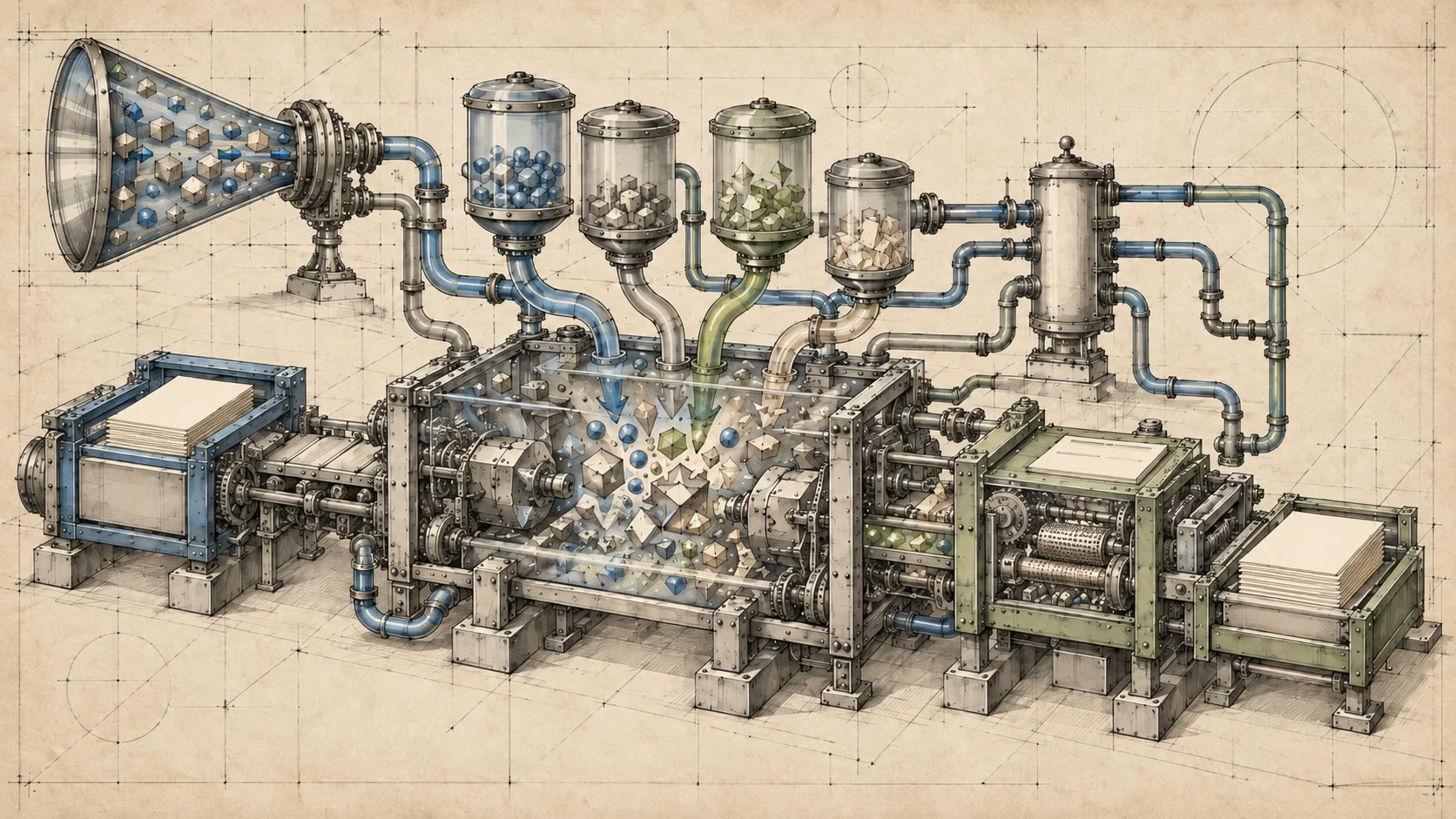
You have gradually constructed the constraints of your epistemic mind. Consilience names the provisional equilibrium reached when explanations that arose independently can coexist under one reality without unresolved contradiction.
So this begins where that equilibrium breaks?
An explanation that had seemed coherent collides with another explanation, an observation, a memory, an expectation, or a possibility. Something no longer fits. The result is not necessarily refutation. The collision may instead expose an assumption that had remained invisible, reveal a contradiction neither side had articulated, connect distant domains, or make a new question possible.
Criticism can create a problem that did not exist before the collision. Criticism is effortful and draws on every epistemic state. In that sense criticism is creative. And creation still has to happen somewhere.
That is the sense in which the creative critic is a solitary mind. You need not be socially isolated. The materials of criticism may come from everywhere. But the conflict becomes epistemically active when you reconstruct it as a problem.
The ordinary picture of criticism can hide this process. One side advances a claim. Another attacks it. Evidence is assembled. Weaknesses are exposed. Eventually one position is judged stronger. Steel-manning doesn't change the character of it. That form of criticism can be useful, but it treats the encounter as a contest whose important output is a winner.
The epistemic encounter has a different architecture. Its question is not merely which side wins, but what new problem survives. What was created that didn't exist before?
A criticism becomes valuable when it forces an explanation to reveal something previously concealed. The hidden element may be an unsupported assumption, an unexplained mechanism, a mistaken category, an artificial boundary, a failed expectation, or a contradiction with another good explanation.
Abstract the difference.
The sequence is therefore not simply:
It is closer to:
That fallibility does not make every objection equally good.
To say that the second law of thermodynamics is fallible does not require treating every denial of it as equally serious. Fallibility, as an epistemic principle, means that no objective knowledge is immune from criticism. It does not mean that an explanation which has survived severe criticism must be suspended whenever a rival slogan appears. That is a problem for creative criticism.
Opposition alone creates no symmetry. One explanation may solve more problems, connect more domains, require fewer arbitrary adjustments, or survive criticisms that destroy another. What matters is what the objection explains, what contradiction it exposes, what mechanism it identifies, or what failed expectation it makes visible. An objection may carry enormous social weight and still contain little explanatory content. It may nevertheless conceal a good problem.
Recovering that problem is a useful operation.
Consider the familiar claim that you are insignificant because the universe is vast and you are small. Call it cosmic mediocrity. The inference feels natural because physical scale is easy to visualize. But once the inference is made explicit, an unstated bridge appears.
Abstract it:
Why should physical magnitude determine explanatory significance? What are the contents of that arrow?
You may occupy negligible volume while constructing explanations with universal reach. A mathematical proof does not become less true because its author is physically small. A theory of stellar evolution can explain processes occurring billions of light-years away. None of this establishes moral or metaphysical importance. It does something narrower and more useful: it separates physical scale from explanatory capacity.
The original problem has changed. Its successor is harder:
what kind of significance follows from explanatory reach, if any?
Nothing had to "win" for knowledge to grow. The collision changed the problem situation.
Due to epistemic reach, a criticism entering at one point can propagate far from where it began. A problem about childhood can become a problem about tools. A problem about tools can become a problem about objective knowledge. A problem about objective knowledge can become a problem about AI. The next question is therefore not only whether an objection is sound. It is where, in this network of explanations, the collision becomes a problem at all.
Before criticism becomes an argument, the answer may be difficult to see because the first sign can be almost inarticulate. Something feels wrong. An explanation feels strained. A conclusion produces unease. A familiar distinction no longer works. You are confused before you can say why.
The feeling is not yet explicit criticism. It may be the surface trace of an explanatory conflict that has not yet been made explicit.
Your epistemic mind is vast and mostly inexplicit. Many of its abstractions remain below conscious articulation until something disturbs them. The sequence can therefore begin earlier than argument.
Abstract the sequence:
The creative act occurs when you reconstruct the unease. What exactly does not fit? Which assumption would have to fail? What alternative would remove the contradiction? You turn a disturbance into a problem that can itself be criticized.
The Savannah objection makes this movement concrete. Human minds evolved in ancestral environments, not within environments of quantum mechanics, cosmology, abstract mathematics, or artificial intelligence. From that fact it is tempting to infer a cognitive ceiling.
But “the Savannah” names an environment. It does not yet explain a limit.
If human beings possess explanatory universality, evolutionary origin does not impose an explanatory ceiling. A universal computer may be built for one practical purpose while remaining capable of indefinitely many computations. Likewise, evolution did not need to select independently for general relativity, programming languages, number theory, and molecular biology. It needed only to produce a physical system capable of open-ended explanation.
The objection has not disappeared. It has become a better problem:
how does evolutionary knowledge embodied in genes produce a physical system capable of universal explanation?
That is a real explanatory gap. Simply calling you a universal explainer does not fill it. But we can creativity criticize the concept by traveling across our best explanations of physics and computational universality.
A different objection presses on you from another direction. If your mind is the locus of experience and criticism, has something immaterial been smuggled into the account? Are you a ghost added to biological machinery?
The epistemic framework does not require that move. You are physically instantiated. Your objective knowledge is physically instantiated. Your tools are physical. Your language has physical expression. But removing the ghost does not remove the difficulty.
It reveals it more precisely:
how does physical matter instantiate subjective experience and explanatory creativity?
Calling consciousness an emergent property does not explain the mechanism. Calling you a universal explainer does not explain it either. You are the locus at which experience, conjecture, criticism, and explanation occur. How a physical system makes that possible remains open.
That open mechanism matters because it changes what a criticism is. A criticism is not merely a proposition moving through public space. The same sentence can have different effects in different minds because it enters different networks of prior explanation, expectation, trust, identity, memory, and inexplicit abstraction. It becomes epistemically active only when you reconstruct it inside a problem situation that is partly your own.
This is why facts alone often fail to persuade.
A fact enters an existing epistemic landscape. If it creates no problem for anything already there, it may be absorbed without much change. Another person can encounter the same fact and find that it breaks a load-bearing explanation. Facts matter as criticism; they do not perform the reconstruction by themselves.
The critic can therefore be changed by the criticism. You may begin with an objection that feels obvious and then decompose it and follow its consequences. The objection can end by creating a problem for assumptions you had not intended to question. The act of criticism has altered both the explanation and your problem situation:
Here is the criticism.
The letters, arrows, and schema are compressed. But they bring into focus a criticism that is often missed. The entire process is creative and conjectural. The later knowledge state is not installed by persuasion. No author can place a better worldview directly into another mind. You have to reconstruct the problem.
Once that is visible, the role of objective knowledge becomes easier to delimit. Memes, identities, institutions, rules, technologies, and datasets can carry material that may become criticism. You can preserve it, compress it, stabilize it, or force it into another person's path.
Carrying a criticism is not the same operation as reconstructing one.
Many objections reveal this distinction because they arrive already compressed: “AI is unsafe.” “Children need basics.” “Experts know better.” “Progress is dangerous.” “Humans evolved for the Savannah.” A short phrase can preserve a conclusion while omitting most of the reasoning that once supported it, and different people can reconstruct the missing reasoning differently. Call that compression.
Compression explains how a criticism can travel without deciding whether it is good. Once the slogan collides with an explanation, the hidden structure has to be recovered.
Abstractly:
A single slogan may then separate into several problems.
Identity can make the compression unusually stable. You may know that people who distrust AI without knowing why. You may know people who celebrate AI without knowing why. Comparable structures can form around climate change, nuclear power, schooling, economic policy, religion, medicine, or political institutions. The issues are not equivalent; the shared structure is that a complex problem can become an identity-bearing symbol.
Then a judgment can arrive before its explanatory reconstruction:
That sequence does not make you irrational. The difficulty appears when criticism of the belief is reconstructed as criticism of you. Error elimination then becomes costly, and a collision that might have produced a new problem can instead trigger identity defense. Networks of abstraction can route around contradiction. Identity can become such a network. Tracing an objection to identity therefore does not defeat the objection. It explains one reason decompression may fail.
Authority can carry a similar compression. “Someone else knows better, therefore they should decide” joins two different claims. The first may be true: knowledge is asymmetrically distributed, and experts, parents, or engineers may know things that others do not. The second claim concerns who may close another person's problem space.
The missing bridge is the explanation that turns greater knowledge into decision sovereignty:
and
are not the same proposition. Epistemology does not eliminate expertise. It makes the connection between expertise and control a further problem rather than treating the connection as contained in the word expert.
The dissenter encounters the same structure at institutional scale. Regulations, professional norms, media narratives, planning rules, moral language, and accepted expectations can feel like the expression of a majority mind. Yet the earlier social ontology still applies. There is no collective consciousness. There are many individual minds reconstructing overlapping bodies of objective knowledge, while institutions give some of that knowledge durable causal force.
The dissenter is therefore not literally arguing with “society.” They are confronting accumulated objective knowledge that many other people currently treat as settled. That knowledge may be correct or wrong. Its durability does not turn it into a subject that can itself understand the criticism directed at it. Reconstruction still occurs person by person.
This gives objective knowledge a positive role without giving it a mind. Memes preserve objections. Identity stabilizes them. Institutions make some of them durable. Rules close or open options. Technologies change what can be attempted. AI can retrieve and recombine explanatory structures. Together these things alter the problem situation into which you are born and through which you move.
During development, that distinction becomes harder to ignore because objective knowledge is not merely encountered by an already formed critic. It participates in constructing the problem spaces through which the critic emerges.
The claim that children need foundations first exposes the difficulty. Taken as a contest, the question is whether children should receive broad epistemic freedom before foundational cognitive skills are established. Taken as a criticism of the explanatory framework, the claim produces a prior problem: what is the mechanism of the correct developmental sequence?
If one sequence is necessary, what makes later explanatory capacity depend on that order?
Development is path-dependent. The child begins with inherited biological knowledge and enters a world saturated with objective knowledge: language, gesture, tools, stories, symbols, norms, games, books, screens, software, and other people. Every retained solution changes the next problem landscape. The missing bridge is therefore not simply between genes and more knowledge. It is between genetic knowledge, the objective world the child encounters, and the eventual capacity to create and criticize explanations.
We do not yet possess a full explanation of that bridge.
Language makes the gap visible because it arrives before the cognitive architecture is finished. A baby does not first master a complete set of abstract prerequisites and then receive permission to use language. The child acts on language while cognition is developing: experimenting, misusing, testing against other people, and building new abstractions through it. Tool and mind change together.
Language is therefore not merely content delivered into a finished system. It participates in constructing the architecture through which later problems can be represented.
Once that is admitted, another question appears. If an external epistemic tool can participate in development, what distinguishes a tool that extends development from one that substitutes for a capacity whose internal growth would matter later?
The comparison does not prove that every tool is beneficial. It makes the mechanism of the distinction necessary.
Schooling sharpens the same problem. Curricula change. Subjects once treated as indispensable foundations can become less central. Technologies externalize abilities that schools once treated as prerequisites. Calculators change arithmetic practice. Search changes recall. Software changes symbolic work. AI changes access to explanation. If “foundations” vary historically with the surrounding epistemic environment, the word foundation cannot itself explain the developmental sequence. The remaining questions are what makes a capacity basic, why that capacity must come first, and for whom.
Resistance from the child makes the problem personal. A child does not merely receive a curriculum. They conjecture about it. They reject explanations, become bored or absorbed, follow one problem and abandon another, and construct distinctions that adults may never notice. Their stock of objective knowledge may be smaller without making them a different epistemic kind.
Development therefore cannot be explained only as prerequisites imposed from outside. It also contains the child's own sequence of problem recognition, conjecture, criticism, retention, and abandonment.
The question changes accordingly:
which environments enlarge the child's capacity to generate and criticize explanations?
That is not the same question as whether children need freedom or discipline. It asks what happens to the future creative critic?
AI intensifies the issue because it is unusually responsive. A textbook cannot adapt its explanation to each question. A fixed curriculum cannot follow the learner's problem. A search engine does not ordinarily reconstruct and compare explanations conversationally. AI can do those things, at least as technology used by the learner. That responsiveness may create new risks and new forms of epistemic extension.
The slogan “children should not use AI until they have foundations” can therefore be decompressed into a more precise problem:
what capacities must remain internal because delegating them would reduce future explanatory freedom, and what capacities can be externalized because doing so enlarges the problem space?
The answer cannot be obtained merely by classifying a capacity as internal or external. Language, books, curricula, calculators, search engines, software, and AI all enter the developing person's environment differently. The explanatory issue is how each coupling changes the person's future capacity for criticism.
That problem does not end with children. Whenever a safety claim closes possibilities for adults, rules and institutions also alter the future problem space.
“AI is unsafe” shows why decompression has to come first. Unsafe how, for whom, and through what mechanism? The slogan may refer to unreliable outputs, centralized deployment, surveillance, economic dependence, weapons, infrastructure concentration, or artificial knowledge creation. Treating these as one fear makes criticism harder because different mechanisms have been compressed into the same conclusion.
Concern from people close to the technology can add observations that outsiders have not encountered. Researchers, engineers, or executives may see failure modes directly. Their proximity can therefore supply valuable observations and explanations. It still leaves creative work to be done: what mechanism is being reported, what consequences follow, and what would distinguish the claimed danger from a more general fear? The speaker's status cannot supply those missing relations.
An ounce of prevention...
The Precautionary Principle becomes attractive when possible harms are large and uncertain. Its intuitive form is simple: if the downside could be catastrophic, action may be warranted before certainty is available. That can be prudent. But the principle also enters the same field of criticism it is meant to govern.
High perceived stakes can create pressure toward centralization. Centralization can narrow the number of actors able to experiment. Fewer independent experiments can reduce the number of paths by which error is exposed.
Abstract the structure.
One possible sequence is:
This does not refute precaution. It reveals a conflict inside the precautionary problem. Protection from one class of error may remove some of the processes through which other errors are discovered. The successor problem is therefore:
what form of precaution best preserves the capacity to detect and correct error under high stakes?
Nuclear energy makes the structure concrete in the source argument. A powerful technology appears. Its benefits are large and its possible harms vivid. Fear grows. Institutions slow, restrict, or stop deployment. Those restrictions then persist as objective knowledge: rules, defaults, expectations, and inherited constraints. A later generation encounters not merely the original argument but the world the argument helped to build.
Suspension therefore has real consequences. When a technological path is interrupted, some knowledge that would have emerged from continued development may never appear. Avoided harms may sometimes be visible; knowledge never created is much harder to observe.
The asymmetry matters because the missing counterfactual can disappear from the problem situation itself. Abstractly:
Austerity produces a related structure. The premise that resources are limited can be locally correct. Physical limits, budgets, and energy constraints are real. But a present scarcity can have two different sources: a boundary fixed by physics, or a boundary that partly reflects missing knowledge. If new knowledge can transform what counts as a usable resource, restriction can become self-reinforcing:
The point is not that conservation is always mistaken. It is that present scarcity does not, by itself, establish a permanent boundary on possibility. A permanent boundary requires something stronger than the fact that the present problem has not yet been solved.
The criticism now reaches a harder case. Some forms of progress may be dangerous enough that preserving the future appears to require stopping knowledge creation in a domain. That possibility creates an internal tension for an epistemology that treats error correction as essential. Knowledge can increase the capacity to solve problems, yet some knowledge may also create risks large enough to destroy the conditions under which future criticism could occur.
Preserving criticism may therefore appear to require restricting knowledge creation.
The contradiction cannot be removed by repeating either “progress” or “safety.” It creates a successor problem:
under what conditions, if any, does restricting inquiry preserve more future error correction than continued distributed criticism?
The cost of suspension becomes harder to ignore when avoidable suffering is interpreted. Disease, famine, violence, coercion, environmental degradation, and institutional failure can persist because the knowledge required to prevent them does not yet exist or is not available where needed. Calling this epistemic structure evil does not remove moral responsibility or imply innocence. It identifies a narrower relation: where a harmful condition remains preventable only in principle, some required knowledge is missing.
Stopping progress can therefore preserve present ignorance as well as avoid future danger. Precaution has to confront both directions of error: harms new knowledge may enable and harms missing knowledge leaves unsolved.
Now the person-level consequence returns. Rules created in response to danger become part of the objective world inherited by later persons. They alter what can be attempted, what can be criticized through experience, and which successor problems can appear. Yet no institution can know in advance the full contents of the knowledge that a closed path would have produced.
That does not establish that every path should remain open. It establishes that closure itself changes the epistemic environment and therefore belongs inside the criticism.
Ah, recursion again.
The same boundary problem appears again when technology approaches capacities the framework currently assigns to persons.
The replacement objection imagines artificial general intelligence eventually displacing human beings. The phrase can anthropomorphize before the underlying criterion has been made clear. The relevant boundary is not the marketing label AGI. It is whether a system itself originates explanatory knowledge, selects its own problems, criticizes its own conjectures, and recursively creates successor problems and new evaluative criteria.
If an artificial system genuinely did those things, it would no longer fit the role assigned to present AI here. It would qualify as another epistemic subject: another person under the present criterion. The possibility does not refute the framework. It reveals that the distinction between you and your technology may be contingent rather than permanent. That remains an open problem.
The replacement objection often contains another claim: eventually there will be nothing left for humans to do. That conclusion requires a finite problem space. It imagines a state in which all economically or socially valuable problems have been solved elsewhere and no new ones of consequence appear.
But within the epistemology developed here, a solution changes the problem situation. New capabilities create new possibilities. New possibilities expose new errors. New explanations reveal contradictions that could not have been formulated before the explanation existed. Knowledge growth therefore produces problems as well as solving them.
The claim of closure needs a mechanism. What state of knowledge would prevent new problems from appearing? What physical boundary would make the problem space finite? And most importantly, what would prevent biological people from continuing to express their creativity?
The framework's present commitment can be stated more precisely:
open-ended knowledge implies open-ended problem creation unless physics supplies a final boundary.
That claim remains criticizable.
A subtler objection presses on you as a biological person instead. Perhaps people are relatively simple organisms whose apparent complexity comes from recurrent coupling with language, institutions, tools, and other objective knowledge. If so, much of what appears to be individual capability may belong to a person-plus-tools system.
The objection does not make objective knowledge less important. It makes the coupling more important. Tools change which problems you can represent and solve, while you remain the locus in which problems are experienced, reconstructed, creatively criticized, and transformed. The unresolved question is where explanatory capacity belongs across that boundary:
which explanatory capacities belong to the biological individual, and which arise only through recurrent coupling with objective knowledge?
The framework does not yet settle that question.
After these collisions, some claims remain standing, but they now stand with clearer boundaries. You remain the locus of experience, conjecture, criticism, and explanation. Objective knowledge remains real and causally important. Biology remains necessary but not sufficient to explain you. Explanatory universality remains one of the strongest available explanations of human cognitive reach. Present AI remains technology under this ontology unless autonomous explanatory creativity can be explained. Freedom remains epistemically important because criticism requires alternative conjectures. Progress remains open-ended unless a genuine physical boundary closes it.
The surviving claims should not hide the gaps the criticisms exposed. We still lack an explanation of how biological evolution produces explanatory universality. We lack an account of how physical systems instantiate subjective experience and creative explanation. We lack an explanation of developmental sequencing for epistemic persons. We do not understand the boundary between beneficial epistemic extension and dependency that reduces future explanatory freedom. We do not possess an account of when restricting inquiry preserves rather than destroys future error correction.
Those gaps are not side notes to an otherwise finished system. They are the problems the collisions created, creatively.
The return to objective knowledge can therefore be made without giving it more agency than it has. Institutions preserve objections and constraints. Memes transmit compressed judgments. Identity can stabilize them. Rules constrain action. Technologies extend capability. AI retrieves and recombines explanatory structures. All of these structures can alter the problem situation in which you think.
None of them substitutes for the act in which a conflict is reconstructed as a problem.
That act changes what criticism means. The creative critic does not merely attach the label wrong to an explanation, or appeal to some authority, like an expert or observation. They expose what would have to fail, follow the consequence, locate the contradiction, and construct a problem that can be worked on. Sometimes the original criticism disappears. Sometimes the original explanation survives. Sometimes both are transformed. In each case, the epistemic gain is the better problem.
Epistemology is available to you in the same form as other objective knowledge. It is not doctrine to be installed in your mind; it is material you can reconstruct, if you choose.
Rejection by itself changes little. A criticism becomes productive when it locates where the explanation breaks or what it fails to explain. It may expose an implication that conflicts with another good explanation, an observation that cannot be reconciled, an artificial distinction, or a missing mechanism.
Creative criticism is therefore not a method for winning arguments. It is one of the mechanisms by which your epistemic mind grows. You encounter an explanation and something fails to fit. The disturbance becomes a problem, propagates through a network of explanations, exposes a hidden assumption, and makes a new question possible.
The examples in this part have each altered the problem in a different way. Physical insignificance separated scale from explanatory reach. The Savannah objection exposed the missing bridge between biological evolution and universality. The ghost-in-the-machine objection exposed the unresolved relation between physical instantiation and subjective explanatory creativity. Development exposed the missing bridge between genetic knowledge, objective knowledge, tools, and the free individual. Precaution exposed the tension between safety and distributed error correction. Nuclear suspension and austerity exposed the invisible epistemic cost of closed paths. AGI exposed the contingency of the present distinction between technology and you. Human obsolescence exposed the assumption that the open future can close.
The list is useful only because the relation across it is now visible. Each objection became more interesting when it stopped being a slogan and began generating a problem deeper than the one with which it arrived.
The framework remains inside the same process. It claims no immunity. Its present form is incomplete, and its surviving explanations remain in use only until criticism produces better ones.
You, the creative critic, do not complete the process by accepting the worldview. The process continues when you find the point at which one of its explanations fails and reconstruct that failure. The reconstruction changes the problem situation from which something better can be created.
How?
The problem of problems may be the deepest epistemic mystery of them all.