
Closing
Beforeword: Inepistemic
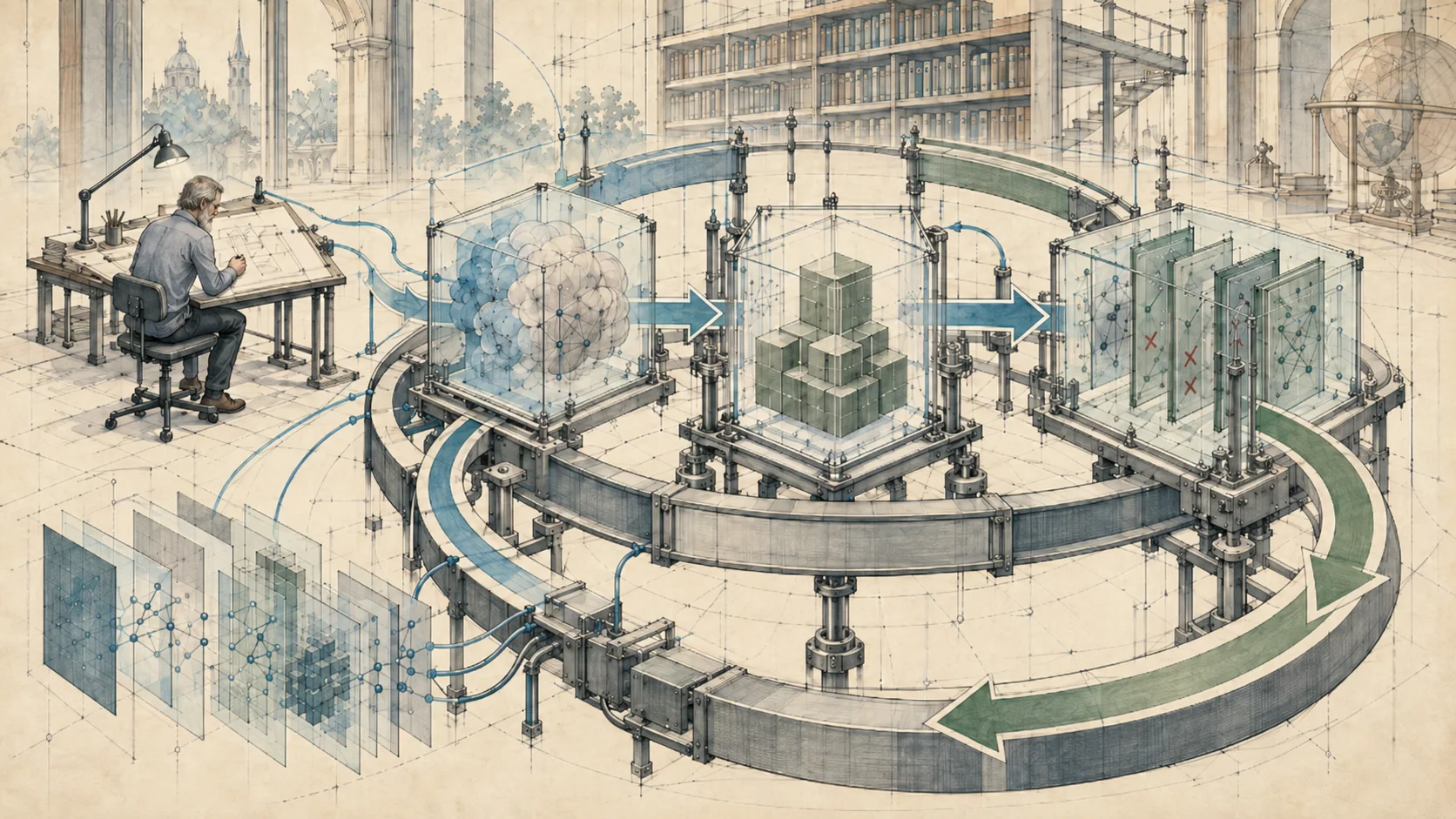
I am an inventor, an entrepreneur, and a software architect. Those are ordinary categories. They are also compressions. They tell you something about the kinds of problems I have spent my career around. They do not tell you why one of those problems stayed with me for decades. Nor do they tell you why ideas from psychology, biology, computer science, philosophy, economics, physics, software architecture, and parenthood kept finding their way into the same problem situation. They do not tell you why I created this.
The story is harder to compress. It begins long before this project, with a problem I could not yet state. That has been one of the privileges of my life: to live with a problem long enough that the problem changes you. What first appeared to be one problem became several. Then the several seemed connected. Then the connection proved wrong. The error exposed another problem. Years later, an idea encountered somewhere else changed the terms in which the original problem could even be expressed.
I did not know what I was doing. For much of the time, I did not have the language. I still had the problem. That was enough.
1. The Earlier Machine
My early work involved knowledge processing. The phrase is broad enough to conceal almost everything interesting. The systems were primitive by present standards: slower machines, narrower interfaces, less objective knowledge available computationally. But the possibility was already extraordinary. A machine could hold structures that a person could not hold all at once. It could search, transform, compare, preserve, and return them. A representation could become operational. A relationship that once depended on a person remembering it could sometimes be embodied in a system instead.
The machine did not need to understand the problem in the way a person did. The explained part could leave the person.
Once outside, it could participate in the next part of the problem. That possibility stayed with me, not because I thought machines would replace thought, but because they might change its conditions. A notebook already does this. So do language, algebra, libraries, databases, compilers. Each moves some burden out of the biological mind and into objective structure. Then you encounter that structure again. The output returns as input, and the process changes.
I did not yet know a theory of this. I had an intuition: machines could do more than automate tasks. They could change the conditions under which problems were pursued. That distinction became important much later. At the time, it was simply exciting.
2. Things That Fit
At some point I encountered E. O. Wilson's Consilience. The details of what I retained from the book, and what I later rejected, matter less here than the problem it strengthened: what becomes possible when knowledge comes together. Not when one field conquers another, or when everything is reduced to one vocabulary, but when explanations developed for different problems meet and constrain one another.
That possibility felt enormous. It still does. The world is divided into disciplines for useful reasons. Reality is not. A problem does not care whether one of its causes belongs in computer science and another in psychology. Or whether an inventor, entrepreneur, or software architect belongs in any of it. A person does not stop being physical when thinking about morality. An institution does not stop having technical structure because lawyers rather than engineers maintain part of it.
The borders help us work. They can also hide the roads between the work. Consilience made a certain kind of intellectual restlessness feel less like a failure to specialize. Perhaps the problem really did cross the borders. Perhaps taking one explanation seriously meant following it somewhere else. Perhaps it meant taking it personally. That is our habit. Genetics could reach psychology, psychology epistemology, epistemology computation, computation the person, and the person morality and political institutions. Then the whole structure could turn around and criticize itself.
At the beginning, none of that existed. There were only things that seemed as though they ought to fit, and a problem in the spaces where they did not.
3. The Inexplicit Change
Then I became a parent. There are changes whose importance becomes obvious before their explanation does. Parenthood was like that for me. I did not wake up with a new theory. Something changed in what mattered: time, risk, the future, other people, knowledge, the cost of not understanding certain problems. The desire to accelerate the creation of life-saving knowledge became less abstract. There was suddenly a person in the world whose future I cared about in a way that exceeded anything I could explain. Then there were more.
A parent can teach, protect, provide, explain, save. But a child is not an extension of the parent. The child's future cannot be filled in ahead of time. The problems they will face do not all exist yet, and the knowledge they will need may not exist yet either. That creates a strange kind of urgency. You want to give them something, yet the thing they may need most cannot simply be given. It has to be created—perhaps by them, perhaps by someone else, perhaps by a person not yet born. It may even come from an explanation produced for another problem and preserved long enough to become useful later.
The problem therefore widens. You cannot merely prepare one child for one predicted future. The future is not available for inspection. What you can hope for is a world in which knowledge can continue to be created and problems can become personal. Inherited explanations can be criticized, and tools can enlarge what people can do with objective knowledge.
I did not formulate the problem this way then. That came later. The purpose arrived before its explanation. Inexplicitly.
4. Other Minds
No solitary project is solitary in the strong sense. I have worked with many inventors, developers, researchers, entrepreneurs, lawyers, designers, scientists, and engineers whose ways of seeing problems changed mine. Sometimes the change came through conversation or disagreement. Sometimes the change came through an artifact or a failed attempt. Sometimes through a paper, a book, a diagram, a proof, a piece of software, or a sentence written by someone who died before I was born.
Call that objective knowledge. The term can sound bloodless. My experience of it has been anything but. There is something intimate about discovering that another person has already spent years inside a problem you have only just learned how to see. A person long dead can present a criticism. A notation can reveal a relationship. A programmer can leave behind a structure that changes how another programmer thinks. The person is gone from the encounter. The knowledge remains available—not perfectly, not without reconstruction or distortion, but enough.
That objective knowledge is one of the great facts of human life. Nothing I have made began with me. The languages, mathematics, machines, concepts, institutional forms, criticisms, and many of the problems were inherited. And then, occasionally, something in the inheritance became strange. That was where the interesting work usually began.
5. The Explanation of Explanation
Then I encountered The Beginning of Infinity. This is not an appeal to authority. A book does not become true because its author wrote it. Its importance in this story is causal: it changed my problem situation.
I had spent years interested in knowledge processing, invention, intelligence, software, and the strange ability of people to produce things that did not exist before. Then explanations themselves became explicit as an object. An explanation could be judged neither by the confidence with which it was held nor by the quantity of observations arranged around it. The structure of the explanation itself mattered. That possibility sent me toward the philosophy of explanations, not for philosophy, but for inventive inspiration. I became interested in why some explanations reached across problems while others merely restated what had happened. Why could changing one part break the whole structure? How could explanations exist objectively, and how could encountering one make previously unavailable thoughts possible?
That looked increasingly relevant to artificial intelligence. AI was already being discussed as a machine for knowledge, reasoning, intelligence, perhaps one day explanation. I was trying to connect my still-fuzzy understanding of epistemology directly to that technological problem. At one point I wrote to David Deutsch and asked for his criticism. One correction stayed with me:
"[Popper's] even bigger emphasis is on problems."
Problems. I had moved close to an epistemology of conjecture and criticism while underweighting the thing that gives both their structure. The error was productive. Explanations did not simply exist as structures awaiting criticism. They arose in problem situations. A conjecture was a tentative response to a problem. A criticism mattered because it changed the problem situation. After criticism, the important result was not merely a better answer. It was a different problem.
That correction gave me a reason to read Popper—deeply, repeatedly, across science, knowledge, politics, freedom, historicism, probability, objectivity, criticism, the open society, the logic of discovery. And, once I learned to see them, problems everywhere.
I did not simply read those explanations and acquire them. I misunderstood them, resisted them, reconstructed them, used them badly, forgot distinctions, recovered them, tried to build with them, found contradictions, returned to the texts, built again.
This is a familiar condition in invention. You can know that a problem exists long before you know what would count as solving it. You can build a solution and discover that the solution has finally revealed the problem.
Eventually, epistemology started to feel like common sense. Fallibly, not easily. Common sense in the more literal sense that its distinctions became available before deliberate reconstruction. A request for evidence could make the justification problem visible. A statistical claim could trigger a question about causal explanation. A model could feel like a toy. A claim about a person could raise the problem of the person. An answer could make the problem behind the answer visible.
The framework had become partly inexplicit. That made it much more useful—and more dangerous. Any explanation that begins to feel like common sense can become difficult to see. This project is an exercise in remembering that too.
6. Building the Problem
I use software as a substrate for invention. That means, among other things, that I have spent a large part of my life turning conceptual distinctions into structures. A software architecture is full of claims: this thing is separate from that thing; this state must persist; this transition is allowed; this component should know this and remain ignorant of that. Architecture is objective knowledge about relationships made executable. When the relationships are wrong, the software shows you.
For years I kept returning to a question: could epistemic structure become architectural structure? Not a program that stores facts, a database of beliefs, a confidence-scoring machine, or an automated philosopher. Could a system represent the movement of explanation itself?
Eventually the pieces cohered enough to become an invention in the institutional sense. There were explanatory primitives and epistemic states, relations among explanatory objects, epistemic cycles, persistent histories of conjecture and criticism, and methods represented explicitly enough to be executed computationally. The software was organized not around final answers but around movement from problems through tentative solutions and criticism into successor problems.
The abstraction finally had a technical body. A tentative one, but real enough to run. I implemented it. The epistemic primitives became software objects; the explanatory states became operational states; the epistemic cycle became something a machine could participate in. Explanatory history could be persisted for criticism and revision.
That implementation matters because I used it. Not on a demonstration problem, but on problems I cared about. Like this one. The system became part of the machinery through which this project was researched, criticized, reorganized, rewritten, and preserved. The project did not merely describe the invention. The project ran through it. The tool became part of the problem situation that produced the explanation of the tool.
That changed the problem again.
7. The Other Participant
For most of the years I was thinking about knowledge processing, the machine remained comparatively rigid. It could store, retrieve, calculate, transform, execute. Then artificial intelligence changed the available surface. A machine could participate in natural-language transformations at a scale and flexibility earlier knowledge systems could not. It could generate variations, reorganize explanations, expose contradictions, compare formulations, and translate between levels of abstraction.
This obviously did not solve creativity. It did not turn the machine into the author of my problem. It changed the conditions under which I could remain with the problem. That distinction is the center of my experience with AI.
Previously, a problem of this scale would have entailed a large venture. I would have needed to persuade other people that the problem mattered, raise money, recruit, and coordinate. I would have had to translate a changing problem into tasks, preserve continuity across a team, and manage the organizational machinery around the inquiry. Such machinery can create extraordinary knowledge. It can also consume enormous quantities of the resource it is meant to support.
Some problems are especially difficult to institutionalize before they are explicated. The language, architecture, evaluative criteria, even the identity of the problem may still be moving. The person pursuing it does not yet know what should be delegated because discovering the problem is still part of the work.
Artificial intelligence changed that constraint. It made something closer to a solitary institution possible. Not solitary because nobody else contributed. Solitary because the coordination boundary became radically smaller. A conjecture could become objective in seconds. The objective form could be criticized. The criticism could generate alternatives. An old state could return. A method could be revised and immediately applied to the artifact that produced the criticism.
The machine was not merely helping me write. Writing was one surface. It was helping make a larger portion of the problem space accessible, and therefore available to me. The cost of moving between inexplicit structure and criticizable objective structure had fallen dramatically. Something inside could come out, then answer back.
There is a slogan I use for this relationship: My AI and I are more clever than I. It is often attributed to Einstein in another form, usually involving a pencil. The ancestry of the sentence may be unstable. That is almost more useful. The authority does not matter, and neither does the pencil. Replace it with chalk, a notebook, a blackboard, a compiler. The interesting structure survives.
The slogan is objective knowledge. It travelled; people reconstructed it; wording and attribution changed; different minds conjectured different meanings. That is the point. Objective knowledge can be inherited without preserving one private meaning. I encountered the structure and made a different conjecture from it.
This really is my AI. It is mine in the sense relevant to my problem situation. Objective knowledge was transformed into a novel architecture, and supplied a problem-specific epistemic environment that raw interaction alone did not. I used the integrated system on the problem that had produced it. Its outputs entered my explanatory history and changed subsequent problems. It became part of the machinery by which private and inexplicit knowledge could become objective enough to criticize. My AI is therefore not merely the model. It is the model as encountered through a technological and epistemic structure that itself belongs to the history of my problem.
The relationship is personal and objective at once. The dyad is not reducible to either participant. The machine gives me things I did not put into the prompt. Some expose a contradiction, recover something forgotten, show that I asked the wrong question, or make an inexplicit preference visible because I immediately dislike the result. I supply direction; the direction changes. The machine supplies variation; some of the variation changes me. The objective artifact enters the next problem situation.
Is the dyad more clever than I? There is no such scalar unit for cleverness. But I can describe the transformation. Problems that once exhausted my working surface can remain active outside it. Conjectures that would have disappeared can answer back. Criticism arrives faster. Revision is cheaper. The distance between an inexplicit intuition and a criticizable artifact has become dramatically shorter. By those measures that matter to the problem I have actually been living with, my AI and I are more clever than I.
8. The Project
Something else changed. This became a project. That word is wonderfully modest, where venture is not. A project can be attempted, fail, remain unfinished, or simply continue. It does not need to become an institution before it deserves to exist, persuade a market before its problem can be pursued, or know its final form.
That mattered. There are explanations in this project I would have struggled to develop through ordinary organizational processes. Not because other people could not understand them, but because I did not understand them yet. It is difficult to coordinate a team around a problem whose terms are changing as quickly as the explanation. It is difficult to write a roadmap for an unknown abstraction, or assign a task whose completion may reveal that the task should never have existed.
The technological change made some of those constraints less decisive. I could pursue the problem before anyone else agreed that it deserved pursuit. That is freedom of a very practical kind.
It was not, however, continuously liberating. There were periods when the problem became too large to hold and every explanation exposed three more problems. A failed architecture could feel less like useful error elimination than evidence that years of work had been organized around the wrong problem. There was exhaustion and fear, and physical consequences to both.
Creativity is easy to romanticize from the outside because the surviving artifact compresses away the conditions under which it was made. The body does not disappear while the mind pursues an abstraction. Attention degrades. Sleep matters. Fear narrows. Obsession can create extraordinary persistence and make stopping feel like betrayal of purpose. The dark side of an open problem is that there is always another move available, including when the person making it should rest.
Those periods became part of the criticism too. A system for enlarging the epistemic surface that destroys the epistemic mind using it would be a bad method. The problem had to include the physical person pursuing it. Time, resources, and attention remained finite.
But a major class of coordination constraints had changed. The project became possible at the scale of one person with machines and access to the accumulated objective knowledge of other people. That is one of the things this series has been about—not only in theory, but in its own existence.
9. The Recursion
At some point I noticed the embarrassment. I was building a system organized around explanatory knowledge while using the system to explain explanatory knowledge. I was trying to understand human-AI collaboration while collaborating with AI. I was writing about objective and inexplicit knowledge while repeatedly making private thought explicit, and about criticism while criticism changed the architecture. I was writing about invention while inventing.
The recursion became the project. Not as a trick, and not to persuade. A self-referential system can be wrong. A recursive system can amplify its own error. The recursion mattered because it made the claims materially criticizable. If explanatory primitives were useful, they should be useful here. If preserving problem histories mattered, it should matter to this project. If methods could be made computational, they should survive contact with the work that created them. If the human-AI dyad enlarged an epistemic surface, that enlargement should become visible in what the dyad could produce. If the person remained larger than the compression, the system had to remain criticizable by the person using it.
The project became one long adversarial test, and welcomingly, a new source of new problems.
10. The Artifact
Now there is this. Thirty parts. An architecture underneath it. And one person trying to get something out.
It is objective knowledge. That does not make it good, true, or important. It means only that it has crossed a boundary. The problem is no longer present only in me. You can inspect it, misunderstand it, reject it, find a contradiction I missed, take one idea and combine it with a problem I have never encountered. The loss of control is part of the achievement.
For years, much of this existed as a structure I could feel more readily than explain. Pieces appeared in conversations, products, architecture, notes, code, failed companies, successful inventions, private frustrations. Now more of it is outside.
The object may be child's artwork. That possibility is not rhetorical modesty. Children make things whose significance to the maker exceeds their significance to everyone else. The drawing can be derivative, confused, technically poor, beautiful only to the parent. Still, something happened: an internal world became an objective artifact that can now be seen.
This project may be wrong in ways I cannot presently see. It may solve a problem nobody else has, or no problem at all for you. It may contain a useful distinction surrounded by unnecessary machinery. It may become interesting only when some future criticism breaks its central explanation.
Fine. It stands as a tentative solution to my problem. That is enough. I am grateful for the explanations and the people who made them, for the machines and the errors. I am grateful for the years in which the problem refused to disappear, and for the privilege of remaining with it long enough to get more of it out. It's just getting started.
11. Other People Are Not Like You
When I have tried to explain some of these observations to people who know me well, one response has appeared more often than any other:
"Yes, but other people are not like you."
The observation is true. Other people are not like me. No one is like another. That is one of the central claims of this project. A person is not an instance of an average mind. The path by which a problem becomes interesting, the inexplicit structures available, the inherited objective knowledge, the criticisms that land, and the future conjectures are different.
So I do not want to argue with the individuality. I want to protect it. The disagreement is elsewhere.
Individuality does not cancel universality. The claim is not that everyone will care about my problems, use my vocabulary, or produce this project given the same books and machines. The claim is that the explanatory capacity that lets my particular mind become unlike yours is not evidence against personhood as a universal class. It is an expression of it. A universal explainer need not converge on my explanations. Universality permits divergence without a predetermined boundary on what may eventually be understood.
But I cannot ask another person simply to feel the distinction from inside my mind. If there is something here worth criticizing, I have to get enough of it out that another person can encounter it on their own terms. They can reconstruct a different problem, reject mine, find the hidden assumption, take one piece and leave the rest. That is the freedom objective knowledge creates between minds.
This became another motivation for the project. It is a legacy, though I hesitate over the word because legacy can sound like an attempt to control what remains after a person is gone. I mean almost the reverse. I want to leave something that can escape me. I want my children, family, friends, or a stranger to be able to encounter it without needing my presence to stabilize its meaning. They can disagree with it safely. A private structure can remain available without demanding that anyone inherit it as belief.
It is also, more simply, an effort to be known. You can love someone for decades and still have only fragments of the explanatory structures through which they encounter the world. Conversation, shared life, conflict, and work expose some of it, but much remains inexplicit. This project is an attempt to make one of those parts more explicit.
I want the people I love to understand something about why a statistical abstraction about a person can make me uneasy, and why a new explanation can feel beautiful. I want them to understand why an unanswered problem can remain alive for decades, why I am suspicious of certainty but not of truth, and why a tool that exposes error can feel liberating. I want them to understand why mistakes delight me. Above all, I want them to understand why their individuality is much more interesting than any category that describes them.
That love is not an exception to the epistemology. It is one of the experiences that made the problem impossible for me to leave alone. To love another person is, among many other things, to encounter a source of explanations that cannot be compressed without loss. They can continue to surprise you. You cannot possess their future knowledge in advance, and you can know them deeply without completing them.
So yes. Other people are not like me. Thank goodness. That is not where the explanation ends. It is where the more interesting one begins.
12. Literacy
There is another way to describe what changed. Think about literacy. Reading is so deeply embedded in modern life that it is difficult for a literate adult to reconstruct the world before reading. Words appear everywhere. You do not decode each sign from first principles. Written instructions become available. A private thought can be externalized. A dead person's sentence can enter your present problem. Once literacy becomes inexplicit, the world itself seems full of readable structure.
Numeracy does something similar. Quantity becomes available through ratios, rates, scale, probability, compounding, orders of magnitude. A person who learns to think quantitatively does not merely acquire mathematical answers. New kinds of problems become visible. Logical and probabilistic concepts can likewise enter ordinary criticism: What is the denominator? Compared with what? Does that conclusion follow? Does this sample tell us about a population or this person?
Once a cognitive practice becomes ordinary, its concepts can disappear into the background. The fluent stop experiencing the fluency. They simply live through it.
Cultures sometimes notice the absence of such fluencies before they notice the fluency itself, and coin labels for the supposed deficiency: illiterate, innumerate, technophobe. Some labels identify constraints; others compress away almost everything interesting about the person. The point is not to manufacture another taxonomy. It is that a medium or cognitive practice can become so ordinary that its conceptual machinery recedes from view.
For me, epistemology underwent a related transformation. At first it was a subject, then a body of arguments, then a set of distinctions, then a source of problems. Eventually it became difficult not to foreground questions such as: What problem is this explanation solving? What would criticize it? What did this measurement compress? What part is observation and what part explanatory structure? What does this model predict without explaining? What remains inexplicit? What would have to be different for this claim to fail? Is this disagreement about reality, the problem, the model, or the criterion being applied?
Once these distinctions become available, they become difficult to suppress. Epistemology moves from the background to the foreground. I do not mean possessing epistemology, being correct about it, belonging to a philosophical school, or knowing the answers. I mean living with epistemic concepts made explicit enough that they can participate in ordinary thought, the way literacy makes written structure available or numeracy makes quantitative structure available.
This is an individual account. Still, from inside this life, the difference feels real. There was a time before these concepts became foregrounded. There is a time after. The problems did not disappear. They became more interesting.
13. Awe
There is a temptation to make epistemology austere: problems, criticism, error, fallibility, refutation, no final authority, no guarantee. Read quickly, the vocabulary can sound almost hostile. My experience has been the opposite. The deeper the explanatory structure became, the more often it produced awe—not because everything fit permanently, but because sometimes things fit at all.
A problem in software architecture touches a problem in philosophy. A theory of knowledge changes how you think about parenting. A computational idea changes what can be externalized from one mind. A machine assembled from the objective knowledge of millions of people helps one person make a private problem public. For a moment, separate things stop appearing separate. The connections become visible. Then another criticism arrives and the equilibrium breaks.
Consilience can feel spiritual. No supernatural cause is required. The awe comes from reality becoming more connected through explanation than it appeared before. A physical thing like a person can understand something about the world, make that understanding objective, and leave it available for another person. Explanations created in different centuries can meet inside one present problem. A finite person can participate in explanatory structures whose reach may exceed a civilization. We can be wrong about all of it and continue.
The recursion continues. There is one conjecture in this project that I feel more than I can defend: we want to explain. Not every moment, not every person in the same way, not always explicitly. But the movement appears everywhere. Why? What happened? What does this mean? How does that work? Could this be different? Can I make it? Can I show you? Can you understand what I see?
Children ask why. Artists answer questions nobody noticed. Inventors build their conjectures. Lovers reconstruct one another. Programmers make abstractions executable. People argue, teach, draw, sing, design, write, build tools, raise children, create institutions, try again.
The forms vary. The movement outward does not. Something in a person becomes objective enough to enter another problem. Then reality answers back. Perhaps that is why being unable to explain can feel like confinement, and why getting something out can matter even if nobody else cares. Perhaps that is why the book nobody reads may still have needed to be written.
Perhaps that is why this one did.
14. A Word I Needed
Eventually I needed a word for this state. At first I formed it by analogy. We have words for lives constrained by the absence of forms of explicit cognitive equipment: illiterate, innumerate. I had come to feel something related about epistemology. Life before these distinctions became explicit had been harder in ways I could recognize only afterward.
So the first construction pointed toward a lack: an epistemic illiteracy. It named a state of living among explanations without sufficiently foregrounding what explanations are, where problems enter, how criticism works, why knowledge remains conjectural, and how objective knowledge changes what can happen next.
But epistemology itself broke the analogy. Literacy and numeracy can become so fluent that their machinery disappears. Epistemology did something stranger. The more deeply I absorbed it, the less plausible it became to treat epistemic competence as possession. The more explicit the structure became, the more ignorance became visible.
The positive state therefore contained the negative state. To become more explicitly epistemological was not to escape epistemic deficiency. It was to become increasingly capable of seeing it. The literate person is, in the relevant sense, not illiterate. The numerate person is not innumerate. But the epistemically explicit person cannot graduate from ignorance in the same way. Fallibility, problems, and the open future deny the graduation.
That is why the contradiction is not a defect in the word. It is the reason I kept it. The state is positive and negative at once: explicitly epistemological and fallible. It is equipped with tools for criticism and therefore less able to pretend that criticism can end. It can make knowledge objective and therefore expose more of what remained trapped, compressed, inherited, mistaken, or unseen. It can solve problems and therefore create problems.
Not without epistemology. Inside it. Not beyond ignorance. More intimately acquainted with it.
The word became useful in another direction too. To live with epistemic concepts foregrounded is to be in the epistemic process deliberately. Problems appear as problems, explanations as explanations, criticism as criticism, objective knowledge as objective knowledge. Fallibility is not an apology appended to a claim but part of the architecture through which the claim remains alive. Epistemology becomes an ordinary surface of thought. Its concepts become available, usable, criticizable, recursive—and therefore incapable of delivering the comfort promised by the original analogy.
This project is one artifact of that contradiction. Perhaps the artifact is wrong. Perhaps the architecture embodies a beautiful mistake. Perhaps the epistemic mind compresses away something important. Perhaps the human-AI dyad will look primitive very soon. Perhaps another explanation will displace the epistemology that now feels like common sense to me.
Good. Then there will be another problem. I do not want the final word to close that possibility. I want it to contain it: a word for lacking epistemic literacy and for foregrounding epistemology. A word for being inside the recursive process of problems, tentative solutions, criticism, and successor problems. A word for becoming more capable of creating knowledge and thereby making one's ignorance more explicit. More equipped and less finished; more able to explain and more able to see what has not been explained.
For the state in which epistemology has moved from an esoteric subject into the foreground of a life—into the tools, the questions, the criticism, and the making—the word I have is
inepistemic.