
Inventions
Make the assumptions about knowledge explicit
The systems used to produce the book and represent its explanatory structure.
inepistemic did not emerge from technology treated as a subject separate from the work. Technology was integral to the project itself. Two proprietary systems played distinct roles.
The book
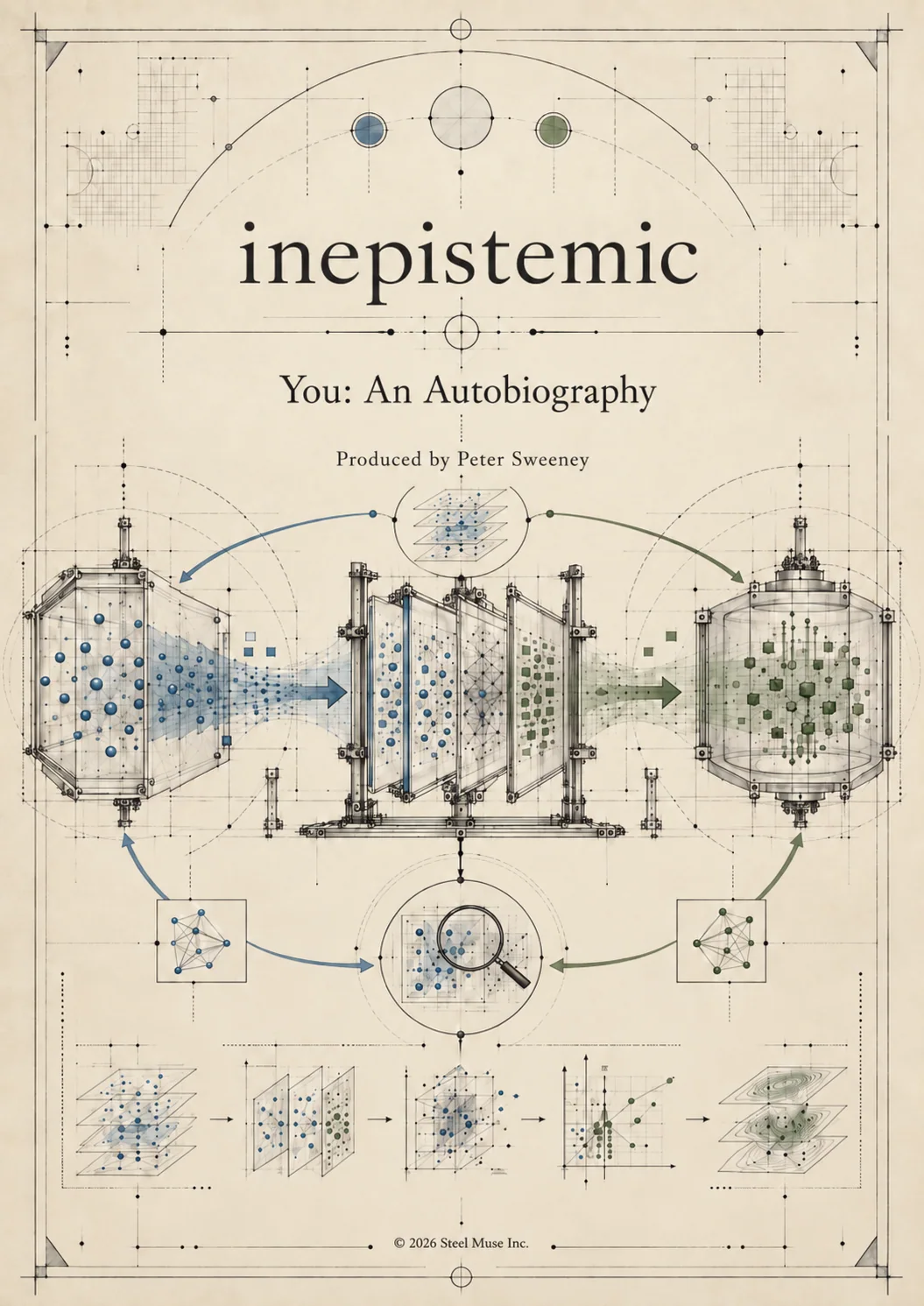
How the two systems relate to the book
Explanata was used during the inquiry that produced the book. It made selected epistemic relations operational inside a human-AI dyad (working environment), helping organize the inquiry around problems, tentative solutions, criticism, and successor problems.
Explanata: technology participating in inquiry and production
Kinematic Data Modeling (KDM) was applied after the book was complete. It represented the human-readable work as a structured, provenance-preserving data structure intended to make its explanatory organization more directly operable by artificial agents.
KDM: technology participating in representation and analysis
Producing the book
Explanata
Epistemology as an agent operating environment
Explanata is an epistemic harness that makes aspects of the epistemology operative in software. It introduces a new data primitive as bounded units of explanatory work, called explanata. These can be exposed to structural criticism through criteria such as consistency, coherence, rigidity, and causal structure. The aim is to make enough of the explanatory structure explicit such that changes, omissions, contradictions, or unresolved mechanisms can become criticizable.
- PProblem
- TSTentative solution
- EECriticism
- P′Successor problem
How Explanata governed the inquiry
The explanatory data (or explanata) can then be processed across explanatory states corresponding to the recurring epistemic structure:
where:
- is an active problem;
- is a tentative solution;
- is error elimination or criticism;
- is a successor problem.
The base harness provided one governing layer of the operative system. The epistemology was itself processed through the Explanata harness to produce a system epistemology, an explicit operating methodology derived from the epistemology. That methodology could then be configured within the harness, alongside a supporting domain methodology governing human-technology interactions, called The Explainable Human.
The relevant distinction was not whether an artificial model could describe the epistemology, but whether selected epistemic relations could become part of the operating conditions of the inquiry. In that sense, epistemology functioned not only as content available to the system, but as part of the environment through which problems, candidate explanations, criticism, and successor problems were pursued.
In the production of inepistemic, inquiry proceeded through successive sessions organized around changing problems. The human operator determined useful session boundaries and selected the successor problems carried into later inquiry. This sequence corresponded to the book's chapters. Explanata provided the governed environment in which candidate explanatory structures could be generated, externalized, retrieved, and reconstructed across that trajectory.
After the book was complete
Kinematic Data Modeling
Produced through Kinematic Data Modeling (KDM), the graph represents candidate explanatory structure across the numbered book chapters 00–30. It makes explanata, explanatory relations, causal pathways, candidate transitions, observations, and source evidence available as explicit machine-operable objects.
Conceptual schematic
The central modeling distinction is:
State represents what explanatory objects are present.
Topology represents how explanatory objects are situated relative to one another.
Motion represents candidate change from one represented condition toward another.
Keeping these dimensions separate matters because a relationship is not the same thing as a transition, a causal pathway is not the same thing as an observed change, and a candidate structure is not the same thing as a fact.
How KDM represents and exposes explanatory structure
From a human-readable book to an agent-operable surface
The book is written for a human reader. It relies on sequence, examples, delayed clarification, remembered context, rhetorical movement, and the reader's ability to reconstruct relationships across long stretches of prose.
After the book was produced, Kinematic Data Modeling (KDM) was used to create a complementary representation of the same underlying work for artificial agents.
KDM asks a different question:
How can explanatory structure in a human-readable source be made explicit enough for an artificial agent to operate over it without severing that structure from its provenance?
Its current representation of inepistemic is a provenance-preserving explanatory hypergraph.
Explanata as represented objects
Rather than reducing the book to isolated facts, entities, or sentences, KDM uses explanata as bounded units of explanatory work. Those explanata can participate in typed relationships such as support, qualification, extension, development, contrast, or reopening as a successor problem. Causal structures can also preserve distinct roles such as cause, mechanism, and effect.
The representation is source-relative. Its function is not to assert that a represented claim is independently true. Its function is to make explicit what explanatory structure the source contains, how that structure relates to other parts of the work, what remains uncertain, and where the source evidence can be recovered.
That provenance boundary is essential. Increased machine readability should not create an appearance of epistemic certainty stronger than the source warrants.
What the representation made visible
Once the book was represented as a structured explanatory surface, it became possible to inspect long-range relationships that are expensive to construct and error-prone if reconstructed by agents from linear prose alone.
Analyses over the KDM surfaced structures including:
- the singular epistemic trajectory;
- changing successor-problem possibilities;
- state versus transition;
- mutable problem topology;
- recursive objective knowledge;
- preservation and transformation of explanatory structure;
- unresolved explanatory burdens carried across the work.
A comparison between an automated review conducted from the human-readable surface and a review conducted from the structured surface illustrates the applications. The same objective knowledge can support different kinds of reconstruction when exposed through different operational surfaces.
Within inepistemic, derivative objects are therefore its proceeds: structured observations, explanatory maps, analytical findings, and other artifacts that can be independently inspected and criticized.