

The Solitary Explainer
I. You Are Not A Geneget
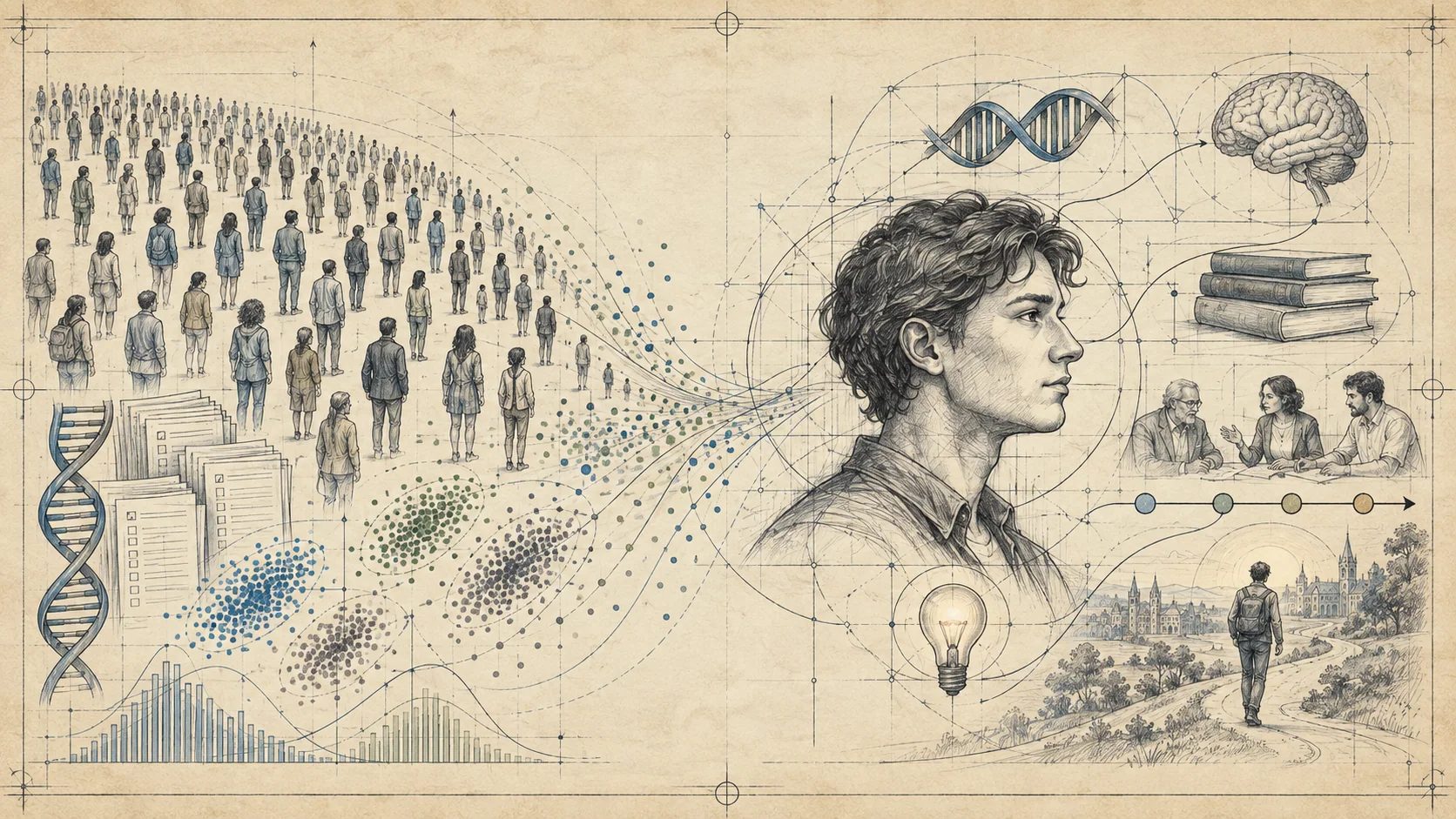
Where does an inquiry into a person actually begin?
One approach explains differences among people using genetics.
Personality genetics can combine large cohorts, genome-wide measurements, personality instruments, statistical models, and increasingly careful controls. It can detect patterns that would be invisible in a single life. It can test whether measured genetic differences covary with measured differences in personality, estimate how much variation in those measurements is associated with common genetic variation, and ask whether those relations survive across samples and methods.
Those are real achievements. The measurements can be precise, the associations reproducible, and the population patterns informative. Yet you still remain unexplained.
That is the first encounter. The problem is not that the observations are unreal. It appears when we ask what the observations are observations of.
Much of what we know about people is produced by comparison. We measure, classify, average, cluster, correlate, and compress. Those operations preserve relations among cases: where people differ, which differences tend to move together, and how those differences relate to other measurable features. An explanation of a person asks a different question: what produced this case?
A representation can therefore contain real knowledge about differences among people without explaining any particular person being compared. Comparison and singular causal explanation are different epistemic tasks. Personality genetics makes the difference unusually clear.
Heritability makes the boundary visible. If a personality score has a SNP heritability of 10 percent, that does not mean that 10 percent of an individual's personality is genetic.
Expand, no jargon.
It means that, within a specified population, historical period, measurement regime, and range of environments, some portion of the variance in that measured score covaries with measured common genetic variation. The estimate describes differences across cases; it does not decompose one case into genetic and non-genetic parts.
The boundary matters especially when major causal structures are shared across nearly everyone being measured. Participants in a contemporary cohort may share a language, legal institutions, schools, technologies, social conventions, scientific concepts, communication systems, and centuries of accumulated knowledge embodied outside any one person. Those shared structures may profoundly affect what people can think, notice, value, and do. Yet because they are shared, they may contribute relatively little to the variance being partitioned.
Stop. Abstract it.
Variance contribution is not equivalent to total causal importance. Some of the largest causes may contribute little to measured variance precisely because nearly everyone possesses them. That is not a defect in variance analysis. It marks the boundary of what variance analysis explains.
The problem begins even earlier, because personality research does not encounter “agreeableness” or “openness” directly. It encounters observations: what people report about themselves, what others report about them, and what their recorded actions show. Researchers then compress patterns of covariance among selected observations into dimensions.
Compression is indispensable because a useful representation must leave things out. A personality score preserves selected regularities while discarding much of the causal history that produced them. That allows the score to support comparison, prediction, and reuse across studies and institutions. The problem appears only when the regularity preserved by the representation is treated as the causal structure that produced it.
Two people can therefore receive similar agreeableness scores for different reasons. One may accommodate others because of religious duty, another because they value reciprocity, and a third because they fear conflict or act strategically. Similar observable outputs can be produced by different explanatory histories.
Compress it.
If different explanatory histories can produce the same observable :
then
does not establish
The similarity in observation is real, and the comparison may be useful. But the shared observable does not establish a shared underlying explanation. A representation built to compare people is not yet an explanation of the people being compared.
Yes, but these results are durable. They replicate across studies.
Replication can strengthen the representation without dissolving this distinction. Several personality instruments may converge; self-report and close-other report may agree; the same genetic associations may appear across multiple cohorts; within-family designs may reduce some forms of confounding. These procedures can eliminate many possible errors and show that a pattern is not merely an artifact of one questionnaire, one sample, or one analytical choice.
But replication within a representation does not by itself establish what the representation represents causally. More observations can make a compression more reliable. They cannot, without further explanation, turn the compression into the person.
Name it.
Replication can stabilize a compression without identifying its causal referent. Precision, prediction, and replication can all improve a representation while leaving the represented object and the representation distinct.
Now let that distinction reach you.
You, too, can be measured, compared, classified, predicted, placed on dimensions, and described by patterns that remain stable for years. If those representations preserve only selected relations, however, a harder question appears:
What would it mean to explain you?
Simply adding more variables does not answer it. A higher-dimensional profile is still a representation, a denser measurement is still a measurement, and a more precise prediction is still a prediction. The missing object is not merely more detail. It is the causal history by which you became you.
That causal history does not require opposing genes to knowledge. Genes are themselves a form of biological knowledge: products of evolutionary variation, selection, and retention, physically embodied in structures that help build and regulate organisms. Genetic variation can alter sensory systems, neural development, physiology, memory capacities, affective tendencies, and other conditions under which you develop.
The relevant distinction is therefore not nature versus nurture. It is between different forms of knowledge and different causal levels.
You inherit biological knowledge through genes. But you also enter a world containing knowledge that already exists outside any one mind: in language, technologies, institutions, arguments, mathematics, stories, laws, and scientific theories. Call this objective knowledge: knowledge embodied in transmissible structures and products that you can encounter without having created them.
The encounter is uneven. Some objective knowledge is taught, some inferred, some misunderstood or rejected. Some becomes skill that you can exercise without being able to state all the rules that make the skill possible; these are inexplicit capacities. Some encountered knowledge creates problems that did not previously exist for you.
Compress it.
The sequence of problems you encounter, carry, and reformulate is your individual problem history. Some encountered knowledge is transformed into explanations that did not previously exist at all.
Your development is therefore not well represented by a simple chain such as
A more faithful structure is closer to:
That seems a jumble. Explain.
Every part of this process is physical, but the terms are not interchangeable. It is a causal architecture of singular personal development and action.
Genes help construct the organism in which your later explanations will exist. They do not contain the language you later learn, the argument that changes your mind, the problem that becomes salient next year, or the explanation you may create tomorrow.
Historical change makes the distinction easier to see. Imagine a person regarded as highly agreeable five hundred years ago. That person might have been dutiful, compassionate, and socially respected while accepting punishments, hierarchies, or obligations that many people today would reject. The genome need not have changed appreciably for the meaning of socially admired conduct to change enormously.
What changed was knowledge.
Moral explanations were criticized, institutions changed, and new concepts became available. Practices once taken for granted became problems. Ideas about equality and rights, punishment and childhood, and political or religious legitimacy were revised and transmitted.
A biological disposition toward social accommodation might persist through such changes. Yet the actions through which it is expressed, the reasons given for those actions, and the moral meaning of the behavior can all change. Biological continuity therefore does not guarantee continuity in the explanatory meaning of behavior. You are not merely the stable bearer of a disposition; you also inhabit a changing world of objective knowledge and can alter the explanations through which that world is understood.
The same point applies to stability within one life. You may display the same behavioral regularity for twenty years. It does not, by itself, identify the causal structure responsible for the persistence.
The regularity may reflect a biological disposition, an explanation you have retained, an institution that has remained stable, a problem that you have never reformulated, or a habit that has never encountered effective criticism. Several of these causes may operate at once. Persistence alone does not tell us which causal history produced the persistence.
This matters especially because you are capable of creating knowledge.
A criticism can expose a weakness in an inherited explanation. A new distinction or tool can reorganize an old problem. Another person can change the framing under which the problem is understood. You may then create an explanation that was not previously present in either the genome or the surrounding culture.
After such a change, an old regularity may disappear. The earlier stability was real; what sustained it remained open. Human stability is retrospective: it tells us what persisted, not what had to persist.
We can now see more clearly what disappears when you are represented comparatively.
Missing from the representation may be which objective knowledge you encountered and how you interpreted it, which problems became salient, and which criticisms reorganized earlier explanations. It may also omit which inexplicit capacities shaped what you noticed or did, which institutions constrained the available alternatives, and which explanations you created or may create next.
The problem is therefore not merely that a population model has low resolution. Comparison and causal explanation are different epistemic tasks. A representation can become more detailed without becoming the history it represents.
Return to personality genetics.
Genetic differences among persons are real. Genes causally affect development. Common genetic variation can covary with measured differences in personality scores, and personality factors can capture reproducible regularities across populations. Those results can be scientifically useful.
But they do not, by themselves, explain the semantic content of your knowledge or why one criticism mattered and another did not. They do not identify which objective knowledge reorganized your understanding or contain the problem history through which you changed. They also do not determine whether a stable behavior is biologically constrained, culturally sustained, institutionally reinforced, inexplicitly learned, or maintained by an explanation you continue to accept. Nor do they specify which explanation you may create next.
Restate the comparison.
The genetics result concerns one explanatory object: variation across cases. The person concerns another: the causal organization of a singular knowledge-creating history. The two are related. They are not identical.
The danger appears when the boundary between them is crossed without supplying the additional explanation the crossing requires. The sequence can look like this:
this person often behaves this way
→ this person receives a stable score on a dimension
→ the score is treated as a trait the person possesses
→ variation in the trait is associated with genetic variation
→ the trait is treated as part of the person's biological psychological architecture.
Each step may sound small, but together they cross several explanatory boundaries. The first statement concerns observed behavior. The second concerns a measurement. The third converts a measurement dimension into an entity. The fourth relates variation in that measured entity to genetic variation across a population. The fifth imports the population relationship back into the causal organization of the individual.
The final statement may be true.
Yes, but it contains more explanatory content than the original observations supplied. That additional content requires its own explanation; it does not arrive automatically with the measurement.
Once this distinction is preserved, personality genetics need not be inflated or dismissed. The field may reveal biological contributions to variation, identify developmental conditions worth explaining, reveal regularities that persist across populations and instruments, and help locate parts of the biological architecture through which persons become possible. Those achievements still do not explain why you became you.
Such an explanation would require the singular causal history by which biological conditions, encountered objective knowledge, interpretations, problems, criticism, inexplicit capacities, and newly created explanations became organized in you. No alternative discipline follows automatically from that demand, and no new taxonomy of persons is required. The point is narrower: silently identifying a population construct with you adds explanatory content that the population construct itself does not supply.
The encounter with personality genetics began with a legitimate question:
How much of the variation in measured personality is associated with genetic variation?
The answer can be informative on its own terms. But once the epistemic structure is taken seriously, another question appears.
The population and the person are not merely the same explanatory object viewed at different resolutions. One concerns variation across cases. The other concerns the causal organization of a singular knowledge-creating entity.
What is the new problem?
The problem is no longer how to construct a better trait model or measure individuality more finely. It is individuality itself: What is your individuality if it cannot be identified with the dimensions along which persons can be compared?