Where Knowledge Becomes
XXVI. I, Inventor
You contain more knowledge than you can say, write, or preserve. Much of it remains inexplicit. It exists in perception, memory, skill, salience, expectation, interest, taste, unfinished problems, half-formed distinctions, a sense that something is wrong, a sense that something could be otherwise.
You can carry such structures for years without making them external. Then sometimes something crosses the boundary: a note, a sketch, a sentence, a tool, a proof, a melody, a new category. Or a machine, a joke, a criticism, a way of arranging familiar things that did not exist before. The object may be trivial. It may transform civilization. Scale is not yet the important distinction. Something that had not previously existed in objective knowledge now does.
We have a familiar word for one class of such events: invention.
The word is usually reserved for conspicuous artifacts such as machines, devices, processes, patents, and new technologies. That use is legitimate, but it may be too narrow for our purpose. If you can create explanations, and explanations can become objective knowledge, then invention may describe something more general than the creation of machines. It may name one characteristic passage through which you change the objective world.
Invention gives the mystery of creativity a more concrete surface. It lets us watch some of the movement between inexplicit knowledge, explicit structure, tools, criticism, and objective knowledge. Once that movement becomes visible, another problem sharpens. The problem is not only how new solutions appear. It is how new problems appear, how evaluative criteria acquire local meaning, and how criticism becomes creative. It is also how you can work with structures that are mostly familiar and still bring a new abstraction into the world.
1. Invention Is Not Inventory
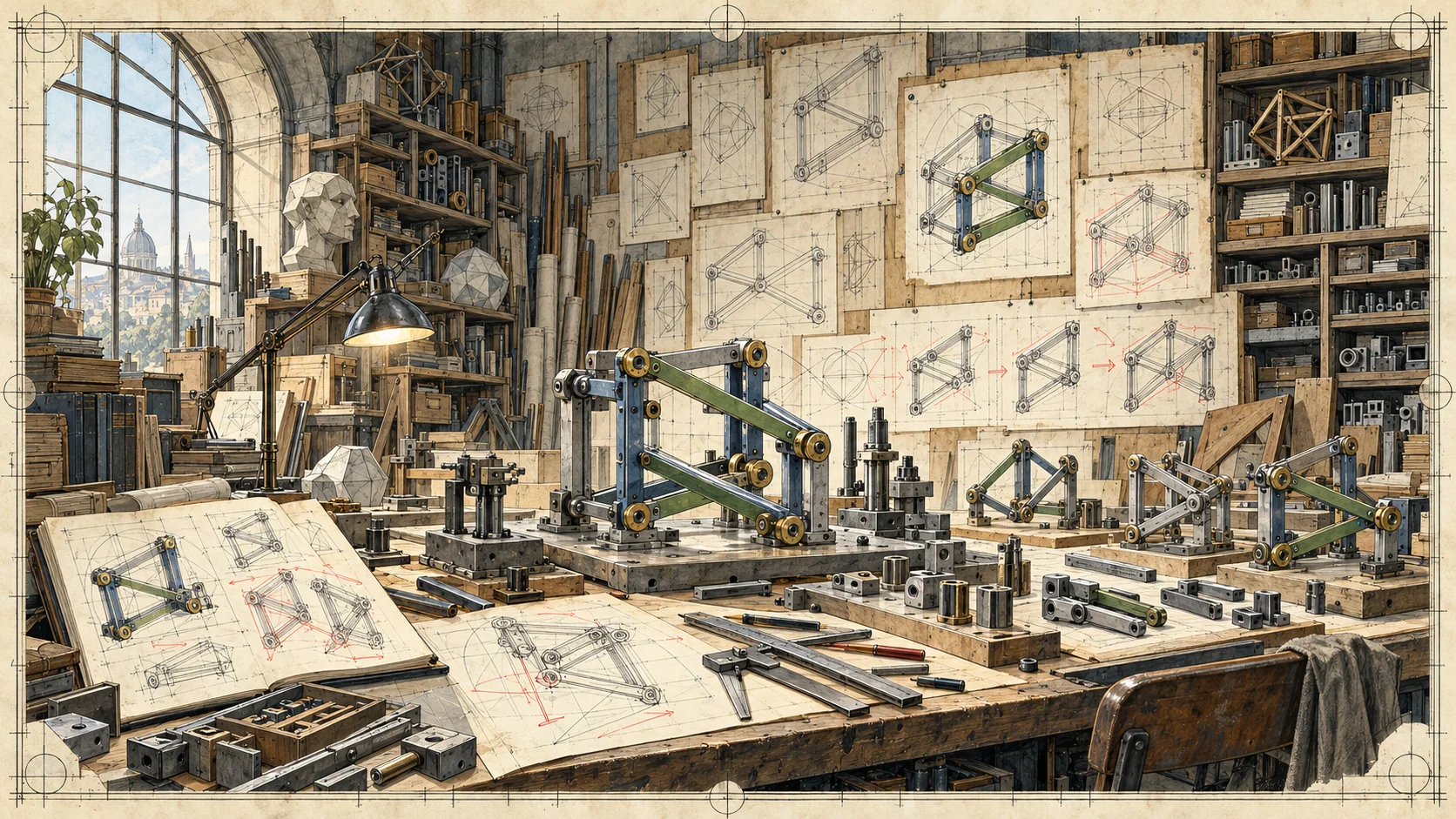
Imagine the stereotypical inventor in the garage. There is a workbench, a notebook, loose components, a motor, wire, fasteners, a sensor, a half-disassembled machine, perhaps some software. Nothing in the room looks metaphysically mysterious. Most of the parts already exist. The materials are familiar. The scientific principles are familiar. The tools are familiar. The inventor did not create electromagnetism, steel, arithmetic, the programming language, the screwdriver, perhaps any individual component.
Yet something can happen in that room that did not exist before. The inventor arranges familiar structures under a new abstraction. The resulting object behaves differently because the relations among its components are different. A causal possibility becomes actual.
The novelty may not reside in any one part. It may reside in the architecture: the sequence, the control relation, the use of one thing as a constraint on another. A familiar component may acquire a new role. A feature previously treated as incidental may become central.
The creation is therefore not well described as the appearance of new matter. The matter was already there. Nor is it merely the accumulation of more information. The information needed to describe every component may also have been available. The new thing can be an abstraction: a new explanatory organization of existing parts.
Compare it.
The naive equation fails:
Possession of the components does not entail the invention. If it did, every garage containing the same parts would contain the same invention. The important event is not that the parts came together. It is that a new way for them to belong together became objective.
Now remove the garage. A child draws something. The drawing may not be new to art history. It may reproduce conventions the child has absorbed without knowing their history. It may resemble thousands of earlier drawings. No patent office would care. No museum would care. No market need care.
Yet something real may have happened in the child's epistemic mind. A distinction became visible. An imagined creature acquired form. A spatial relation that had existed only vaguely became explicit. A story became drawable. A hand learned how to make a line correspond to an intention. A problem became solvable that had not previously been solvable for that child.
The drawing is objective knowledge in a modest sense. It can persist after the thought passes. It can be inspected, criticized, revisited, changed, shown to another person. It can teach the child something about what the child meant.
The child may look at the page and say:
No. That is not right.
The page has become a criticizable surface. Enough of an internal structure has become objective that the structure can answer back.
Calling the drawing an invention may sound inflated if we hear the word only through patent law or industrial technology. But the epistemic structure is recognizable. Something not previously available to the child has become available through creation. The scale differs. The institutional status differs. The reach differs. The kind of event may not.
This gives us a first distinction:
The institutional category may identify a special class of inventions. It does not necessarily define the more general phenomenon.
The same distinction turns back onto you. You never begin from nothing either. Your language, concepts, tools, memories, skills, and inherited explanations all pre-exist the next thing you create. They constrain what can happen, but they do not specify the next abstraction.
Suppose you struggle with a problem for days and then suddenly think:
I have it.
If the explanation is only creativity, the event has been classified without being explained.
The apparent leap may be only the visible surface of a longer transformation in your largely inexplicit epistemic mind. A memory becomes relevant. An analogy changes. A distinction sharpens. A contradiction accumulates pressure. An evaluative criterion shifts. Something peripheral becomes central.
You observe the result, not necessarily the path.
Creativity therefore remains a known unknown. Invention does not solve it. What invention can provide is a history: the notebook, the sketch, the discarded version, the prototype, the failed test. A changed claim, a revised diagram, an observation that forced a redesign, or a criticism from another person can extend that history.
Abstract it.
That history lets us replace one dramatic picture:
with something more realistic:
where each is an objective partial structure and each is some criticism, constraint, or failure.
The unknown has not disappeared. It has become more local. We can ask what changed between the partial structures, why this criticism mattered, why this feature became salient, why the problem was reformulated, why the next sketch took that form.
Invention gives creativity a longer observable shadow.
2. Getting It Out Changes What There Is to Know
The usual story of invention begins too late. It begins when you have an idea. Then the idea becomes a design. Then the design becomes an artifact. But what is an idea in that sequence? Where did its boundaries come from? Why did that problem become visible? Why did these facts become relevant together? Why did you see a relationship that had not previously been available to you?
Before the first explicit sketch appears, you already contain a vast epistemic mind. You can know that something is wrong before you can say what is wrong. You can perform a skill without explaining its control structure. You can recognize a face without possessing a proposition that performs the recognition. You can feel that an argument has failed before identifying the contradiction. You can be drawn toward one problem and not another without possessing an explicit account of why.
Abstract it.
A better starting point is therefore not:
It is something more like:
Your inexplicit knowledge shapes the problem field. A problem becomes sufficiently explicit to work on. You externalize a partial structure. That structure encounters criticism. Your epistemic mind changes. Another structure becomes possible. The invention develops across the boundary between you and objective knowledge.
This changes the meaning of the epistemic imperative. Get it out can sound as if your mind already contains a finished object and the task is merely to transfer it, like copying a file. But much human expression does not work that way. You begin explaining and discover what you think while speaking. You begin writing and discover that the apparent argument depends upon a premise you do not accept. You begin coding and discover that the conceptual model lacks a required state. You begin building and discover that the elegant design is mechanically unstable.
Externalization can be transformative because the structure that becomes objective may not have existed fully even in explicit form before you attempted to express it.
Compare it:
Sometimes the attempt to explicate is itself part of invention. The notebook does not merely receive the idea; it participates in the causal environment through which the idea changes. The prototype does not merely instantiate the invention; it may reveal what the invention actually is. The explanation does not merely report the knowledge; explaining can create the problem that makes the next knowledge possible.
Get it out can therefore mean: externalize enough of the problem that reality can begin to answer back.
Tools matter because they change what can become objective and therefore what can be criticized. Writing preserves language beyond working memory. Drawing preserves spatial relations. Mathematics permits abstractions to be manipulated with precision. A physical prototype forces a design to encounter matter. Code forces an explanation to encounter execution. A simulation lets explicit assumptions generate consequences. A conversation makes a private conjecture vulnerable to another mind.
The important relation is not merely that a tool extends execution. A tool alters the surface on which criticism can occur.
You may be unable to hold ten candidate designs in active memory; a notebook can preserve them. You may not be able to calculate the behavior of a complex system by inspection; a simulator can expose consequences of explicit assumptions. You may forget an earlier explanation; a document can return it later.
Compare it:
A tool can make criticism persistent, expose contradictions, enlarge search, preserve history, and return an objective structure to you in a form you did not anticipate. None of that requires the tool to become you. It changes the reachable epistemic environment, and the changed environment can change the invention.
That makes invention recursive. You notice a problem and sketch something. The sketch reveals another problem. A crude prototype makes the problem physical. The prototype fails and exposes an assumption. The assumption becomes explicit. You change the abstraction. A second prototype works but creates a new constraint. A familiar component becomes relevant in a new way. A third design removes half the original structure. What had seemed central turns out to have been incidental.
The invention becomes clearer by repeatedly becoming objective.
Abstract it.
We can represent the relation as:
where is your changing epistemic mind and is an objective partial structure.
This is not a model of brain machinery. There is no inner engineer, internal examiner, or miniature workshop hidden behind consciousness. The notation expresses an epistemological relation: you and the objective world repeatedly constrain one another, and the invention develops across that relation.
3. What Counts as an Invention?
The broader account creates an immediate problem. If every objective expression of new knowledge counts as invention, the word becomes useless. A copied sentence would qualify. So would a transcription. Every unprecedented arrangement of words would count merely because no identical arrangement had existed before.
Novelty alone is too weak. The new structure must belong to a problem situation and do more than differ accidentally. It must change what becomes possible to explain, criticize, or do.
So a provisional construction is:
An invention is the creation and objectification of a new abstraction that changes the available problem situation.
The abstraction can be embodied physically, computationally, mathematically, linguistically, institutionally, or artistically. The invention need not be patentable, commercially important, or historically unprecedented. The child can still invent within their epistemic mind.
It excludes mere copying and accidental novelty without epistemic consequence. The important novelty is explanatory: a new relationship, a new constraint, a new causal organization, a new distinction, a new way of making some transformation possible.
It also clarifies why inherited knowledge does not dissolve invention. The garage contains inherited tools because civilization contains inherited objective knowledge: language, mathematics, scientific explanations, engineering standards, manufacturing techniques, software libraries, materials, design patterns, recorded failures. You create inside a world already dense with knowledge.
This can make invention look paradoxical. If the components are known, how can the invention be new?
The paradox appears only if knowledge is treated as an inventory of parts. Objective knowledge also contains relationships, transformations, constraints, and explanations. An invention can therefore be built almost entirely from familiar elements while embodying an abstraction that did not previously exist.
That is why recombination is not yet an explanation of creativity. Everything physical can be described as a recombination of prior matter. The relevant question is not whether familiar things were recombined. It is why these elements became related under this abstraction, why you saw the problem this way, why one familiar component acquired a new role.
Calling the result a recombination does not explain the abstraction that made the recombination intelligible. Nor is the invention identical to one physical token. The object may be destroyed while the invention survives in drawings and descriptions. Another person may reproduce it. The same abstraction may be instantiated in different materials. A software version may preserve the relevant structure. A later inventor may generalize it.
The invention is closer to an explanatory abstraction that can be embodied. It specifies relationships that make a transformation possible. The new knowledge resides partly in the structure of those relations.
Often the result is modest: a better hinge, a new fastener, a strange toy, a revised workflow, a trick in code. Market size does not determine the epistemic structure of the event. An abstraction has become objective that was not previously available in that problem situation.
And it may not happen in one moment. The romantic picture wants a spark, a date, a flash in which the inventor sees the whole structure. In practice, the initial idea may contain the core abstraction but fail mechanically. The first prototype may work for a reason the inventor misunderstands. A later failure may reveal the real mechanism. A critic may force a distinction that becomes central. A patent claim may isolate an abstraction that was only implicit in the drawings. A commercial deployment may reveal a second invention inside the first.
The invention has a history because knowledge has a history; it evolves. A new abstraction can become increasingly explicit through repeated cycles of objectification and criticism. The process may contain many inventive acts. Some survive. Some disappear. Some were never as important as they felt at the time. The final artifact is the surviving trace of that trajectory.
Once objective, the invention also escapes the problem situation that produced it. Another person can reconstruct it, misunderstand it, improve it, reject it, combine it with something else, or use it for a problem the inventor never imagined. A local tool may become a platform. A convenient notation may become a way to formulate a theory. A criticism may outlive the argument that provoked it.
The creator does not control that reach. Your inexplicit knowledge does not travel directly. The objective structure does. Another person reconstructs it through another epistemic mind, and the invention can change again.
4. Patentability Makes Dynamic Evaluation Visible
Societies encounter a narrower coordination problem. Some inventions matter economically. Some require large investments. Some are easy to copy after disclosure. Some are difficult to distinguish from what already existed. Some appear new only because the evaluator lacks relevant knowledge. Some are trivial variations.
If a society wishes to assign legal rights around inventions, it needs public criteria. Patent law provides one institutional answer. The exact doctrines vary across jurisdictions. For the present epistemic problem, three familiar classes are enough: novelty, non-obviousness, and utility.
These criteria do not define invention in the broad epistemic sense. The child's drawing remains outside their intended institutional scope. A private conceptual invention may never enter a patent system. A scientific explanation may transform the world without being patentable.
The institutional problem is narrower: decide which objective technical structures should receive a special legal status under relatively stable public constraints. That stability matters. A criterion such as novelty can be written down and taught: is the claimed invention already present in the relevant prior knowledge? Non-obviousness asks whether the claimed invention is more than an obvious continuation of what was already known. Utility asks whether the invention has an operative use. Without relatively stable criterion classes, similarly situated applicants could not expect similar treatment.
But stable criterion classes do not produce static evaluation. Every application creates a new problem situation. What exactly is the invention? Which abstraction is claimed? Which prior knowledge is relevant? Does a previous artifact contain the same structure? Would a skilled person have had a reason to combine familiar elements in the claimed way? Is the claimed result merely asserted, or causally supported?
The criteria do not apply themselves. They have to become specific, and becoming specific requires explanation.
Compare it:
Patent prosecution makes the difference unusually visible. The applicant presents objective knowledge: a specification, drawings, claims, perhaps examples. The applicant says, in effect:
this abstraction satisfies the institutional criteria for invention.
The patent examiner cannot settle the matter by replying only no. A rejection has to identify a reason; it must be explained. It may show where the alleged novelty is already disclosed, explain why a previous invention bears on obviousness, question the claimed utility, or show why the specification does not support the requested scope.
The examiner therefore creates a criticism. That criticism is not the original invention, but it is still creative epistemic work because it can identify a problem that was not explicit before the examination.
The applicant then receives a different problem. Perhaps the cited reference has been misunderstood. Perhaps the claim must be amended. Perhaps the apparent invention was framed at the wrong abstraction level. Perhaps one supposedly central feature was never inventive while another, previously treated as incidental, carries the real novelty. Then the examiner receives a new problem.
The process is not merely adversarial procedure. It is a recursive exchange of creative criticism over an objective surface, the patent application.
Abstract it.
A static picture of evaluation might look like:
The tentative solution is fixed. The criterion is fixed. The result is classification. That picture works for some problems. If a component must fit within a specified tolerance, a measuring device may settle the question.
Open explanatory problems are different. A criticism can reveal that the wrong thing was measured or that the criterion was being applied at the wrong level. It can expose a hidden dependency, isolate an abstraction no one had noticed, or show that an apparent success solves a different problem.
Abstract it again.
The dynamic picture is closer to:
The evaluative criteria constrain the cycle, but their local application must itself be constructed.
Suppose the applicant begins with:
The examiner supplies prior art. The problem may then become:
The applicant responds, and a further problem can appear:
A later exchange may expose the deeper question:
Novelty is still novelty. Non-obviousness is still non-obviousness. The criterion classes remain recognizable. What changes is the problem to which they are being applied. A criterion therefore does more than score a fixed object. Its application can create a new problem situation that changes what object should be evaluated next.
This is the useful content of dynamic evaluative criteria. Criteria constrain creativity, but creativity may also be required to determine how the criteria apply. The standard need not be abandoned for the evaluation to change. A criticism can force a distinction. The distinction changes the evaluation. The evaluation changes the problem.
Any system that evaluates open-ended creative work faces the same general tension. Consistency requires stable constraints. Novelty prevents the valid future outputs from being exhaustively enumerated in advance. If every acceptable invention could already be fully specified, the institution would already contain the relevant knowledge.
The workable structure is therefore not a catalog of all acceptable future inventions. It is closer to:
The explanation remains contestable. The next actor may expose an error. That is how the process can remain constrained while facing an open future.
5. Criticism Can Create the Next Problem
The applicant-examiner exchange makes a broader relation hard to ignore: criticism is creative. The examiner creates a reason. The applicant creates a response. Either can expose a problem the other did not formulate, change the abstraction under discussion, or force a reconstruction of objective knowledge. The same relation can appear between inventor and prototype, engineer and simulation, reader and text. The common structure is not opposition. It is that criticism can produce a successor problem.
Creativity therefore cannot be confined to the generation of tentative solutions. The person who says "no, because..." may create more knowledge than the person who supplied the original proposal. A devastating question can contribute the crucial invention to an explanatory trajectory because it creates the problem that makes a new abstraction necessary.
Patent practice also exposes a different distinction. Not everyone who contributes to producing an invention is necessarily an inventor of the claimed invention. A complex artifact may require technicians, programmers, fabricators, researchers, designers, managers, writers, lawyers, and testers. Someone can make a practical contribution without having created the abstraction that is claimed as inventive.
The legal details vary. The epistemic distinction is more general.
Compare it:
This matters because technologies can displace enabling contributions without thereby explaining the inventive contribution. A machine can calculate, render, search, fabricate, optimize, translate, write, and simulate. It can remove enormous amounts of human labor from the production of an artifact. That fact alone does not answer where the new abstraction came from. The distinction does not prove that only humans can ever be inventors.
It blocks a narrower inference: causal participation in production is not by itself an explanation of inventorship.
Surface performance does not by itself reveal the machinery that produced it. Output does not by itself reveal the person. Participation in execution does not by itself reveal explanatory origin. What makes these distinctions usable is an objective surface.
The invention cannot be examined as a private feeling. It must be expressed sufficiently for another person to reconstruct it: a drawing, a description, a claim, a causal sequence, a working example. The surface will always be incomplete relative to the inventor's epistemic mind, but it can still be sufficient for criticism. A scientific paper, proof, diagram, musical score, program, machine, story, model, or patent can all serve this function. Each makes something objective enough that another epistemic mind can work on it.
The surface is not the mind. The reconstruction is not the inventor's internal state. Yet objective knowledge makes criticism possible across the gap. Private epistemic worlds remain solitary. Invention can still travel.
This also means the evaluator is inside the problem. The examiner reconstructs the invention. The applicant reconstructs the rejection. Each carries different knowledge, histories, expectations, and prior abstractions. The shared objective objects — statute, claim, specification, drawings, prior art, written rejection, response — do not produce identical minds. They do something more modest yet important: they make disagreement criticizable.
The institution does not require telepathy. It requires objective surfaces over which different epistemic worlds can collide under shared constraints. The table can be shared. The explanation of how the table applies still has to be created.
6. Invention and the Open Future
Now return to the garage and give an artificial system everything in it: every component, every relevant patent, every scientific paper, every technical standard. Add every previous prototype, known failure, candidate material, and design pattern.
Has the invention therefore been specified? No. The knowledge landscape constrains what can be created. It does not uniquely determine what will be created.
You do not create outside history. You inherit objective knowledge. But inheritance is not destiny. The same library can enter many minds. The same components can enter many workshops. The same problem can generate different explanations. The same criticism can reorganize your epistemic mind and leave another person's unchanged. The existence of the primitives therefore does not entail the new abstraction.
This is what non-obviousness tries to capture institutionally — not metaphysically, not perfectly, but recognizably. The difference between "everything was already there" and "therefore the invention was already there" is the difference between ingredients and explanation.
Of the familiar patentability criteria, non-obviousness makes that difference especially visible. Novelty asks whether the structure was already there. Utility asks whether the structure can do something. Non-obviousness asks about the path from existing knowledge to the new structure: could the claimed invention have been reached as a routine continuation of what was already known?
The legal standard is not a theory of creativity. But the problem it confronts is epistemically recognizable. If future knowledge were fully derivable from present knowledge by a fixed procedure, the future invention would already be implicit in a mechanical, executable sense. The epistemology explains instead that new knowledge leaves the future open. An explanation that does not yet exist cannot be fully consulted in advance.
Invention gives that openness a practical form. The ingredients can exist. The physical possibility can exist. The relevant person can exist. And still the abstraction does not exist until it is created.
Utility reveals a complementary relation. Useful for what? A structure becomes useful relative to a problem. Knowledge turns physical possibilities into resources by making transformations possible. The same relation appears here. A device is useful because someone can place it inside a problem situation. A mathematical technique becomes useful when a class of problems becomes visible. An artifact can remain useless until another invention changes the surrounding problem space.
Utility is therefore relational:
Invention is not a property sitting entirely inside an object. It participates in a world of problems. Change the problems and its meaning can change. An old invention can acquire new utility. A new invention can reveal a problem no one had previously formulated. The arrow runs both ways.
Novelty depends on a different relation: objective memory. You may independently create something that already exists. For you, the process may have been genuinely inventive. For the institution, the result may not be novel. Both descriptions can be true because epistemic invention and institutional patentability answer different questions.
As more prior knowledge becomes searchable, rediscovery becomes easier to detect. That can prevent some wasted effort, but the collision can also improve the problem. A prior solution may reveal that your contribution is narrower, broader, or located at a different abstraction level. The previous inventor may have solved a neighboring problem under a different description.
Objective memory does not make invention unnecessary. It changes the problem situation in which invention occurs.
7. Artificial Intelligence Enlarges the Criticizable Surface
Artificial intelligence changes the scale of that objective memory. For most of history, the practical landscape of relevant objective knowledge was sharply bounded. No inventor could read every book. No examiner could inspect every technical document. No scientist could compare every neighboring model. Every evaluator worked through compression: indexes, libraries, expertise, classification systems, search strategies, professional memory.
Now much larger regions of objective knowledge can be brought into one interaction. Not perfectly, neutrally, or without selection, but at a new scale. You can ask whether the same structure has appeared under another vocabulary or which familiar components have been arranged differently. You can ask what criticism another field might make, which prior explanation destroys a claim of novelty, or what assumption the design is smuggling in. An evaluator can ask symmetrical questions.
Technology can therefore make parts of the evaluative surface computationally active across an immense landscape of objective knowledge.
Suppose your inexplicit knowledge has produced a weakly formed conjecture. You may discover almost immediately that the idea already existed under different terminology. That collision can destroy one problem formulation and expose another. Your real contribution may be narrower, broader, or located at an interface between two bodies of knowledge. The criticism may even reveal that there was no invention at all. Those outcomes differ, but each can improve the problem.
The expansion can also produce noise: spurious similarities, bad analogies, confident errors, premature closure, a flood of candidate criticisms that makes the important criticism harder to see. The resource is therefore not manifest truth. It is a larger criticizable surface.
That distinction becomes especially important if we imagine automating patent evaluation. Search an immense patent corpus. Retrieve similar claims. Map technical terms. Compare diagrams. Identify components. Trace support from claims to specifications. Find candidate prior art. Generate possible combinations. Preserve contradictions and return them later. These are substantial capabilities. A biological person cannot inspect the whole landscape. A computational system can traverse far more of it.
But a machine containing the criteria has not thereby replicated the process. A machine searching prior art has not thereby replicated the process. A machine generating candidate objections has not thereby replicated the process.
To reproduce the dynamic process in the strong sense, the system would have to participate in the creation of the next problem. It might have to recognize that the abstraction under evaluation had been framed incorrectly and create a new interpretation of a familiar structure. Its criticism would then have to change the problem situation, provoke a reformulation of the claimed invention, or reveal that the previous evaluative criterion had been instantiated at the wrong level.
Then recurse. That is a deeper requirement than retrieval.
A machine can carry astonishing amounts of the table: criteria, precedents, examples, technical corpora, prior arguments, rejected claims, successful amendments, language patterns, diagrams, distinctions made objective by thousands of earlier participants. That capability is epistemically important because the machine becomes a new kind of objective surface. It can return more of the inherited landscape to the current problem.
Carrying the table is still not the same as recreating the dynamic process. The stronger claim would require the machine not merely to generate text labeled criticism or retrieve an analogous rejection, but to create the explanatory distinction that changes what the actors believe they are evaluating.
Suppose a system nevertheless produces excellent patent-examination outputs. Its searches are strong. Its rejections are accurate. Its explanations resemble those of skilled examiners. Perhaps applicants prefer them. Perhaps appeals decline. That would establish powerful technical competence. It would not establish that creativity had been explained. Successful behavior does not by itself settle the causal explanation of the behavior. A machine may participate productively in creative criticism without giving us a theory of creative criticism. Engineering can outrun philosophy.
The same caution becomes clearer if the hierarchy is kept visible.
-
External epistemology: problems, tentative solutions, criticism, successor problems. This gives the structure of knowledge growth.
-
Your internal epistemic mind: vast, path-dependent, historically constructed, partly inaccessible to introspection, capable of creating explanations. This is where the unresolved transition becomes intimate.
-
Tools: language, notes, sketches, prototypes, mathematics, code, machines, artificial intelligence. They enlarge the surfaces through which internal structures can become objective and criticizable.
-
Objective knowledge, which subsumes the tools. The invention leaves you. It persists, travels, collides, enters institutions and other minds, and generates criticism you could not anticipate.
The levels interact, but they are not interchangeable. The tool is not you. The objective artifact is not your inexplicit epistemic mind. The epistemic cycle is not a brain mechanism. The institutional criterion is not creativity.
Artificial intelligence can expand many practical stages once a problem has become available to interaction. It can help you articulate, generate variants, search, compare, simulate, criticize, remember, reconstruct earlier states, expose contradictions, translate between vocabularies, return old objective knowledge to a new problem.
It can make the loop faster, denser, less forgetful, more adversarial, more expansive — and noisier. You may confront more candidate explanations than you can evaluate, more criticisms than you can inhabit, more prior art than you can reconstruct, more variants than you can meaningfully compare.
The problem can shift from scarcity of objective knowledge to abundance without salience. That shift does not collapse the hierarchy. It makes the hierarchy more important. The tool does not own the arrows. It enlarges the surface over which you can move without, by that fact alone, explaining the transition.
8. The Depth of the Arrows
Return to the smallest marks in the familiar epistemic cycle:
The arrows looked simple because the schematic is compressed. They are in reality strange and deep. Invention makes one class of them concrete.
Consider an inventor who has just received a criticism. The criticism is objective. The inventor can read it, perhaps even agree with every sentence. Still, the next move is not determined. The invention may be abandoned, narrowed, generalized, given a different mechanism, defended against the criticism, redirected toward another use, or transformed into an entirely different invention. Nothing in the arrow symbol explains which transition occurs.
The institutional process does not remove that uncertainty. It gives the uncertainty an explicit surface. The problem becomes harder to hide behind words like creativity, intuition, judgment, or insight. Candidate generation is not the deepest difficulty; it can be made cheap. Candidate testing is not the deepest difficulty either; many tests can be automated.
The deeper problem is that criticism can create the next problem, and the next problem changes what counts as a relevant solution. The state space is therefore not fixed. The evaluator is not merely moving through a known landscape. Evaluation can alter the landscape.
Where does the problem come from? Why this arrow, and why now?
Invention gives us an external history in which that mystery becomes concrete if not explained. A prototype fails. Why does this failure become the important one? A prior patent is discovered. Why does it force a new abstraction rather than abandonment? A criticism is offered. Why does it reorganize one epistemic mind while another criticism leaves the structure untouched? A familiar component is noticed. Why does it suddenly solve a problem that had seemed unrelated? The records may show what happened. They do not explain why the next problem became alive.
For you, this changes the form of the mystery. You do not experience your epistemic mind as a search through a fully specified landscape. Problems become salient. Criticisms wound one explanation and leave another intact. An old memory becomes relevant. A failed attempt makes a distinction visible. An objective artifact returns something to you that you did not know you had put into it.
The causal surfaces can often be reconstructed after the fact. Reconstruction of the surfaces is not yet an explanation of the transition.
The sharper question is no longer merely:
How does creativity happen?
It is:
Why does this epistemic mind produce this new abstraction through this problem now?
That question remains open. Invention has not dissolved the problem of problems. It has made more of the problem criticizable.
9. The World Answers Back
To be a person is not to be constantly inventive. It is to be the kind of entity for whom invention is possible. You are always inventive in the broader sense that you are always creative.
And invention does not merely solve problems. It can create them. A prototype reveals a hidden constraint. A new machine creates a safety problem. A new abstraction exposes a contradiction in an old theory. A criticism reveals that the inventor was solving the wrong problem. A successful invention creates new classes of problems because new possibilities now exist. This recursion is not incidental. It is part of the evolving structure of knowledge.
The patent case makes one part especially concrete. Applicant and examiner can begin with shared criteria and still have to create the actual evaluative problem together. The criterion class is stable. The problem is not. Evaluative criteria are created. Dynamic evaluation is possible because the next problem does not sit waiting as a labeled item in a fixed list. It has to become visible through criticism, failure, a tool, another person, or an objective artifact behaving in an unexpected way.
Invention changes the meaning of the epistemic imperative to get it out. The route across the boundary is not transcription. You may discover the structure while trying to express it. A tool can preserve enough of the trajectory for an earlier state to return. Objective knowledge can answer back.
The familiar garage makes the structure visible because the inventory is not enough. Patent evaluation makes the criticism visible because the criteria are not enough. Artificial intelligence can enlarge the objective surface because search and variation are not enough. At each scale, more of the trajectory becomes inspectable without the creative act itself being explained.
That is why invention is useful here. It prevents creativity from disappearing into a single word. An invention evolves. The history has objective surfaces. The surfaces expose failures. Failures generate criticisms. Criticisms can generate problems. Problems reorganize the path. Somewhere through that recursive movement, a new abstraction becomes objective knowledge.
The invention may depend on thousands of inherited explanations, tools, materials, and institutions. The inventor may add one distinction, one new relation, one abstraction. Without the inherited knowledge, the invention would not exist. Without the new abstraction, it would not exist either.
The contribution can be small in visible form while changing what the entire inherited structure makes possible.
What would it mean to say that the inherited knowledge did most of the work, while the new explanation contributed only a little? How do we weigh knowledge?