
What Moves You
XVI. Mount Mysterious
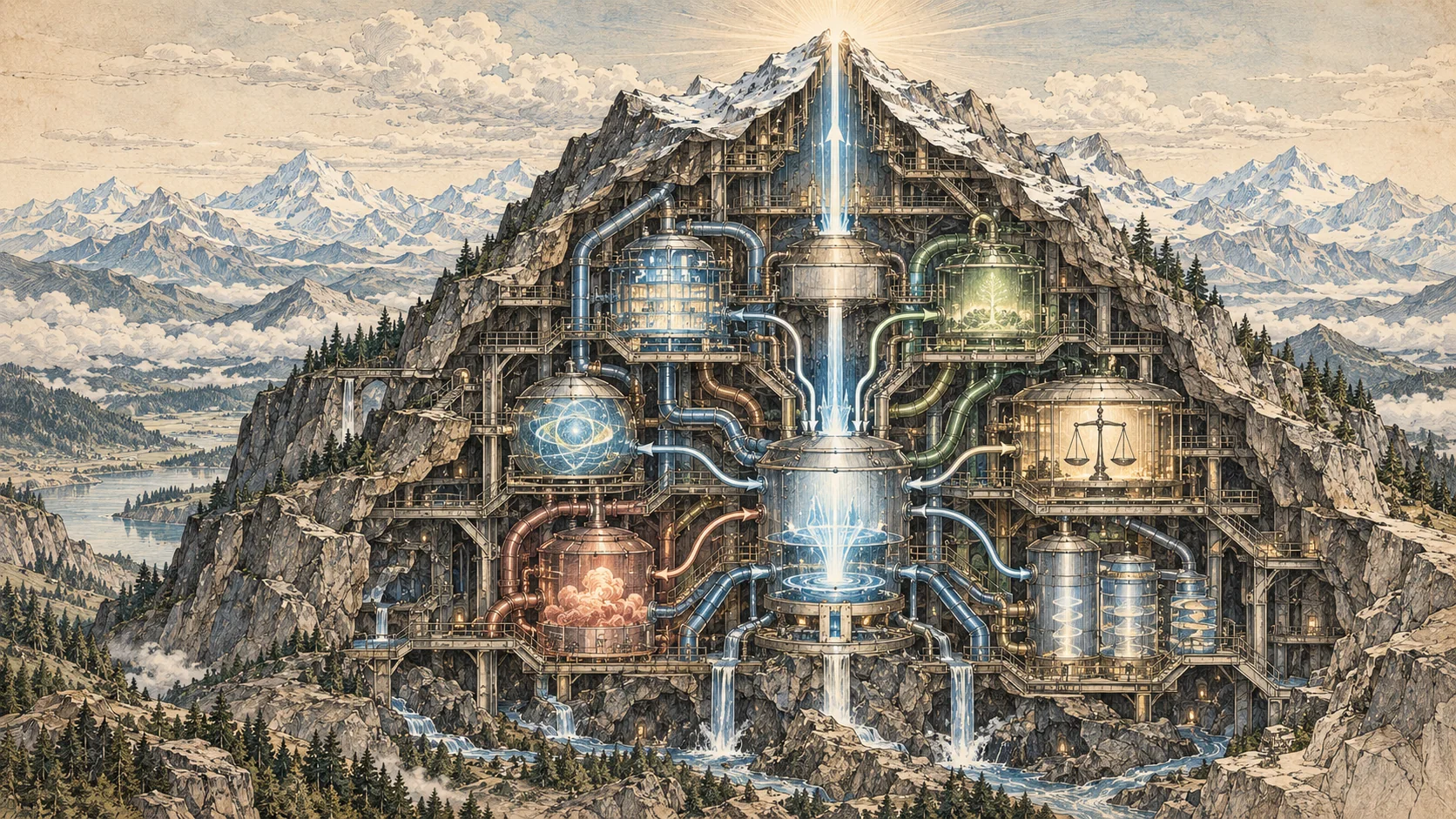
There are parts of personhood we are strongly inclined to protect from explanation: creativity, insight, beauty, art, love, grief, consciousness, the soul, and the feeling that another person contains something no mechanism could ever exhaust.
Sometimes the resistance is aesthetic. A scientific explanation seems to flatten the thing it explains. Sometimes it is moral: if love is physical, perhaps it becomes less meaningful. Sometimes it is spiritual: if the soul can be explained, perhaps it was never a soul. Sometimes it is phenomenological. A thought appears. A melody arrives. You suddenly understand. Nothing in conscious experience seems to contain the steps that produced the change.
The tempting conclusion is that something essential must lie beyond explanation. What happens instead when our best explanations reach the parts of you that seem most resistant to them.
The central conjecture is not that mystery is unreal. It is more demanding:
What appears as mystery may mark a boundary in our present explicit knowledge rather than a boundary in reality.
You can fail to explain a process that is nevertheless physically real. A process can remain inaccessible to introspection while remaining causally continuous with the rest of you. A work of art can exceed every explicit criterion we presently possess without ceasing to arise in reality. Another person's belief can be false while remaining deeply intelligible within the epistemic mind through which that person encounters reality.
The mystery remains, but as a problem rather than an exemption.
1. The Apparent Leap
Creative thought often arrives discontinuously. You struggle with a problem for weeks and suddenly see the solution. You walk away from a bug and wake with an answer. A composer hears a phrase that had never existed before. You carry a moral conviction for years and then, during one conversation, can no longer believe it. The explicit experience has the structure of a jump.
The transition itself may be unavailable to you. That absence is easy to interpret metaphysically. If you cannot consciously reconstruct the steps, perhaps there were no steps. Perhaps creativity arrives from somewhere else, genius is discontinuous by nature, or the soul intervenes.
Abstract it.
Let represent the epistemic mind of person . Use this abstraction to distinguish one reality from the many individual minds through which reality becomes intelligible:
You do not directly possess reality. You encounter it through perception, memory, abstraction, language, expectation, inherited objective knowledge, and explanatory history. Much of your is not available as explicit proposition. You can know without being able to say what you know. You can detect that something is wrong without knowing why. You can play a phrase correctly without describing the motor knowledge that makes it possible. You can dislike a room, trust a stranger, or feel that an argument has gone wrong before you can identify the relevant structure.
Your conscious surface is therefore not the whole epistemic mind. It is one interface with it. That changes what the apparent leap can mean. If explicit experience reveals only a thin slice of a much larger evolving structure, a sudden thought may have a long invisible preparation. The leap may mark the point at which a transformation becomes explicit rather than the point at which the transformation begins.
Imagine several structures inside your changing at once. A memory is reconsolidated. A distinction becomes more salient. A skill becomes easier. A social expectation weakens. An analogy becomes available. A familiar explanation fits less well. A new concept changes what counts as relevant. An emotional association shifts. An evaluative criterion changes slightly.
None of these changes need become explicit, and no single change need be dramatic. Their relations can still alter the problem situation.
Abstract it again.
Schematically:
The notation is not meant literally as addition. The structures interact. A small change in one region may matter only because another region has also changed. A new concept may remain inert until an old memory becomes newly salient. A criticism may fail repeatedly and then become devastating because your evaluative criteria have moved.
Your epistemic mind is not a single structure that changes all at once. It contains memories, habits, skills, fears, values, interests, social knowledge, bodily states, unfinished problems, explicit theories, inexplicit expectations, and changing criteria. These structures can conflict. They can change at different rates and become conscious at different times.
You are therefore an epistemic multiplicity without becoming multiple people. The subjective locus remains one. The epistemic structure beneath it can be extraordinarily heterogeneous. One part of you may remain stable while another changes quickly. A new explanation may enter one domain while old habits preserve another. A moral criterion may change before behavior does. A skill may change behavior before language catches up. A new relationship may reorganize salience long before you notice that your goals have changed.
Eventually some consequence of that changing structure crosses the narrow explicit surface. You say, "I just realized something." The realization may be sudden even when the change that made it possible was not.
A simple physical analogy establishes only the structural possibility. Water can be heated gradually. At the molecular level, innumerable local interactions change and energy accumulates. At the level relevant to ordinary experience, a qualitatively different state then becomes obvious: the water boils.
A creative insight is not being claimed to be a thermodynamic phase transition. The point is narrower:
Continuous lower-level change can become visible as qualitative discontinuity at another explanatory level.
The conscious report "now I understand" therefore does not establish that nothing relevant changed before now. The absence of conscious access is not evidence of causal absence.
2. Causal Continuity and the Open-Ended Self
Physics constrains the mystery here. Whatever happens when you think, remember, love, grieve, invent, compose, criticize, or change your mind happens in a physically instantiated system.
That claim does not identify the relevant mechanism. It does not tell us which neural structures matter. It does not explain subjective experience or explanatory creativity. It only prevents those phenomena from being treated as though they occur outside reality. Your body is not a vessel carrying an epistemic process from somewhere else. The epistemic process is physically instantiated.
The unexplained event may be extraordinary, but it cannot be causally arbitrary. Physics therefore constrains what an explanation of you can require. We need not settle every philosophical dispute about determinism to see the general point. Physical states have causal histories. Interactions occur under physical constraints. A thought does not need to appear from nowhere in order to be novel, and a new explanation does not need a breach in locality in order to be creative.
Randomness does not solve the problem. Suppose an unexplained neural event were genuinely random. That might explain unpredictability. It would not explain why the event instantiated a good explanation of orbital mechanics, a new proof, or a melody that transformed music.
Randomness is not creativity. The problem is therefore not how novelty escapes causation, but this:
How can causally continuous physical processes instantiate epistemic novelty?
That is a harder problem because it preserves both sides of the phenomenon: novelty is real, and so is causal continuity.
The same constraint reaches self-transformation. Earlier essays rejected fixed personality as destiny. You can criticize inherited explanations, create new problems, and become radically different. But open-ended transformation does not imply instant revolutions.
You have a history. Your body, skills, relationships, concepts, fears, attractions, and inexplicit knowledge all have histories. You can create a new explicit explanation in an afternoon and spend years reconstructing the rest of around it. Freedom inside a causally continuous system therefore has a particular shape. The future is open, but it is not causally isolated.
3. When Incremental Change Becomes Revolutionary
Problems contain evaluative structure. You do not merely ask a question; you possess some sense, often inexplicit, of what would count as improvement. The difficulty is that those criteria can themselves change.
Objective knowledge records such changes everywhere. A scientific explanation can change what later scientists count as an adequate explanation. A moral innovation can make a previously ordinary practice intolerable. A new technology can alter what users later expect from every technology in its class. A work of art can change what later listeners can hear.
Abstractly:
The historical change is visible. The mechanism is not. We can say that evaluative criteria change without pretending to know how you create the change. That distinction preserves the problem rather than filling it with a label.
Now suppose several dimensions of your change piecemeal. Your skill improves. Your attention becomes trained. A new abstraction becomes available. A previously invisible contradiction becomes irritating. An old criterion weakens while a new one begins to form.
None of these changes alone looks revolutionary. Then one explicit product appears: a theory, a painting, a moral argument, a line of code, a political idea, a musical phrase. The artifact may reorganize the objective knowledge around it. Its explanatory content may be revolutionary even if its causal history was not.
This gives incrementalism a precise meaning. It is not the doctrine that important change must be small. It is the recognition that complex adaptive systems have histories and dependencies, so large visible transformations can emerge from many smaller changes that never became explicit.
The same architecture helps explain why the parts of personhood we most readily call mysterious often share a feature. Artistic taste, love, grief, beauty, intuition, spiritual experience, moral revulsion, creative inspiration, a sense of meaning, and the soul can all be experienced with extraordinary force. The structures that produced the experience may remain largely inaccessible.
The asymmetry matters. The explicit experience can be vivid precisely where the explanatory mechanism is obscure. The obscurity then becomes part of the phenomenon, and the experience can feel as though it arrived from beyond explanation. But the process may instead lie mostly within inaccessible regions of . The mystery may reflect the architecture of access.
4. Mystery as an Epistemic Relation
There is an important difference between saying "I cannot explain this" and saying "this cannot be explained." The first locates a deficiency in present knowledge. The second makes a universal claim about reality.
That second claim has much greater reach. If some physical process is intrinsically inexplicable, then a further problem appears: why does the same reality that permits the process not permit explanatory access to it? Without an answer, the mystery has only been renamed.
A forever-mystery therefore requires more explanatory work than a temporary one. "We do not know yet" marks the present boundary. "No one can ever know" makes a stronger claim about reality itself.
You are physical. Your art is produced physically. Your grief is physically instantiated. Spiritual experience occurs in a physical person. Your memory is physical. Your changing evaluative criteria are physically instantiated. Your explanatory creativity, however mysterious, occurs in physical reality. Every successful explanation we possess is also created from within that same reality.
None of this guarantees that a problem will be solved. Time, resources, access, history, or civilization may impose limits. But present ignorance does not establish an in-principle boundary.
The resulting epistemic position is modest but strong:
No physical phenomenon earns permanent exemption from explanation merely because our present explanations do not reach it.
There are then two importantly different uses of mystery. One says: there is a real phenomenon here that our present explanations do not adequately explain. The other says: because we cannot presently explain it, explanation must stop here.
Call the first good mystery and the second bad mystery. Good mystery creates a problem. Bad mystery closes one. Mystery becomes anti-explanatory when a description of ignorance is converted into a prohibition on inquiry, so that the unknown becomes protected precisely because it is unknown.
Several mysteries of personhood remain genuine known unknowns. We do not explain how a physical system creates a new explanatory problem or how evaluative criteria change inside one person. We do not explain why one criticism becomes transformative while another remains inert, or how subjective experience relates to physical implementation. We do not explain why some artistic perturbations reorganize whole traditions, or why an idea can arrive explicitly after years of invisible preparation.
These are not failures to be hidden by a more impressive vocabulary. They mark the present edge of the explanation. Their epistemic role is to remain exposed as problems.
5. Art as a Natural Experiment in Mystery
Other minds provide an unusual source of criticism because human cognitive machinery varies far more than ordinary conversation reveals. Some people visualize vividly; others do not visualize at all. Some possess rich inner speech; others report little or none. Some can re-create music internally; others know music without consciously hearing it. Different people can reach similar outward competence through very different subjective routes.
These differences function as natural experiments. They let us separate a phenomenon from one candidate explanation of the phenomenon. If two people can produce the same kind of objective result without sharing a conscious mechanism we assumed was necessary, that mechanism cannot be decisive. The deeper process remains unexplained, but one explanation has been removed.
Consider two musicians. One possesses extraordinarily vivid auditory imagery. They can hear orchestration internally, rehearse candidate phrases without making a sound, and compare variations inside conscious experience. The other has little or no voluntary auditory imagery. There is no internal concert hall. A melody may be known without being consciously heard. A harmonic possibility may be represented symbolically, relationally, spatially, or in some other form the musician cannot fully describe.
The second musician may need to externalize more of the critical process. They play the phrase, hear it physically, revise it, and play again. The external world supplies a critical surface that the first musician can partially simulate internally.
Their conscious workflows differ radically. Their music need not. The hyperphant and the aphant can therefore travel radically different internal routes toward the same objective musical world.
Once the work becomes objective knowledge, you may have no access to the cognitive route that created it. Two songs can be equally moving, two compositions equally complex, and two performances equally original. You may still be unable to infer which creator heard the piece vividly before playing it and which had to externalize almost every tentative solution.
Abstract it:
At least some conscious mechanisms associated with creativity therefore cannot be necessary conditions of artistic quality. The comparison does not dissolve the mystery; it moves it. The remaining question is what process actually carries the creative work.
6. Artistic Soul and Changing Criteria
People sometimes say, "this music has soul." The phrase can be meaningful without yet being explanatory. The work may feel emotionally alive. It may violate a convention in a way that feels necessary or carry traces of struggle. It may surprise while remaining coherent, connect distant parts of your own , change what you are able to hear, or resist every decomposition you presently have. Those are different possible problems. The word soul can compress them into one apparent solution.
Once they are separated, the explanatory question changes. Where is the soul supposed to be? It might be located in the artist's feelings, the method of production, the artifact, you as the listener, the relation between the artifact and your evaluative criteria, or the history of the genre. The more precisely the possibilities are distinguished, the less the mystery behaves like one thing.
The problem becomes sharpest when art changes the criteria by which later art is judged. Most art is evaluated within criteria that already exist. A musician can write a competent song, a painter produce a skillful image, or a novelist satisfy the conventions of a genre. Sometimes, however, a work changes the criteria. Listeners begin to hear differently. Later musicians inherit distinctions that did not previously exist. An innovation that first sounded wrong becomes indispensable.
The future criterion is not fully available to the present evaluator. The work may help create the standard by which it is later recognized. That makes genius difficult to identify from inside an existing evaluative landscape without making it mystical. The unknown remains elsewhere: we still do not explain how you create the perturbation that changes the criteria.
Artificial intelligence sharpens that unknown. A system with access to enormous objective knowledge can reproduce, recombine, and optimize against explicit musical structures at extraordinary scale. As evaluative criteria become explicit enough to be represented in objective knowledge, artificial systems should become increasingly capable of satisfying them. The relevant criteria include harmony, rhythm, instrumentation, genre conventions, production patterns, formal structure, and stylistic resemblance.
Listeners may call much of the result derivative or slop, but human beings also produce enormous quantities of derivative work. Mediocrity therefore cannot by itself distinguish the human from the machine.
The more interesting boundary lies in the creation of new problems and criteria. The strongest present human distinction available to this argument is not that every person creates great art; most do not. It is that a person may create a problem or criterion that did not previously exist in objective knowledge.
A tiny perturbation may matter: one strange chord, one unexpected pause, one lyric that changes the interpretation of the whole form, one aesthetic decision that initially looks like an error. Many minds may encounter the perturbation, and something inexplicit changes in each. The new criterion can therefore become distributed across many before anyone can state it explicitly: listeners begin to hear and judge differently without yet being able to say what has changed. Only later do creators reconstruct the perturbation until the new criterion becomes part of the explicit landscape.
That is miraculous.
The mystery is not that the original artist violated rules. Machines can violate rules. The mystery is how you create a variation that another person experiences as the beginning of a better rule. That returns us to dynamic evaluative criteria.
Not all artistic value works this way. A parent may cherish a child's drawing more than a technically accomplished painting because the drawing belongs to a particular developing person. It records effort, carries a relationship, belongs to a moment in a shared history, and may reveal a new capacity. The artifact is inseparable from the parent's model of the child.
The emotional value is real, but it differs from the claim that the work changed the objective history of art. Value can depend on the relationship between artifact and without becoming a universal artistic criterion.
One can avoid the difficulty by defining art as "the expressive process of a human person." Then the child's drawing is art by definition and AI output is not. The distinction becomes easy because the explanation has disappeared into the category. The process is artistic because a human performed it; the human is special because the process is artistic. Nothing has been explained about why one artifact changes evaluative criteria while another does not.
The same definition excludes any future non-human person before the relevant capacities are examined. Biological membership carries the difference by classification. If personhood is used that way in aesthetics, the categorical error returns: a classification has become an explanatory substitute.
7. From Artistic Soul to Human Soul
The artistic soul points naturally toward the human soul because both name an invisible something that seems to explain why the visible object exceeds the explicit account.
A musician can be technically perfect and said to lack soul. A cruel person can be called soulless. A loved person can be imagined as possessing a soul that survives the body. The soul can be treated as the essence of identity or as what animates the body. It can be treated as what experiences reward or punishment after death, creates art, or grounds moral worth. It can remain invisible and also be declared beyond explanation.
A single word is therefore carrying several different explanatory problems. The pattern becomes clearer when the word is used as an answer:
Why is the living person different from the corpse? Soul. Why does this music feel alive? Soul. What persists after death? Soul. What gives the person moral worth? Soul. What distinguishes the person from a machine? Soul.
Yet when the causal structure is requested, the answer may become "the soul is beyond explanation." The concept is then asked to perform explanatory work. At the same time, it is protected from the conditions under which explanations can be criticized.
The problem is structural rather than spiritual. If the soul explains, it must have consequences. If it has consequences, those consequences enter reality. Suppose the soul animates the body, preserves memory, influences action, creates artistic expression, or survives death. Each statement asserts a dependency: something happens because the soul exists or acts. Those dependencies must coexist with our other explanations of physical bodies, memory, cognition, death, and causation.
Taking the soul seriously as an explanation therefore does not require banning it. It requires following what the explanation says happens. An unfamiliar domain can remain unfamiliar without acquiring immunity from criticism merely because it is important.
8. Mystery Inside an Epistemic World
The inquiry now turns outward again, toward other people. Mystery reveals something about how you inhabit : you do not experience your own explanations as diagrams sitting beside reality. You experience the world through them.
A child is not experienced as an abstract bundle of propositions. The child is loved. A deceased partner is not experienced as a missing variable; the absence can reorganize the whole experienced world. A religious cosmology is not necessarily stored as a detached list of claims; it can structure family, morality, death, hope, fear, identity, and future expectation.
A mysterious explanation can therefore occupy an enormous region of even when its explicit sentence is small. Its epistemic roots may be vast.
Consider a person who says, "I refuse to believe that the people I love are really gone, that I will never see them again." The sentence can be criticized as a proposition about reality. It is also a doorway. Behind it may sit decades of memory, attachment, shared plans, habits of expectation, family stories, and religious knowledge. It may also contain fear of finality, a sense of justice, the inability to reconstruct identity without the loved person, and the persistent feeling that the dead remain present.
None of this makes the proposition true. It makes the person's problem situation much larger than the sentence. A reply that consists only of "you are wrong" can therefore miss what was exposed. You may not have presented an argument; you may have exposed a fracture in .
The same structure appears in other beliefs. Suppose a person sincerely believes in eternal punishment. That belief may be integrated with love. The parent says, "I do not want my child to go to hell." Inside the parent's , this can be a profound protective problem. The imagined consequence is larger than physical death, so the urgency can exceed the urgency attached to ordinary danger.
Once that structure is visible, coercive behavior can become explicable without becoming correct. The parent may restrict speech, friendships, sexuality, books, technology, or belief and experience each restriction as care. The problem is not necessarily an absence of knowledge. A large body of knowledge may instead be organized around a false explanation of .
That distinction becomes important when criticism reaches the person carrying the belief.
9. Criticism, Reconstruction, and Coercion
A criticism does not simply strike a false proposition with reality. It's creative. You reconstruct it, and the reconstruction changes your problem situation.
That structure creates a possibility that is easy to miss: criticism itself can become coercive.
Suppose someone reveals a fragile explanation that is presently holding together a devastated epistemic mind. The critic responds, "that belief is false; abandon it." The critic may possess the better explanation of . Even so, the intervention can function as:
The destructiveness does not make the criticism false. The falsity of the belief also does not establish that forced replacement can complete the recipient's reconstruction. The relevant distinction is:
A criticism can expose a problem. It cannot perform another person's reconstruction for them.
Pain does not define the difference. Some valuable criticisms are painful. An explanation can collapse. A cherished identity can become untenable. You can discover that you harmed someone. A scientific theory can fail. A relationship can end. Error elimination is not obligated to preserve comfort.
The coercive element appears when another person attempts to close your epistemic process by requiring a successor explanation: "you must now adopt this explanation." The space to reconstruct, reject, defer, or modify is then removed. So is the space to create a successor problem. Creative criticism has become authority using the vocabulary of truth.
Two parents make the structure easier to see.
The first sees a child step toward an oncoming car. Within the parent's :
The parent grabs the child. The intervention is commonly treated as justified.
The second parent believes that some action could condemn the child eternally. Within that parent's :
The parent constrains the child. That intervention may be condemned.
Yet the abstract problem structures can be strikingly similar. Both parents believe they are preventing catastrophic harm. The difference is not that one cares and the other does not. It lies in how the relevant structures in each correspond to .
An action can therefore be intelligible within a person's epistemic mind without the explanation producing it being true:
The parent who fears the car may possess a good explanation. The parent who fears hell may possess a false one. Understanding either action requires identifying the problem the parent believes they are solving.
That is not relativism. There are not two realities. There are two fallible epistemic minds, both encountering one , both open to criticism, and neither accessing except through its own evolving .
10. The Roads Between Epistemic Minds
This changes the interpersonal problem. Suppose I believe your conclusion is false. I can criticize the conclusion directly, and sometimes that is enough. But if the conclusion is integrated across a large region of your , my criticism may never reach the structure sustaining it. It may be heard as noise, threat, evidence that outsiders cannot be trusted, or proof that the sacred thing is under attack.
The disagreement then persists for reasons that cannot be reduced to missing information. You may possess an enormous amount of knowledge. The criticism may fail because it must travel through an epistemic landscape I do not understand.
Understanding another person therefore requires more than locating an explicit belief. It requires reconstructing the road by which that belief became part of reality-as-experienced.
This also explains why more argument does not necessarily produce less disagreement. A criticism enters and creates a problem. You generate new explanations. Those explanations protect or reorganize the existing structure. Your epistemic mind becomes richer while the disagreement becomes more sophisticated.
So:
Sometimes:
The result is not an absence of knowledge. It is knowledge against knowledge. Deep conflicts can therefore become more durable among intelligent and highly informed people.
Private mystery can also become social. You externalize an explanation. It enters language and becomes story, doctrine, ritual, music, institution, law, or tradition. Later people can reconstruct it without having your original experience.
The mystery has become objective knowledge. It can preserve insight or error, create beauty or authority, help a person survive grief, or justify coercion. The same externalization that makes criticism possible also allows an explanation to persist beyond the individual who first created it.
When mysterious explanations become socially authoritative, their causal reach changes. A private belief can become doctrine; doctrine can become role; role can become institution; institution can become coercive structure. The explanation now acts through objective knowledge.
The social system does not possess a mind. Individuals reconstruct the explanation. They teach it, enforce it, fear its consequences, and create new explanations around it. Mystery can therefore become socially durable without ceasing to depend on solitary minds. Control need not arise from cynicism or power seeking. It can arise from sincere explanatory commitment, which can make the structure harder to criticize rather than easier.
You can sometimes travel toward another person's epistemic mind, not by entering or merging, but by conjecture. You build an inexplicit model, ask what problem the other person is solving, let them criticize your reconstruction, and discover where your own categories fail.
Mystery gives that practice a harder purpose. Epistemic travel can be necessary for effective criticism. If you do not understand the structure in which your explanation lives, you may attack a sentence while leaving the explanation untouched. You may even destroy a fragile scaffold without understanding what else it supports.
Taking another person's explanation seriously and personally therefore begins by allowing it to become a problem for my model of them. But understanding is not endorsement.
Abstract it.
To reconstruct is not to adopt . My model of your epistemic mind remains:
It is a conjecture, and you can criticize it. Even if I reconstruct you accurately, your explanation remains criticizable against .
Two questions must therefore remain separate:
Do I understand what you mean and what problem your explanation solves?
and
Is the explanation true?
The first is interpersonal reconstruction. The second is criticism. Confusing them produces two symmetrical errors: because I understand you, you must be right; or because I think you are wrong, there is nothing to understand. Both stop inquiry too early.
The critic has no privileged escape. I do not criticize you from outside all epistemic worlds; I criticize from mine. My explanations may correspond better to and survive criticism yours does not, but I still reconstruct reality through my own abstractions, language, history, and inexplicit knowledge. That does not make truth relative. It makes fallibility universal.
The critic can therefore become part of the problem. You can mistake confidence for direct access. You can confuse possession of a better explanation with possession of your reconstruction process. You can treat criticism as correction rather than creation, and become coercive while believing you are merely supplying truth.
11. Consilience Without Reduction
The inquiry returns to fear. If art is physical, does art become less? If grief is physical, does grief become less? If spiritual experience is physically instantiated, does meaning disappear? If creativity is causally continuous, does creativity become mechanical?
Those conclusions do not follow from physical instantiation. A lower-level explanation does not erase the higher-level phenomenon. The art remains. The grief remains. The insight remains. You remain.
Consilience requires the explanations to coexist. It does not require one vocabulary to replace all the others. Preserving every real phenomenon while refusing explanatory exemptions is harder than reducing one level to another, and harder than leaving the mystery untouched.
The choice between explanation and awe is false. Mystery is not preserved by ignorance. A better explanation can reveal that the phenomenon was stranger, deeper, and more connected than the mysterious prohibition allowed us to see.
At the same time, objective knowledge shows that evaluative criteria really do change. Art changes. Science changes. Morality changes. You may create a perturbation that later minds inherit as a new way of judging. We can observe that transformation without yet understanding its origin or transmission.
Rejecting explanatory immunity does not make the people who carry mysterious explanations unintelligible. Their explanations live somewhere. A belief about death may sit inside love, memory, identity, fear, family, religion, and the inability to reconstruct a world after loss. A belief about hell may create a sincere protective problem for a parent. Understanding that problem does not make hell real; it makes the parent intelligible.
Exploring another person's mystery therefore requires travelling the road available to that person. The problem they are solving has to be reconstructed, and that reconstruction remains open to their criticism. Understanding must remain distinct from agreement, while every road remains oriented toward one reality.
You can reconstruct another person's explanation without accepting it. You can expose an error without compelling the person to reconstruct the knowledge that sustains it. And even when a criticism is understood, it may fail to change the problem.
Why does one criticism remain inert while another reorganizes an epistemic mind? What makes a person move from one explanatory state to another?
We have become increasingly precise about the problems, explanations, and criticisms through which knowledge grows. But something essential remains hidden in the movement between them.