

One Reality, Many Worlds
V. The Popperian Heckle
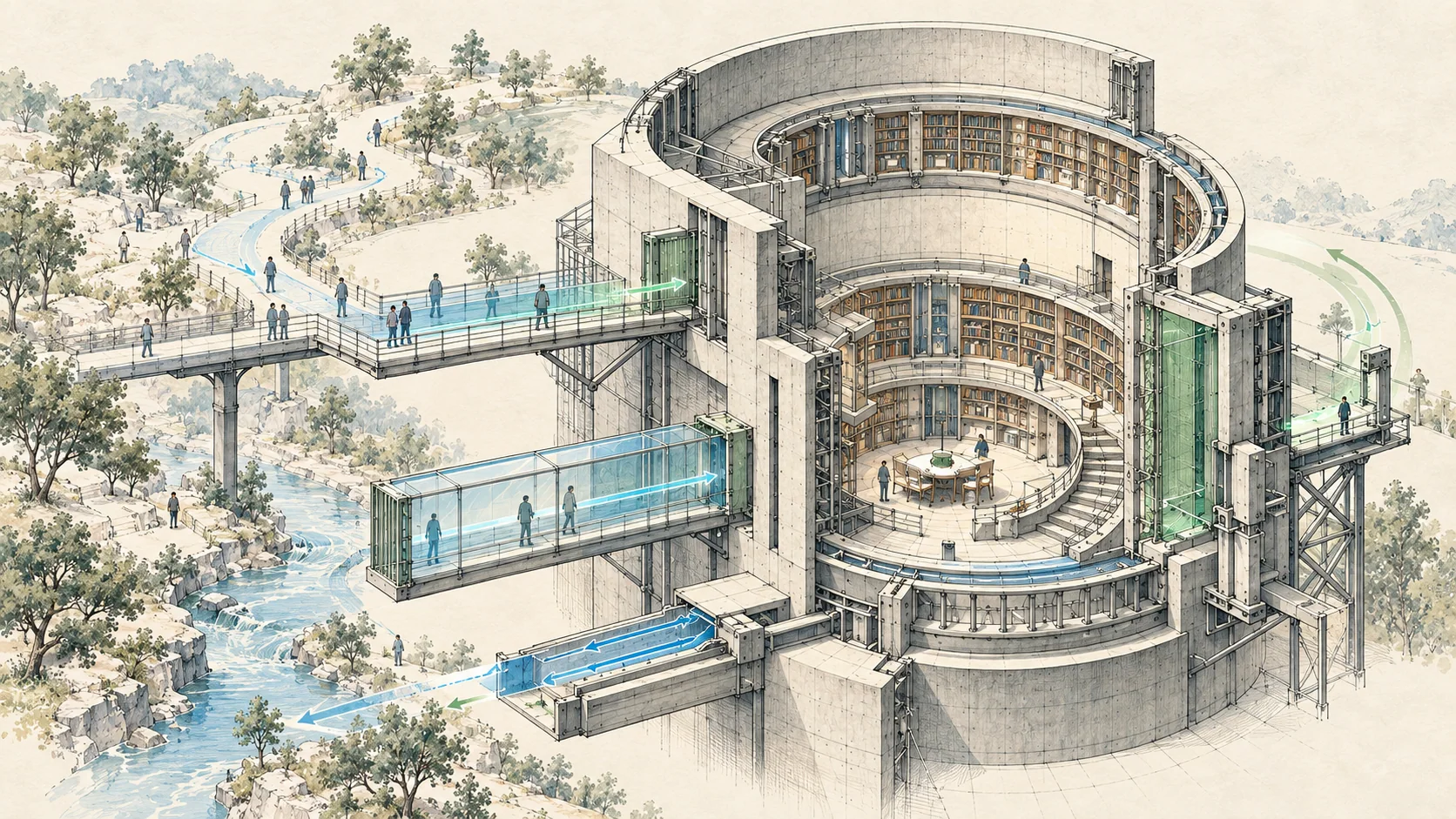
You've been largely defensive. You should not be confused with genetic covariance, a psychometric category, a social class, an institutional role, or a collective abstraction. Genes matter. Psychological regularities matter. Social knowledge, institutions, and technology matter. But none of them is you.
Lots get positive then. What is the positive claim?
You is where objective knowledge can become a problem, where a problem can produce a conjecture, where a conjecture can be criticized, and where criticism can make a different problem possible. The schematic is:
That doesn't sound hard. In fact, it sounds simplistic.
That's the problem with compressions: we're apt to lose the underlying explanation.
So what's hard about it?
The schematic is simple, the underlying epistemic schema is not. The schematic is useful because it describes the evolutionary logic of knowledge growth without pretending to explain its mechanism.
Like the familiar hard problem of consciousness, where describing neural and functional processes does not by itself explain qualia, this schematic leaves its own explanatory residue. We can name a creative problem, a creative tentative solution, a creative criticism, and the successor problem that results, but the letters conceal almost everything important about how those states are instantiated and how the transformations between them occur. We do not yet understand, even in general, how you come to have this problem rather than another, create this explanation rather than one already available, or produce the criticism that changes an evaluation of the problem itself.
The underlying schema is therefore closer to an evolutionary state machine: it identifies a system (not a sequence) of epistemic configurations whose operation can be reconstructed historically, while leaving the generative content of those states and transitions largely unexplained.
Call that epistemic mystery the Popperian heckle. Richard Dawkins invented the term to describe pedantic philosophical arguments that are advanced to conceal manifest truth. Here we take that criticism seriously.
You're being defensive again.
If that epistemic cycle is not merely something we use to describe science or culture, but something that also occurs within your epistemic mind, what does it say about you. The question is no longer only what goes wrong when you are reduced to a category.
What becomes possible when you are treated as an open-ended creator of knowledge?
That question leads to freedom, but not first to freedom as the absence of physical constraint, an exemption from causality, or a political doctrine. A more primitive possibility appears earlier: your present knowledge does not contain all the knowledge you may later create.
A problem can become visible that is not visible now. A criticism can destroy an explanation that presently feels obvious. A distinction can appear that changes what you think the problem was. A future self can understand something the present self cannot yet think.
Your Popperian heckle is much more powerful than your selfish genes. Most of it remains unexplained. Some of it hides from criticism behind authorities of observation and manifest truth. That is the nature of universal explanations. They collide, they make us uncomfortable, even confrontational. But they don't care what we believe.
Your future self is still physically constrained, historically situated, biologically instantiated, and immersed in inherited objective knowledge. But no present description of what you know can also contain the explanations you have not yet created.
1. The Open Future
It offers us a different way to reflect on two old problems: If people move uniquely through evolving problem situations, how might free will and consciousness appear inside that movement?
The answer remains conjectural, as always. But the conjecture may reveal how much of freedom is not choice among already known alternatives, and how much of consciousness may not be a common container holding different contents. The epistemic individual may be more individual than that.
The explanation of you first appeared as something that had to be protected from explanatory substitution. But you are not merely what remains after false abstractions are removed. You are generative. You can encounter knowledge that already exists and produce knowledge that does not. You can inherit a problem and reformulate it, inherit an explanation and reject it, or inherit a value, institution, or category and discover that the problem it once organized has changed.
None of this implies infallibility. You also create errors. You misunderstand, become dogmatic, and construct explanations that make your own problem space smaller. The optimism lies elsewhere: if an error can be created, it can also become a problem. The present state is not final.
This gives freedom an epistemic structure. Freedom is often discussed as permission: permission to speak, leave, associate, or choose. Those freedoms matter because they affect what you can do. They also affect what you can come to know.
Your future depends partly on whether present explanations can still become problems. If an explanation cannot be questioned, a problem cannot be reformulated, rival knowledge cannot be encountered, or an unusable environment cannot be left, some epistemic transitions become unavailable. The same is true when you cannot try something whose value no authority can presently recognize.
Freedom preserves the possibility of movement into epistemic states that cannot be specified completely from the present one.
This is broader than choosing from a menu. A menu contains known options. An epistemic future can contain alternatives that do not yet exist because criticism can change the problem itself. You may eventually reject every alternative you can presently name and create another.
Freedom is therefore not only a question of which available path may be chosen. It is also a question of whether the landscape of possible paths can continue to change.
That claim immediately creates a physical problem. The cycle
compresses relations in the growth of knowledge. It does not imply that the brain contains a problem compartment, a tentative-solution compartment, an error-elimination compartment, and a successor-problem compartment. The symbols describe what states are doing in an epistemic process; they do not identify the mechanism that does it.
But the relations cannot float outside reality. If your state functions as a problem, that state must be physically instantiated somehow. The same is true of conjecture, criticism, and the transition by which one problem gives way to another. The implementation may be distributed, partly inexplicit, different across people, and badly aligned with the conceptual boundaries imposed by our notation.
The epistemology therefore does not give us a cognitive mechanism. It gives us a constraint:
if epistemic transformations occur, physically possible processes must instantiate them.
The distinction matters because it lets epistemology generate questions about the mind without turning epistemic vocabulary into imaginary brain machinery.
Theory-laden observation gives one concrete clue about what such dependence can look like.
No jargon, please.
You do not first receive a neutral observation and only later attach an interpretation. What can be noticed already depends upon knowledge. A radiologist can see a structure in an image that another person cannot. A chess player sees a threat where a novice sees pieces. A mechanic hears a problem in an engine sound that another listener hears only as noise.
Abstract it.
The theory need not be an explicit sentence, and you may not know what objective knowledge is doing the work. The point is functional: prior knowledge changes what can become observable.
Now extend that structure cautiously. Let denote, not a bare observation, but a physically instantiated epistemic state organized by the person's existing knowledge. Then we can write:
The notation does not say that contains a little object called a problem. It says that this state functions as problematic for this person: something does not fit, attracts attention, or resists the current explanation. Likewise, is a state in which a conjectural relation has become available, and is a state in which criticism has changed what can be retained.
The arrows remain schematic, and they also contain unexplained content. They tell us that transformation occurs, not how it occurs. Something moves you from confusion into a problem, from a problem toward a conjecture, from a conjecture toward criticism, and from criticism toward another problem. Sometimes that movement is explicit. Often it is not. The arrows may point in many directions at once. A sentence can feel wrong before the criticism can be stated; a solution can appear before its ancestry can be reconstructed; a criticism that seemed weak yesterday can become decisive today.
We do not yet possess an explanation of those transitions. But the ignorance is now more precise. The problem is not to find an uncaused mental event. It is to explain physically instantiated transformations whose epistemic role cannot be read off from a description of the present state alone.
That physical problem gives us a different entry into free will.
2. Freedom Inside a Mind
The traditional question often asks whether you could have chosen otherwise under the same physical conditions. That problem can remain where it is. The narrower epistemic question is:
what might free will look like inside a mind whose activity includes movement through changing explanatory states?
Start with something ordinary. You can act in ways that change the conditions under which later thought occurs. You can redirect attention or ask a question, enter or leave an environment, consult an artifact, create one, or withhold one. These actions alter what you are likely to encounter next.
The plain relation comes first: you can change part of the environment that will later participate in changing you. Call that function Choice. The name does not refer to a proposed brain module or a little agent inside your mind. It compresses one relation: altering the epistemic conditions under which what happens next will occur.
An altered environment can change what becomes salient, which problem appears, which criticism becomes available, and which conjecture can be constructed. New knowledge can then alter later action.
Abstract it.
where is the person's epistemic environment, their knowledge, the actions that become available, and the wider physical environment. The changed world becomes part of the next epistemic environment, and the loop continues.
Under this conjecture, free will may concern a causal process in which newly created explanations become new causes of later action. The explanation was not present before it was created. Once it exists, it can change what you notice, criticize, attempt, avoid, build, or seek.
The conjecture can therefore be stated cautiously:
Free will may be the evolving organization of epistemic openness: your capacity to participate in transformations that alter the conditions of your own future knowing and acting.
This does not explain how explanatory novelty is produced. It changes the location of the problem. Instead of asking how freedom escapes causality or physical determinism, the inquiry asks how new knowledge can be physically created and then become causally relevant to what happens next.
Continuous evolving development makes the conjecture more individual. A capacity to alter epistemic conditions would not remain historically untouched, because every successful or failed attempt changes you before you attempt the next one.
People can therefore develop different architectures for performing related epistemic work. One person learns to decide by writing or speaking until a problem becomes explicit. Another builds rules or trained intuitions that reduce what must be reconsidered each time. Another learns to delay choice, seek disagreement, or interrupt the felt need to choose until the problem itself changes.
Abstract this choice architecture.
Call the developed form for individual :
The notation does not imply a discrete mechanism. It marks a possibility: the epistemic function may be shared while the developed architecture through which it is instantiated becomes highly individual.
This matters because the experience of choosing can vary. You may experience decision as forceful conscious authorship: I chose this. Training can change that experience. Meditation, for example, can make thoughts and intentions appear less like commands issued by an explicit chooser and more like events that become available to awareness. That phenomenological change does not by itself show that epistemic freedom has disappeared. The organization of choosing may have changed.
Injury can also alter forms of agency that had become central to one person's developed organization. Neurodiversity makes the observation universal. The point here is conceptual rather than clinical. Similar reports of choosing may arise from different evolved architectures, while different reports may arise from architectures performing related epistemic functions.
Free will, on this conjecture, would therefore not be one uniform inner object distributed across otherwise unique people. It would name related forms of epistemic movement whose mature organization becomes particular to a life.
That possibility creates the next problem. If choosing can become developmentally individual, perhaps conscious availability can too.
3. Consciousness and the Evolving Architecture
You embody and use far more knowledge than appears in your explicit consciousness. Biological knowledge, perceptual expectations, motor skills, language, memories, learned salience, emotional associations, habits, unfinished problems, and inexplicit criticisms can all affect what happens without first appearing as explicit objects of awareness.
Some of this becomes conscious. Much does not. Consciousness therefore cannot simply be identical to all the knowledge operating you.
The narrower epistemic question is:
what changes when some part of your larger epistemic organization becomes available in a form that can participate differently in criticism, comparison, communication, or reconstruction?
A pain can become a problem rather than only a disturbance. A memory can become something that is compared with evidence rather than merely something that biases action. An intention can become something that is inspected and criticized before it is acted upon. Inexplicit unease can become a sentence: something does not fit.
Perhaps consciousness includes transformations through which parts of a much larger epistemic organization become available for forms of error correction that would otherwise be unavailable. That is a conjecture about what conscious availability may do in the epistemic cycle.
Development now returns. Shared biological capacities do not imply identical mature or static epistemic organization. People acquire different languages and distinctions, practice different forms of attention, inherit different social explanations, and turn different skills into inexplicit competence. Those histories change what later becomes salient and what criticism can reach.
Why assume that conscious organization is exempt from that history or that the process ever stops?
Perhaps people do not merely have different contents inside one common conscious processor. Perhaps some of the organization through which content becomes consciously available also develops. One person may rely heavily on inner speech while another reports little of it. One may organize thought visually or spatially while another relies more on bodily salience or explicit conceptual chains. One may experience agency as a strong internal act while another experiences an intention as something that seems to arrive.
These differences support a narrower conjecture:
evolving consciousness may be a shared biological possibility expressed through individually developing epistemic architectures.
If so, the familiar hard problem remains. Nothing here explains why physical processes are accompanied by subjective experience at all. But another problem becomes visible beside it: Are you carrying the implicit assumption that the conscious organization whose subjectivity you are trying to explain is one uniform object across evolving persons?
The opacity of another mind may therefore arise not only because experience is private. It may also arise because the structures through which experience becomes epistemically available have been shaped by a history no other person shares. This does not solve the mystery. It makes one part of the mystery more local and more individual.
The free will and consciousness conjectures meet at one correction. Freedom cannot require complete conscious control over the causes of thought. You do not explicitly choose every problem that becomes interesting, command every useful memory to appear, or issue an internal instruction that generates each conjecture. You can know that something is wrong before knowing what, and the next thought can surprise you.
If freedom required a conscious executive directing every epistemically relevant transition, the epistemic mind would appear mostly unfree. But the conjecture developed here requires less: You can participate in changing the conditions of future thought without controlling every transformation that follows.
You can learn, externalize a problem, practice a skill, seek criticism, build a tool, alter a relationship, or change what you expose yourself to. Or you could choose not to. Each intervention modifies part of the environment in which later cognition occurs. The altered environment changes what you encounter; what you encounter changes what becomes salient; what becomes salient can change your next problem.
The mind changes the environment. The changed environment returns to the mind. You change.
Epistemic freedom may therefore operate recursively across explicit and inexplicit processes. You need not be transparent to yourself to remain the locus of epistemic development. Self-opacity and agency are not opposites.
That result is interesting because your environment is not made only of physical objects. It is already full of explanations created by other people.
4. When Social Knowledge Enters
You enter a world already filled with knowledge embodied in language, family explanations, institutions, media, laws, moral concepts, role descriptions, categories, and technologies. This is objective knowledge in the earlier sense: knowledge that can exist outside any one person's present awareness and be encountered, reconstructed, criticized, or reused.
You do not receive this knowledge as a neutral object. You reconstruct it through an existing epistemic organization. Once reconstructed, social knowledge can participate in your own problem situation. It can open problems, but it can also close them.
Consider explanations such as this is what I am, this failure reveals something permanent, or this problem has no alternative solution. Each can become internally causal without subsuming you. An inherited explanation can affect what you notice, which alternatives you consider, what criticism feels available, and which successor problems can even be formulated.
This gives social knowledge a concrete route into individual life. The damage need not be a mysterious social force acting from outside. An explanation enters your epistemic environment and reorganizes what movement appears possible from inside it. The same mechanism also explains how social knowledge can heal: a new explanation can reopen the landscape.
Consider someone who explains their situation this way:
I am defective because I lack conventional social success.
The explanation locates the problem in a fixed property of the person. It also constrains what can follow. If the cause is an essential defect, many possible next questions disappear before they are asked.
Now consider a different explanation:
I have not yet solved the problem of finding relationships in which the things that matter to me can be shared.
The outward condition may be identical. The epistemic condition is not. The second explanation creates different successor problems: where are such people, what forms of communication could make connection possible, which inherited expectations misdescribe the problem, and what kind of community might not yet exist?
A better explanation need not remove loneliness. It changes what loneliness can lead to. You occupy a different problem space because different successor problems have become available.
Objective social knowledge can enter your mind and alter the sequence of epistemic transitions that follows. You can inherit an explanation that closes movement. You can also encounter one that makes movement possible again.
Once freedom is conceptualized this way, flourishing need not produce greater psychological convergence. The opposite can occur because expanding objective knowledge gives people access to more specialized epistemic environments: unusual disciplines and technical subcultures, distant communities and languages, new artistic forms and explanatory traditions.
The reachable epistemic landscape becomes larger, but individuals need not distribute themselves through it in the same way. Greater opportunity can therefore generate greater divergence. You may become increasingly unlike the people nearest you in interests, knowledge, language, explanatory commitments, skills, and problems.
From the perspective of an aggregate, divergence may look like fragmentation. From your perspective, it may be flourishing. Divergence itself settles neither interpretation. You can diverge into error, isolation, dogma, or obsession.
The narrower claim is:
distance from the mean cannot tell us whether an epistemic trajectory is flourishing or failing.
That requires criticism of the trajectory itself. The same conclusion now reaches inward. If epistemic histories diverge, the architectures produced through those histories may diverge too. Different people may not merely think different things. They may differ in how problems become salient, how choice is organized, how criticism is experienced, and how parts of the mind become consciously available.
You become hardest to infer from the population precisely where your history has done the most work.
Divergence then creates a practical problem for anyone responsible for another person. A parent may watch a child enter technological environments the parent does not understand. The child develops interests, friendships, language, and problems that no longer overlap neatly with the parent's world. The uncertainty is real, and so is the loss of legibility.
The epistemic error begins when one explanation is substituted for another:
I no longer understand the child's world
becomes:
the child's world is harmful.
Sometimes it is harmful. Sometimes restriction is necessary. But unfamiliarity and harm are different claims. Restoring an environment the parent recognizes can restore parental legibility without necessarily improving the child's epistemic condition.
The same structure can appear in schools, workplaces, institutions, and governments. When another person's trajectory becomes difficult to interpret, control becomes attractive because control reduces variation. Reduced variation makes the system easier for the controller to see. That is an observable effect. It does not by itself tell us what happened to the controlled person's problem space.
Legibility and flourishing can therefore come apart. Once they do, the problem is no longer merely interpersonal. It becomes a problem about coordination, authority, and the preservation of criticism.
5. Freedom, Legibility, and Epistemic Closure
Authority can solve real coordination problems. It can act quickly, concentrate expertise, set standards, and prevent local actions from imposing unacceptable costs on others. Nothing in epistemology eliminates those functions.
The problem begins when responsibility for a problem is mistaken for possession of its uniquely correct solution. The epistemic cycle is:
An authority can instead produce:
The danger is not authority as such. It is closure. A problem definition becomes mandatory, alternative conjectures disappear, criticism becomes disobedience, and a successor problem is reinterpreted as refusal to accept the solution.
The immediate system may become easier to coordinate while becoming less able to discover errors in the explanation governing that coordination. Coordination and criticizability are therefore not opposites. A coordinated response can still preserve routes through which dissent, revision, exit, competing experiments, or replacement can occur.
It is not only whether anyone is in charge. It is whether the explanation governing the intervention can itself still become a problem.
Pressure sharpens the tension. The more serious a problem appears, the stronger the temptation to close the epistemic cycle. High stakes make variation look dangerous, delay irresponsible, and criticism obstructive. But urgency does not transform a tentative solution into infallible knowledge.
That creates an asymmetry between effects that exist after an intervention and alternatives prevented from existing. A restriction may reduce a measured exposure, a rule may increase compliance, or a ban may stop a particular action. Those effects can often be observed. The suppressed alternative is different.
If you are prevented from pursuing a problem, the conjecture you would have created does not exist. If an institution suppresses a criticism, the successor problem that criticism would have produced may never become visible. If a child is prevented from entering an unfamiliar domain, a later skill or relationship that might have emerged cannot appear in the data.
Compress it.
Coercion can produce:
The second term cannot be inventoried in advance because it refers partly to knowledge that was never created. That does not imply that every restriction is wrong or that emergencies require decentralization. Sometimes rapid coordination is indispensable.
The narrower point is epistemic:
severity increases the cost of error in the imposed solution as well as the cost of error in failing to act.
A system can therefore gain coordination while losing some of the mechanisms through which errors in that coordination would have been discovered. The loss is hardest to measure when the prevented future never becomes actual.
6. The Expanding Epistemic Environment
The same open-future argument applies to physical constraints. Matter, energy, time, and infrastructure are real. You cannot explain scarcity away. But the practical meaning of a physical constraint depends partly on knowledge.
Oil existed before people knew how to use it as an energy resource. Uranium existed before people knew how to release useful energy from it. Silicon existed before people knew how to build computational systems from it. In each case, the material world set constraints while knowledge changed which possibilities inside those constraints became reachable.
Abstractly:
The climate and energy demands associated with artificial intelligence provide an immediate example. AI infrastructure consumes real electricity and materials, creating real problems. But a description based only on current energy technology cannot contain every future way of responding to those problems. Compute demand can create pressure for better hardware and software efficiency, different cooling and storage, changes in generation and transmission, or technologies not yet available.
Innovation may fail, arrive too slowly, or create new problems. Nothing in epistemic openness guarantees rescue. The narrower claim is that the future resource landscape depends partly on explanations that do not yet exist. Present scarcity is evidence about present constraints. It is not a complete inventory of future practical possibility.
Artificial intelligence matters here for another reason. It can change not only the resources available to society, but the problems you can reach. You can use it to cross unfamiliar technical vocabularies, generate and test candidate models or code, and revisit bodies of objective knowledge at scales unavailable to unaided memory. You can use it to cross unfamiliar technical vocabularies, generate and test candidate models or code, and revisit bodies of objective knowledge at scales unavailable to unaided memory.
We're doing it now, for better or worse.
The relevant consequence here is immediate: the technology changes your epistemic environment.
You can reach problems you previously could not practically enter and encounter rival explanations faster. You can construct tentative solutions with tools you did not possess and expose a conjecture to forms of criticism that were previously too costly or inaccessible. That enlarged reach can produce error, but it can also expose error.
Abstract it.
The technology therefore enters the reciprocal process:
You remain the locus at which inherited knowledge becomes a live problem and at which a generated output is accepted, rejected, misunderstood, corrected, or transformed. AI changes the reachable landscape. It does not displace the epistemic mind.
This reciprocity prevents the argument from becoming individual against society. You do not create from nothing. You begin inside objective knowledge created by others: language, mathematics, crafts, moral vocabularies, scientific explanations, stories, legal concepts, technologies, and ways of naming experience.
You may suffer partly because the explanations available to you are poor. A new distinction can then reorganize the problem. A failure can become a learning problem rather than a verdict on worth. A relationship can become a coordination problem rather than proof of defect. A diagnosis can become one useful description rather than a complete identity.
The physical world may not change immediately. Your problem space does. That is one way social knowledge can heal.
The recursion moves outward.
Changed, you can criticize inherited knowledge and externalize something new: a distinction, tool, explanation, institution, method, or previously unformulated problem. Social knowledge can therefore be changed by precisely the kind of person that existing categories do not yet describe well.
The dissenter, eccentric, difficult student, lonely outsider, unconventional researcher, obsessive engineer, or misunderstood artist may ask why something has to be the way it is. Most such questions will not produce important objective knowledge by conventional measures. That does not negate the opportunity. An important criticism cannot always be identified before it is created.
You are therefore not outside social knowledge. You are a place where social knowledge can change.
This is also why more freedom need not make people more alike. More objective knowledge need not produce one common epistemic landscape. Better communication need not eliminate deep disagreement, and greater technological reach can increase differentiation.
You can find collaborators around an interest nobody nearby understands. A child can encounter a discipline unknown to the family. A researcher can combine fields whose institutional boundaries previously kept them apart. These developments can produce fragmentation, but they can also produce flourishing.
Uniformity can arise from shared good explanations or from restricted possibility. Divergence can arise from error or from expanded possibility. Neither convergence nor divergence therefore settles the epistemic question.
The trajectory has to be criticized at the level of the problems, explanations, errors, and consequences actually involved. No population metric can automatically tell us whether your epistemic path is flourishing merely because it is common or uncommon. Freedom preserves variation partly because future knowledge cannot be identified in advance by conformity to present knowledge.
That returns us to the boundary no abstraction can cross for us: another person.
7. Another Person
We cannot leave our own minds, directly occupy another person's epistemic state, or inspect their conscious organization from inside. We encounter speech, action, artifacts, silence, expression, and history. From that surface we construct an explanation.
Understanding another person is conjectural. The explanatory questions become concrete: what problem are they trying to solve? Which distinctions matter to them, and what history made those distinctions salient? What alternatives do they think are available? What knowledge or transition am I failing to see?
Then the other person can criticize our model.
No. That is not me.
An error becomes visible, and the model changes. That is progress. The goal is not fusion. Two minds do not need to become the same to understand one another better. The distance can remain while the bridge improves.
That distance can itself become epistemically useful. A person whose world overlaps heavily with ours may leave many of our assumptions invisible. A person who is very different can expose them. They may reject a distinction we never thought to question, notice a problem we cannot see, or misunderstand us in a way that reveals how poorly we explained ourselves.
Difference therefore has epistemic value even when agreement never arrives. It creates surprise, and surprise can create a problem. The stranger can reveal the invisible boundaries of our own landscape. Interpersonal distance is then more than a communication obstacle. It can become an engine of error discovery.
If choice and conscious availability are partly shaped by individual epistemic development, the distance may run deeper than disagreement over beliefs. People may differ in some of the structures through which salience, choosing, criticism, and conscious availability are organized.
That possibility weakens the assumption that your own internal form can serve as a universal template for another person. It also completes the initial movement of this series. You first had to be protected from explanatory substitution. You then became a positive epistemic object: a physically instantiated, socially embedded, historically developed locus at which inherited objective knowledge can become problematic and new knowledge can appear.
The same account that makes you generative also makes another individual difficult to compress.
Every person inherits different objective knowledge, encounters different problems, develops different inexplicit expectations, and follows different epistemic transitions. If evolving architectures of choice and conscious availability also become increasingly individual, the distance between minds may be much larger than ordinary social categories suggest.
There is one reality. But there may be billions of deeply path-dependent ways of experiencing and explaining it.
How can persons who share one reality come to inhabit epistemic worlds that are so profoundly different, and what does that imply about the abstractions through which each person experiences both reality and everyone else?