What Moves You
XX. Wealth In Equality
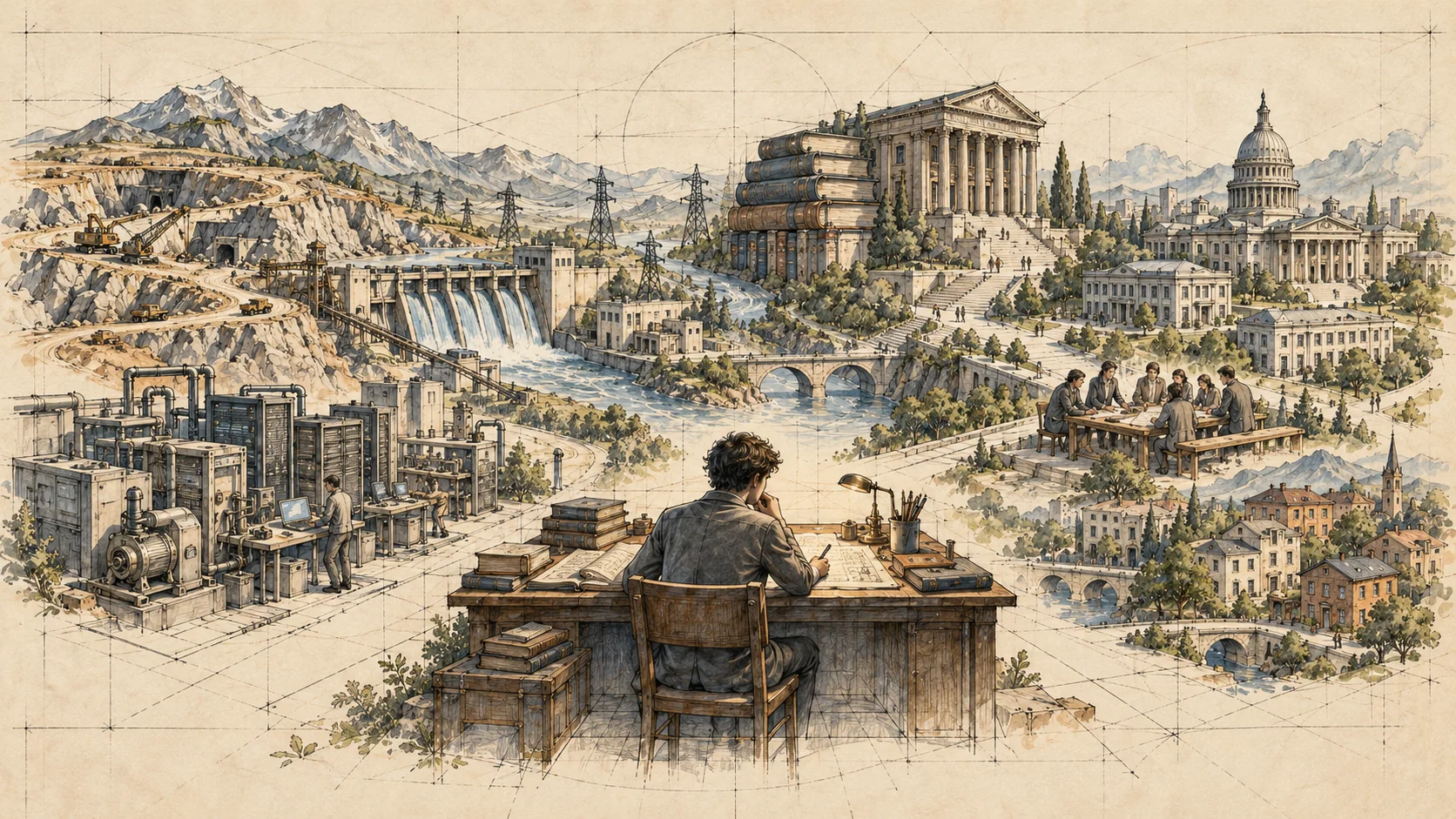
Whatever moves you epistemically, you are physically constrained. You need time, food, energy, shelter, tools, communication, objective knowledge, other people, institutions, technologies, and increasingly computation.
None of those things explain why this problem becomes alive for you, why that conjecture appears, or why a particular criticism suddenly reorganizes what you see. They do something else. They alter the space in which your epistemic movement can become consequential.
You may possess a beautiful explanation and lack the means to test it. You may notice an important problem and lack the time to remain with it. You may invent something and lack the means to build it. You may possess knowledge that nobody presently wants. You may live inside a society whose institutions cannot yet recognize what you have created.
You are therefore neither an economic object nor a disembodied universal intellect. You are physically finite and epistemically open.
Here we ask what resources mean under those conditions. A familiar meme seems to answer immediately:
knowledge is the ultimate resource.
Too fast.
Knowledge does not abolish matter, energy, or scarcity. A data center requires electricity. You require food. A semiconductor requires minerals, machinery, technical knowledge, logistics, and accumulated infrastructure. Artificial intelligence requires computers. Computers require energy. Energy requires physical systems through which knowledge can be embodied.
Knowledge is not an escape from physical reality. It changes which transformations of physical reality become possible. A material becomes a resource only relative to a problem and to the knowledge required to use it. That is the beginning of an economic explanation.
But economics will not explain the arrows. Markets, firms, patents, money, entrepreneurship, and artificial intelligence enter here as external structures through which you may acquire resources, coordinate action, expose conjectures to criticism, and preserve enough room to continue creating knowledge.
The deeper question remains with you: What conditions permit your epistemic mind to flourish?
1. The Space Around the Arrows
The word resource already risks misleading us because it invites a fuel metaphor. A fuel is consumed to produce a transformation. Coal is burned. Food is metabolized. Electrical energy is dissipated. From there it is easy to imagine that knowledge creation must have an equivalent internal fuel: attention, motivation, dopamine, curiosity, intelligence, energy.
But no such term presently explains epistemic motion. You can possess abundant food and produce no new explanation. You can have time and remain uninterested. You can be exhausted and suddenly discover a devastating criticism. A child can become absorbed in a problem every adult in the room considers trivial. A scientist can leave a difficult problem for weeks and return with an idea that did not exist before.
The physical system matters. The physical resource does not tell us why this problem became that conjecture.
So the first distinction is:
The narrower question is what external conditions enlarge or restrict the space in which you can epistemically move.
You may be a universal explainer without being a perpetual motion machine. Your explanatory reach may be open-ended. Your practical resources are not. So you rely on accumulated objective knowledge: language, mathematics, books, standards, software, legal structures, scientific theories, markets, technical systems, institutions, and other people.
This dependence does not diminish personhood. It is one of the conditions under which personhood becomes practically consequential.
The same epistemic capacity can inhabit radically different reachable worlds depending on the resources around it. With access to a library, you can pursue problems unavailable when books are denied to you. With access to computation, you can attempt transformations unavailable without it. With time, you can remain inside a problem that economic pressure would otherwise force you to abandon.
This does not mean wealth produces greater epistemic capacity.
It means:
Material inequality can therefore become epistemic inequality without implying any inequality in personhood.
Now look again at the word resource. Oil, uranium, silicon, sunlight, and water sound like resources in themselves. But the category is not contained in the material. A physical structure becomes a resource only relative to a transformation someone knows how to perform. Before the relevant knowledge exists, the same physical reality can remain economically inert.
Abstract it.
The structure is closer to:
The material was already there. The resource was not.
Knowledge can therefore change the resource map. A previously useless material can become valuable. A waste product can become an input. A scarce material can become replaceable. A dangerous process can become safer. An expensive process can become cheap. A local constraint can become technically irrelevant. Knowledge does not create matter from nothing. It creates new possibilities for transforming matter.
That gives the slogan its explanatory force:
knowledge is the ultimate resource.
But the slogan immediately recurses. Knowledge is itself physically instantiated. A book occupies matter. A server consumes energy. A scientist requires food. A laboratory requires equipment. A software system requires hardware. A language model requires processors, networking, storage, cooling, and power.
Abstract it again.
The structure is recursive:
The cycle is not free. It is physically instantiated. Several different external conditions have been compressed into the single word resource. Separating them makes the structure easier to see.
Physical resources are matter, energy, land, water, machinery, biological viability, and infrastructure.
Temporal resources are time, attention, persistence, and the opportunity to remain with a problem long enough for criticism and reconstruction to occur.
Objective epistemic resources are books, code, theories, procedures, institutions, standards, databases, tools, and technologies through which prior knowledge becomes available to you.
Coordination resources are money, contracts, markets, firms, patents, licensing systems, professional institutions, and other structures through which people gain access to scarce physical and epistemic resources.
The categories overlap. A patent is objective knowledge and a coordination mechanism. A data center is physical infrastructure embodying technological knowledge. Money can purchase time from other people. AI can provide access to objective knowledge while consuming physical resources and altering economic coordination.
The distinctions matter because no one category explains the others. And none explains their internal arrows.
2. Markets, Criticism, and Residue
Economics appears wherever finite people must allocate finite resources among competing problems. You can want to pursue many things. You cannot pursue all of them at once. You may choose one problem and abandon another. You may need income, childcare, equipment, collaborators, or a way to convince someone else that an objective artifact is worth exchanging scarce resources for.
Economic structures therefore matter to your epistemic life without defining epistemic value. The distinction is:
A mathematical insight may have no present buyer. A beautiful explanation may never become a company. A profitable product may contain little explanatory novelty. You may spend years pursuing a problem that produces no economic return. The market cannot tell you what you ought to find interesting. It cannot tell you which explanation is true. It cannot tell you which future problem will matter.
It can do something narrower: coordinate resources among people whose internal problem situations differ.
Entrepreneurship makes that relation unusually visible. An entrepreneur notices that something does not work. A process is too expensive. A tool is missing. A group of people cannot do something they want to do. An inconvenience everyone else tolerates becomes intolerable to one person.
Finding a good problem can itself be a creative achievement. Entrepreneurship makes the point materially concrete. The entrepreneur conjectures a tentative solution, builds something, and exposes it to other people. Their response creates criticism. The solution may be ignored, misunderstood, rejected, used unexpectedly, or valued for a feature the creator considered secondary. The problem may have been badly formulated. The product may work while the business fails. The market may exist but remain unreachable.
Product-market fit is interesting because it records a relation between an artifact and a market. It is not always progress. A successful product can be harmful. A bad explanation can be profitable. A good invention can arrive before its market. Market response is therefore one class of criticism, not the final epistemic tribunal.
But the entrepreneurial cycle leaves something behind. Code. Designs. Customer knowledge. Technical understanding. Distribution channels. Reputation. Processes. Contracts. Explanations. Even failure can become objective knowledge.
Abstract it.
The next entrepreneurial attempt need not begin from zero:
Knowledge can compound. This is why a small experiment can matter without containing the final answer. You can create an artifact, expose it to criticism, learn, revise, and try again. The eventual value may emerge from a sequence of individually modest changes.
Science, art, engineering, and personal knowledge can evolve through the same broad pattern. Entrepreneurship merely makes the resource loop especially visible because the artifact eventually encounters people willing or unwilling to surrender scarce resources for it.
The entrepreneurial case leaves one question unresolved: what does any of this mean for your problem?
3. The Problem You Actually Have
What is the deepest problem in your life? Do not answer quickly.
It may concern the health of someone you love, financial security, your children, a relationship, a scientific problem, a creative problem, a moral problem, or a problem you cannot yet name.
The answer is yours. No population category can provide it.
Now ask a second question:
Does the knowledge required to solve that problem already exist?
Sometimes it does. Often it does not. The eventual solution may depend on objective knowledge that nobody presently possesses.
That is the deepest problem of resources. It is not merely how existing resources are distributed. It is how the conditions are preserved under which knowledge that does not yet exist can be created.
This is where the earlier distinction between personhood and practical reach becomes personal. Someone outside a library, laboratory, network, market, institution, or computational system does not thereby become a lesser person. But the set of transformations they can presently attempt may shrink. That set is their practical repertoire of transformations. Call it their epistemic wealth.
Equal personhood does not imply equal epistemic wealth. External resources do not create your epistemic direction. They do not tell you which problem will become alive or which conjecture will occur to you. They determine something more limited and more concrete: how much of that direction can be made objective, criticized, built upon, exchanged, or carried into the world.
With that distinction in place, artificial intelligence becomes interesting for a reason more precise than intelligence in the abstract. It changes the cost of reaching beyond the resources already attached to you.
4. Artificial Intelligence and the Cost of Reach
Historically, turning one person's problem into an economically useful artifact often required many specialized people: software, design, writing, legal work, marketing, finance, operations, research, administration. The rare person capable of traversing many of these domains could sometimes act alone. Most could not.
Artificial intelligence changes this threshold. It does not create your problems. It does not supply your epistemic direction. It does not contain your individual problem situation. It changes the cost of crossing functional boundaries.
You can ask one interface to help draft code, explain an unfamiliar legal concept, compare technical approaches, criticize a design, structure a document, translate specialist language, investigate a market, or build a prototype. You can move among domains that once required separate institutional interfaces.
That recurring relation is what generalist interface names here: AI can connect one person to specialized objective knowledge and operations across domains. This does not abolish expertise. It lowers the cost of borrowing from it.
The economic implication is therefore not:
everyone can now become a genius.
It is narrower:
the minimum institutional scale required to attempt some problems has fallen.
Abstract it.
The structure can begin to look like:
where a similar attempt might previously have required:
What changed? Not your arrow, but the boundary around what you can attempt.
AI also makes access divisible in an unusual way. At the technical level, there are units inside a computational process. Call these units tokens. Tokens are not money. Economically, however, computational usage can be purchased in small increments. You can buy another increment of synthesis, drafting, code generation, explanation, comparison, or administrative assistance, then stop, return, and pursue a completely different problem.
General-purpose epistemic assistance has become metered. That is what metered epistemic capacity names here: not intelligence sold by the unit, but incremental access to transformations that can extend your practical reach.
The fit with a path-dependent epistemic life is unusual. Your internal movement can remain irregular. The external resource can follow. Then the physical bill arrives. None of this escapes physics.
Generative AI feels abstract because you interact with language. Behind the interface lie semiconductor fabrication, transmission lines, cooling, data centers, networks, capital, water, energy, maintenance, land, and supply chains.
The illusion of weightlessness knowledge is carried by material systems. Data centers expose that substrate. A community may want economic development and object to water consumption. A grid may not support projected demand. A company may seek dedicated generation. A cooling system may be criticized. A local government may demand concessions.
Each attempted solution can create a successor problem. New generation changes energy constraints. Water recycling changes water demands. Different cooling architectures change engineering tradeoffs. New siting decisions and contractual arrangements move rather than abolish criticism. The physical constraint does not disprove the knowledge economy. It generates its next problem.
Institutions do the same kind of work at a different level. Civilization contains accumulated knowledge not only in machines but in contract law, corporations, courts, licensing, insurance, standards, markets, property systems, and patent offices. These structures are imperfect, but they preserve attempted solutions to recurring coordination problems.
Technological change therefore need not imply institutional replacement. An institution can encounter a new problem. Its current solution can fail. The failure can become visible. A modification can be attempted. The new result can be criticized. The institution survives not because it is sacred but because useful structures need not be discarded merely because one application becomes obsolete.
Patents make the point concrete. The historical bargain is epistemic. The inventor discloses the invention. In exchange, the institution grants a time-limited exclusive right:
The monopoly eventually ends. The disclosure remains. The arrangement can be criticized in many ways. Exclusive rights can obstruct use, be accumulated strategically, be asserted by entities remote from the invention, impose litigation costs, or become tools of coercion.
Those criticisms do not remove the coordination problem the patent system attempts to solve. If inventive knowledge can be copied cheaply, the creator may lose the ability to capture enough economic value to continue developing it. The patent bargain is one tentative solution. Its epistemic interest lies in trying to align disclosure, temporary control, public accessibility, and eventual unrestricted use.
AI can alter the process on both sides. Applicants can search, draft, compare, and criticize more cheaply. Examiners can search prior art and evaluate claims with stronger computational assistance. That does not imply better patents. It can enlarge the explanatory surface: more of the reasoning on either side can become explicit and therefore available to criticism.
The point is broader than patents. AI does not need to abolish institutions to change the conditions under which they process objective knowledge.
The patent case returns us to the resource problem. Epistemic wealth determines which physical transformations are available. A society that knows how to produce semiconductors can perform transformations unavailable to one that does not. If you know how to build a functioning product, possibilities are available to you that are unavailable when that knowledge is absent. A patent can convert some of that possibility into bargaining power. A company can convert it into organized production. A market can convert it into exchange.
Economic inequality and epistemic access can therefore interact strongly. If powerful AI systems exist but access becomes concentrated among governments, incumbent firms, or wealthy institutions, the resulting distribution is not merely a distribution of software. It is a distribution of reachable transformations. A person outside the boundary retains equal personhood. Their practical repertoire is still smaller.
Once resources are conceived this way, restriction acquires an additional epistemic consequence. It does not only prevent uses already visible. It can prevent problem trajectories from beginning.
5. What Restriction Removes
Suppose AI has become useful enough and authorities decide to keep what exists while stopping further development.
The proposal can sound moderate. But moderation is not an epistemic criterion. Two fallible explanations do not produce a better explanation merely by meeting in the middle. Call it the fallacy of compromise.
Abstract it:
Given two candidate explanations
There exists no transformation function called that results in a new explanation:
The transformed explanation remains a creative and conjectural operation across the two parties. Compromise may serve political functions. It can preserve peace, permit incremental change, reduce transition costs, and coordinate people who disagree. Those functions are different from error elimination.
A capability freeze therefore requires its own explanation. Why should the present state of knowledge possess jurisdiction over future knowledge? Why is today's capability permitted while tomorrow's is prohibited? Who retains access to the systems that already exist? A freeze imposed after powerful AI already exists may entrench actors that already possess models, infrastructure, capital, and regulatory access. The result could be less decentralization rather than more.
Calling the proposal a compromise does not answer that problem. The same problem appears when the causal direction is reversed.
The precautionary principle is meant to avoid harm. As an epistemic structure, however, it can foreground the harms of acting while leaving the harms of not acting less visible.
Abstract it.
Abstention changes the future:
But also:
The second branch is important. A restriction can prevent known uses, but when future knowledge is open it can also prevent unknown problem trajectories. The knowledge that would have emerged cannot be inventoried in advance because it does not yet exist.
That makes the opportunity cost difficult to represent. The precautionary principle can then become self-protecting:
if the future is uncertain, restrict the technology.
But the same uncertainty applies to the consequences of restriction. Precaution can be a useful tentative solution to a particular threat. The epistemic error begins when uncertainty itself is treated as a reason to close the process that might create the missing knowledge.
Nuclear energy makes the asymmetry concrete. Imagine not the reactors that were built but the path that might have followed much earlier and much broader deployment of clean nuclear power.
The counterfactual cannot be reconstructed. A different energy economy would have changed fossil fuel demand, grid architecture, industrial investment, pollution, research priorities, engineering experience, geopolitics, and the later climate problem. Perhaps safety problems would have appeared that never occurred in our history. Perhaps reactor technologies would have evolved much further. Perhaps different institutional failures would have emerged.
We do not know. That is the point. The opportunity cost of a suppressed technological trajectory is not a number waiting to be calculated. It includes a missing history of knowledge creation. The visible accident has a date. The foregone invention does not. The victim of an actual technology can often be named. The person who would have lived because an uncreated technology solved an unanticipated future problem cannot.
This asymmetry gives visible harms a psychological advantage over missing possibilities. It does not make restriction neutral.
The same structure applies more directly and immediately to artificial intelligence. No prediction about what AI will discover is required. There is no need to claim that it will cure cancer, forecast economic abundance, or assign probabilities to unknown future industries.
A simpler claim is enough. People already pursue some problems differently with AI than without it. They can traverse domains more quickly, prototype more cheaply, interrogate objective knowledge interactively, and write, code, compare, simulate, or criticize through a general interface. Remove the interface and those pathways disappear.
What knowledge would have emerged from them cannot be known. But the missing pathways are real in the narrower sense that the resource enabling them has been removed. A world without that resource would not pursue the same set of individual problem situations in the same way.
Now recall your deepest problem. 8-billion deepest problems is catastrophic, right now.
That is not prophecy. It follows from changing the external conditions under which people can act. None of this implies that every person should use AI, or that every use is beneficial.
The next problem is direction: who owns your arrow?
6. The Tool Does Not Own Your Arrow
Children make the problem unusually clear. A child begins inside an inherited world of objective knowledge: books, rules, language, stories, screens, games, schools, tools. The adult sees the medium. The child inhabits the problem. From the outside, the visible object is easy to classify: a book, a calculator, a computer, a network, an AI system. What the child is actually doing with it can be much harder to see.
That is why restrictions are epistemically ambiguous. A restriction may remove distraction. It may also remove the problem space through which the child's knowledge is developing. The adult often cannot know which in advance.
No technology is automatically beneficial. A screen can harm. A book can mislead. A network can expose a child to danger. An AI can generalize badly.
The claim is narrower: the authority cannot infer the child's epistemic content from the visible medium alone. The child's epistemic mind is individual, path-dependent, largely inexplicit, and open. The authority sees fragments.
Artificial intelligence creates a related danger precisely because it is so general. The same interface can follow you across many domains. That can enlarge your reach. It can also import population-scale regularity back into your individual problem.
The model has encountered enormous bodies of social objective knowledge. It is therefore unusually capable of producing familiar explanations, conventional classifications, common framings, average language, and expected solutions.
Abstract it.
The failure mode can be written compactly:
So the human-AI dyad is not automatically liberating. Its epistemic value depends partly on direction:
is not the same structure as:
The distinction becomes real when you reject an answer, reformulate the problem, abandon the tool, ignore the recommendation, or pursue something strange. Those acts keep explanatory direction with you. AI can expand the explanatory surface. It does not get to own the arrow.
Now the adoption question changes. The argument is not everyone should use AI. That would replace one authority with another. You may refuse any tool for practical, moral, aesthetic, intellectual, or personal reasons. Freedom includes abstinence.
But abstinence is not consequence-free. Human personhood has long extended through objective knowledge. Writing extends memory. Mathematics extends working cognition. Books extend encounter. Telescopes extend perception. Computers extend calculation. Networks extend communication. Search extends retrieval.
Your epistemic mind has never been reducible to the unaided biological brain. Refusing an external tool therefore does not preserve an epistemically pure baseline. AI is striking because its generality makes the extension broader: it can become an interface to many forms of objective knowledge at once.
That does not make non-users lesser persons. It means only that the surrounding world may increasingly contain transformations more easily reached by people who possess and can operate through the new interface.
Equal personhood still does not imply equal epistemic wealth. The problem of wealth inequality sits uncomfortably with AI abstinence.
That problem becomes sharper as civilization itself becomes more abstract.
7. Operating Through Abstraction
The device can be present while the usable resource is still missing. Someone may own a computer and still be unable to recover an account, install software, configure a router, navigate a digital form, understand cloud storage, distinguish a browser from a search engine, set up authentication, or interpret an unfamiliar interface.
What is missing is not hardware alone. It is explanatory fluency: enough understanding of the surrounding abstractions to operate through them.
Modern life increasingly consists of abstraction layers inherited rather than reconstructed. You can use a payment network without understanding banking infrastructure, cloud software without understanding distributed systems, navigation without understanding satellite timing, or an AI system without understanding transformers. Reality becomes more abstract.
Technological inequality therefore increasingly concerns the ability to operate through abstraction, not merely access to technology.
Historically, younger generations have often helped older people cross new technical interfaces. Children learned the computer. Parents asked for help. Young people adopted networked communication earlier. Later generations inherited the abstractions as normal.
AI may complicate that pattern. Some young people may choose not to use it. Some may encounter AI mainly through social objective knowledge describing cheating, job loss, dehumanization, environmental cost, homogenization, or existential danger. Some may form an identity around AI abstinence.
If that happens at meaningful scale, the familiar adaptation mechanism weakens. If AI becomes a common interface to increasingly abstract technical and institutional worlds, deliberate non-use can produce a capability gap inside the incoming generation itself.
Whether that gap becomes socially severe is unknown. The possible intergenerational reversal is narrower than a prediction: the younger generation may no longer function as the bridge into the next abstraction layer.
Why does that possibility matter here? Because it exposes the larger trajectory underneath it.
Abstract it.
Civilization accumulates objective knowledge. That knowledge becomes technology. Later people inherit the technology without reconstructing all the knowledge inside it. The next generation builds on top of that layer, and then another:
Ordinary life therefore becomes progressively mediated by objective structures no individual fully understands.
This is not necessarily a defect. Abstraction is part of how civilization progresses. You do not need to understand transistor physics to write a novel on a laptop or packet routing to talk to a friend overseas.
But the same abstraction that enlarges reach also creates dependence. You may need to trust interfaces you cannot reconstruct. Institutions may operate systems nobody fully sees. Errors can propagate through layers. Eventually, the explanatory complexity of the world can exceed what unaided individuals can practically navigate.
AI sits on both sides of that problem. It is another abstraction layer. And it may become one of the principal tools through which you navigate the layers beneath it. The resource that enlarges your practical repertoire, your wealth, may therefore also increase your dependence on an interface whose underlying causal structure you cannot explicitly carry.
That tension returns us to the original question.
8. The Resource We Cannot Inventory
Knowledge has one further property: it cannot be inventoried. We do not know who will create it, which present problem will lead to it, or what criticism will make it possible. We do not know whether it will begin in a laboratory, a company, a school, a studio, a bedroom, a workshop, or in a conversation between one person and an artificial system.
That uncertainty does not make resources irrelevant. It makes their role more precise.
Freedom matters materially because different people need room to pursue problem situations that cannot be specified in advance. Institutions matter because they preserve and coordinate objective knowledge across people and time. Physical, temporal, epistemic, and coordination resources matter because they enlarge or restrict what can be attempted.
None of them tells the arrows where to go. A book cannot determine what problem you will discover. A market cannot determine what invention an entrepreneur will imagine. A patent system cannot determine what will be invented. An AI cannot determine which region of your epistemic mind will suddenly become alive without beginning to replace your own epistemic direction.
The mystery remains where it began. We still do not know what moves the arrows from problem to conjecture, from criticism to reconstruction, or from one problem world into another.
But the surrounding structure is now clearer. Resources do not explain epistemic motion. They change the reachable space in which that motion can become objective knowledge.
And once civilization accumulates enough objective knowledge, that reachable space acquires a new problem of its own.
The external world is becoming more abstract more quickly than any individual can reconstruct it. If objective knowledge continues to accumulate through technology, institutions, automation, and artificial intelligence, then you may increasingly depend on interfaces to navigate a world whose causal structures you cannot carry.
Resources change how far your arrows can reach. Objective knowledge can become technology, institutions, and systems whose effects extend far beyond the person who created the explanation.
But greater reach does not eliminate fallibility. An explanation can remain wrong while the system embodying it becomes faster, larger, and harder for any individual to reconstruct.
What happens when the technologies that extend our capacity to create knowledge also extend the consequences of error beyond our capacity to correct it?