
The Unfinished Explainer
XIII. Gut Your Trust
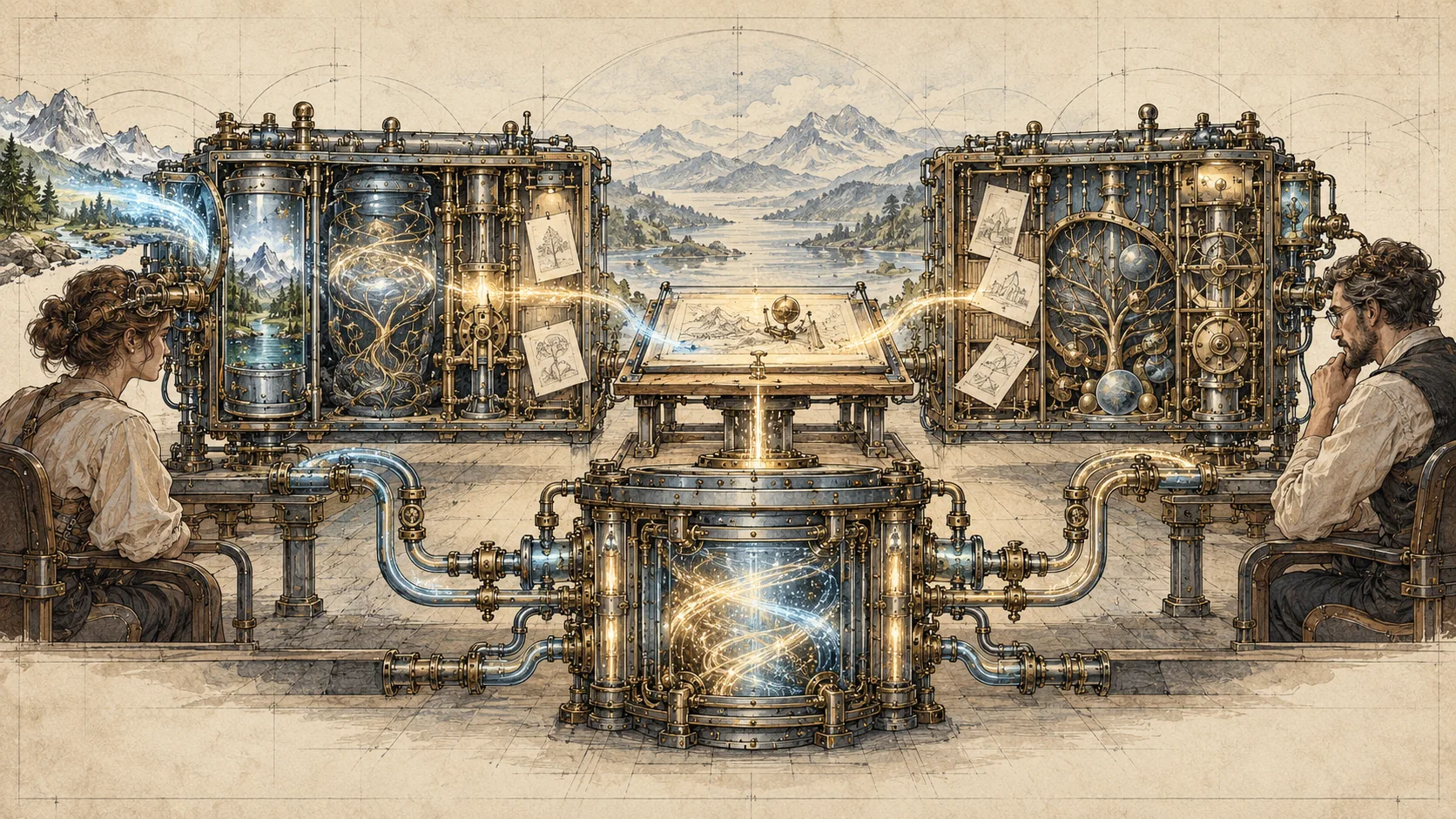
We treat explanations as structures that can be compressed, transmitted, defended, criticized, preserved, and reopened. We distinguish explanations from models, models from experiments, and observations from the theories in which they acquire meaning. We argue that artificial intelligence can sometimes help you preserve more of an explanatory surface than unaided biological memory can comfortably carry.
But all of that assumed that the relevant knowledge had become explicit enough to appear on a surface at all. Much of what guides you never does.
A scientist may know that something is wrong before they can say what is wrong. A musician may hear that a phrase needs to move before they can explain why. A child may stop touching a hot stove long before they possess a theory of heat transfer. You may dislike a room, trust a stranger, avoid a street, return to a melody, or feel that a life decision is wrong without possessing an articulate explanation.
Something changed. Something was learned. But the knowledge is not yet explicit.
That suggests the next problem:
How much of your epistemic life exists before you can say it?
And behind it sits a stranger one:
What if the machinery carrying that inexplicit knowledge differs radically from one person to another?
You are inhabiting a unique, path-dependent epistemic mind. The next step is not merely that people believe different things. The machinery through which knowledge becomes available may differ too. Memory may or may not arrive as imagery. Thought may or may not be accompanied by inner speech. Sensory experience may be recalled through different forms, leaving different internal resources available for manipulating what you know.
The visible person gives you almost no direct access to this machinery. Similar behavior invites an inference of similar inner architecture. That inference can be profoundly wrong.
1. Before Knowledge Becomes Explicit
Start with the physical world.
There is one physical reality, and you are part of it. Explanations are attempts to describe structures within that reality. Physics gives us unusually rigorous examples: relativity, quantum theory, mathematical models that make parts of explanations explicit, experiments designed to expose implications to criticism, and observations produced under carefully constructed conditions.
Abstract it.
A simplified picture looks like this:
where is physical reality, is explanation, is model, is experiment, and is observation.
Something important is missing.
The next explanation does not follow mechanically from the observation. A scientist notices that an anomaly matters. They feel that one interpretation is strained. They wonder whether two successful theories conceal a deeper contradiction. They imagine a critical experiment that no textbook yet contains.
Much of this may begin before the problem is articulate. A scientist may spend months with little more than:
something here does not fit.
That is not yet a theory. It may not even be a fully formed problem. But it is already affecting attention, salience, and what can no longer be ignored. The problem is epistemically alive before it can be stated.
Put the scientist back into the picture:
Between observation and the next explicit explanation lies a living epistemic person.
The phrase inexplicit knowledge can sound mysterious. It need not. An animal learns a route to food. A child learns the timing of conversation before they can explain conversational timing. A pianist learns how much pressure a key requires without calculating force. A driver learns how close another car feels without being able to specify the geometry.
In each case, behavior changes in a way that reflects accumulated encounter with reality. The knowledge improves without first becoming a proposition.
So the conjecture
knowledge must become explicit in order to improve
fails.
The simpler structure is:
No explicit statement need intervene. Organisms were learning long before any organism could state an explanation.
Then why does explicit knowledge matter?
Because once something becomes explicit, you can inspect it, state it, criticize it, compare it, teach it, write it, model it, preserve it, recombine it, and externalize it. So can other people.
An animal may learn a route. You can say:
the lower trail floods after rain, so take the ridge.
Now the knowledge can leave the original learner. Someone else can criticize it. A map can modify it. Weather data can refine it. A future traveler can benefit without repeating the original experience.
Explicit knowledge does not create epistemic life. It changes the architecture and rate of possible criticism.
That difference matters because inexplicit knowledge is not merely explicit knowledge with the words missing. What is inexplicit may be a tension, a skill, a discrimination, a learned expectation, a pattern of salience, or a felt incompatibility. When language appears, it may create a new representation rather than transcribe a proposition that was already waiting intact inside you.
Call the process of making previously inaccessible knowledge explicit, explicitation. It is a creative act. You conjecture an explicit representation of something that was only partly available. The representation can be wrong. Once it exists on a surface, it can also be criticized.
That gives us the first bridge into the hidden world: knowledge can change before you can say what changed, and saying it does not merely reveal the old knowledge. It creates a new object on which criticism can operate.
2. Different Machinery, Similar Competence
Now keep the competence in view and vary the machinery.
Most of us carry an assumption we rarely state:
other minds probably work more or less like mine.
We know that people differ in memory, personality, interests, and skill. We may imagine some as more visual, some more verbal, some more emotional, some more analytical. Yet the underlying cognitive machinery still feels broadly shared.
A simple question destabilizes that assumption:
What happens inside your mind when you remember your childhood bedroom?
Do you see it? Do you know it without seeing it? Do you hear anything? Do you feel its spatial layout? Do you narrate the memory to yourself? Does the scene arrive from your own point of view, from outside, as a fact, as a feeling, or as a sequence of words?
There may be no single answer that represents the human norm.
Consider someone who cannot voluntarily visualize. Not dim imagery. None.
Ask them to picture an apple. There is no apple. Ask them to picture their mother's face. Nothing appears. Ask them to imagine walking through their childhood home. There is no internally projected scene.
If you possess ordinary or vivid imagery, this can be difficult to conceive. How can someone remember a face without seeing it? How can someone navigate without a map in the mind? How can someone rotate an object mentally if there is no object to rotate?
Yet people with aphantasia can navigate, recognize, reason spatially, remember, create, program, design, and plan. The outward deficit you might expect is often absent.
The relation that survives the case is simple:
the knowledge was never identical to the internal image.
Someone can know what something looks like without consciously seeing it. They can solve spatial problems without consciously manipulating perceptual objects. The internal format differs. The competence can remain.
The surprise runs both ways. Someone with lifelong aphantasia may assume that picture this or see it in your mind's eye is metaphorical. Then they discover that other people really do generate visual imagery, sometimes voluntarily and sometimes involuntarily. Some can also re-create sounds, voices, music, textures, smells, bodily sensations, and spatial scenes.
The person without imagery discovers that others may literally be doing something they had assumed nobody did. The visualizer discovers that a person can think and remember without machinery they had assumed was necessary.
Private phenomenology had been mistaken for universal architecture.
The contrast creates a conjecture. If conscious imagery is unavailable, does repeated reliance on semantic, symbolic, or relational structures make some forms of abstraction especially natural? Computer science offers an interesting case because programming often concerns invisible structures: relations, transformations, nested abstractions, formal constraints, and symbolic representations.
Perhaps some aphants become unusually comfortable there because they have long practiced cognition without conscious visual objects. Perhaps not. Nothing here establishes a category such as aphants are abstract thinkers.
What survives criticism is narrower:
different internal machinery may create different cognitive affordances.
Move to the opposite pole. Imagine someone who can revisit previous sensory experience with extraordinary vividness. A childhood kitchen returns with the angle of afternoon light, the pattern on the floor, a voice from years ago, rain against a window, perhaps even the smell of the room and the bodily feeling of being there.
The obvious description is an extraordinary virtual-reality generator. The deeper move is to turn that description around. You already inhabit one.
This is not an analogy. Your nervous system is physically embedded in reality and interacts causally with it, but conscious experience is an internally constructed representation generated through those interactions. There is no second channel through which reality arrives in consciousness unrepresented.
You do not experience photons. You experience color. You do not experience molecular vibration. You experience sound. You do not experience neural firing. You experience distance, movement, warmth, texture, and significance.
Abstract it:
where is one physical reality, is embodied sensory interaction, and is the experienced world constructed in person .
The word virtual does not mean unreal. The representation is physically real. The person is physically real. The experience is physically real. But the experienced world is not an unmediated copy of external reality. It is a constructed interface with it.
Hyperphantasia makes this interface harder to ignore. If someone can return to a remembered moment with unusual intensity, a new set of questions becomes available. Does vividness give previous problem situations a stronger pull? Does sensory-rich memory feel more trustworthy merely because it is vivid? Can emotional events remain phenomenologically present long after their practical relevance has changed? Can rich imagery make internally generated material unusually available for artistic work?
These remain conjectural affordances, not destinies. One distinction is already secure:
A rich internal representation can still be mistaken, reconstructive, selective, or emotionally weighted. The spectacular quality of recall does not make it reality.
Now change another variable. Imagine someone whose memory and sensory recall seem broadly ordinary. They can visualize, remember, hear, and reason, but there is no continuous inner narrator: no voice explaining the day, no verbal stream announcing thoughts as they occur.
If you possess persistent inner speech, this can be as difficult to imagine as aphantasia is to a vivid visualizer. What happens when they decide? How do they know what they think? How do they plan, argue with themselves, or reflect?
Abstract it.
The erroneous identification is:
The case breaks it. Thinking can occur without continuous verbal narration. A linguistic report may come later. A conclusion may become explicit only when communication requires it.
That creates another conjecture. If cognition is not continuously serialized into words, might some relations be held more holistically? Might a conclusion emerge before the verbal chain that explains it? Might language function more as output than as continuous internal workspace?
Possibly. Nothing here establishes an advantage. The explanatory gain is different:
the form in which thinking appears to consciousness is not identical to thinking itself.
These cases do not establish three cognitive types. They expose dimensions that can vary independently: sensory imagery, memory re-experiencing, and inner verbal narration. Many other dimensions may vary too.
Can you hear music internally? Imagine smell? Summon bodily sensation? Do you remember autobiographical events as scenes or facts? Do thoughts arrive spatially? Do you rehearse conversations? Do you experience memory from the first-person perspective or as an observer? Can you manipulate shapes without imagery? Do you need time before a thought becomes verbal? How much of your own problem situation is available to introspection at any moment?
The list is not the map. It is enough to show that the space is much larger than the familiar categories suggest.
3. Turn the Cases Back on Yourself
The cases become epistemically important only when they alter what you can infer about yourself.
You already know that your beliefs and memories differ from those of other people. The stronger claim is that the machinery through which your knowledge becomes available may also differ. The forms in which you remember, imagine, rehearse, discriminate, and explicate may be partly hidden even from you, because you have no independent view from outside your own implementation.
At first, your own mind feels normal. Then some people appear unusual. Then several dimensions begin to vary independently. Then those dimensions combine. Eventually the more plausible picture is that each person may instantiate an effectively singular cognitive configuration.
The movement resembles the expansion of a cosmos. Earth once seemed central because it was the standpoint from which the sky was seen. Your own phenomenology can feel central for the same reason: it is the standpoint from which every other mind is interpreted.
Once that assumption breaks, familiar surface categories become less explanatory. Someone needs long periods of rumination, and we call them slow. Someone seems emotionally distant, and we call them detached. Someone repeatedly revisits the past, and we call them obsessive. Someone prefers abstraction, and we call them analytical. Someone rarely narrates their inner life, and we call them unreflective.
Those descriptions may capture behavior. They do not yet tell us what form knowledge takes inside the person.
The explanatory question is causal:
what hidden epistemic architecture could make this pattern of behavior intelligible?
That question reaches your own life as directly as it reaches your interpretation of others. Different forms of inexplicit knowledge may alter which problems become salient to you and which representations feel natural. They may affect what is easy to manipulate, what becomes exhausting, what attracts prolonged attention, which experiences remain accessible, and which past situations remain active.
Abstract it.
A possible structure is:
Your hidden epistemic machinery shapes the field of problems that becomes available to you. That problem field shapes interest. Interest shapes action. Action changes the knowledge.
This does not explain why one person cares intensely about abstraction while another requires concrete sensory contact. It does not explain why one needs long periods alone before deciding while another thinks most clearly in rapid conversation. Nor does it explain why one seems unable to release the past while another appears almost discontinuous with previous experience.
But the failure matters. That is simply their personality had looked like an answer. Once hidden epistemic machinery becomes visible, it becomes a placeholder for a better problem.
For another person, the question becomes:
what hidden epistemic architecture makes this problem alive for them?
For you:
what hidden epistemic architecture makes this problem alive for me?
The same change in resolution alters introspection. Instead of asking only what you believe, you can ask what happens when you remember, when you plan, when a thought becomes verbal, when a problem becomes tractable, or when an old situation becomes present again.
Do you see anything? Do words appear? Does the thought arrive whole? Do you need time before you can say what you know? Does the memory feel present? What makes one problem easy to inhabit and another exhausting?
These questions are not diagnostic. They expose a variable that surface categories conceal: the form in which knowledge is available to a particular person.
Keep that variable separate from competence. Aphantasia does not imply poor spatial reasoning. No inner monologue does not imply weak self-reflection. Vivid imagery does not imply superior memory. Different implementations can produce similar outward competence. Variation in mechanism does not establish variation in epistemic kind.
Now the claim that a universe exists inside every person becomes less metaphorical. You may carry mathematics, music, family history, political theory, private humor, moral conflict, professional knowledge, imagined futures, and unsolved problems. But those worlds may not even be instantiated through the same phenomenological machinery from one person to another. The differences are not only semantic. They may be experiential, representational, temporal, sensory, and linguistic.
The visible person is therefore a narrow interface. You see behavior. You hear words. You observe choices. From those outputs, you infer an epistemic mind vastly larger than what the surface contains. The category may describe the interface. It does not explain the universe behind it.
That creates a tension. If the internal machinery can differ this much, what remains common enough for people to understand one another at all?
4. Communication Without Sameness
The first observation is easy to miss: people still communicate.
A person with no visual imagery can collaborate with a vivid visualizer. A highly verbal thinker can work with someone with no continuous inner monologue. A person with weak autobiographical re-experiencing can love someone whose memories remain intensely sensory. Across these differences, people still teach, negotiate, design, build, make music, raise children, run institutions, write science, argue, cooperate, and coordinate across continents.
The diversity does not make this less remarkable. It makes the mechanism more interesting.
Earlier we treated communication as reconstruction rather than mental-state transfer. One mind does not copy another. Instead:
where is an objective expression and is the recipient's reconstruction.
Hidden cognitive diversity sharpens the claim. The reconstruction may differ not only in content but in representational basis. A visual thinker may express an idea in words; a non-visual thinker may reconstruct the same relation semantically. Someone with inner speech may receive a diagram; someone without inner speech may convert it into a nonverbal relational structure.
Communication succeeds without internal sameness. The requirement is not identical representation. It is enough shared explanatory structure for the problem at hand.
Now look at the medium. A sentence is thin. A diagram is thin. A musical score is thin. A photograph is thin. A mathematical expression is thin. None contains the full internal world of the person who produced it. Yet another mind can reconstruct extraordinary richness from these narrow channels. The medium is impoverished relative to the mind. The recipient supplies the rest.
This reverses the usual complaint about the signal. Human communication works not because the signal contains everything, but because the receiver can create explanatory structure from what the signal makes available. The receiver is a universal explainer.
Objective knowledge now returns with sharper boundaries. Speech, writing, drawing, notation, maps, photography, recording, film, and software are translation interfaces between private epistemic worlds. Each creates an objective structure that carries some portion of one person's internal world into a form another person can reconstruct.
The interface is always incomplete. That incompleteness is not simply an engineering defect, because the objective object was never identical to the private world that produced it. Its distinctive power is different: once knowledge is externalized, people who do not share the original person's internal implementation can criticize it.
Separate two operations that are easy to collapse: making knowledge explicit and making it objective.
Inexplicit knowledge can learn, adapt, guide, discriminate, orient, and evolve. It is the older layer. Animals were learning long before language, writing, mathematics, or formal science existed. Inexplicit learning is therefore not a secondary residue beneath explicit thought. Explicit explanation emerged later from this older, living epistemic machinery.
The scientist who cannot yet explain why an anomaly matters is not an exception. The same architecture appears when a relationship becomes troubling before you can say why. It appears when an artistic problem becomes active before its solution can be stated, or when an interest reorganizes your attention before you can explain its importance. The content changes. The epistemic structure may be continuous.
Abstract it.
When explicitation succeeds, a new loop becomes possible:
The explicit object becomes a surface on which error can operate rapidly. Instead of waiting for repeated lived experience, you can imagine counterexamples, compare alternative explanations, seek criticism, manipulate models, and revise before acting.
Call that change in the rate and reach of criticism the first great acceleration.
A second acceleration occurs when explicit knowledge becomes objective. Once the objective knowledge leaves you, it can be preserved, copied, distributed, recombined, criticized by strangers, and recovered by future generations. Your solitary mind remains the place where knowledge is apprehended and where criticism matters, but the knowledge environment becomes cumulative.
One person's explicit surface becomes another person's starting point. That cumulative crossing of persons through objective knowledge is civilization as epistemic recursion.
Explicit knowledge is therefore not a superior substance placed above inexplicit knowledge. It adds inspectability, transmissibility, deliberate criticism, objective preservation, recombination, and cross-person comparison. It changes the architecture of possible criticism.
And once communication is understood as reconstruction across different implementations, a further possibility appears. What if the interface itself could adapt to the person rather than forcing the person to adapt to the interface?
5. When the Interface Adapts to You
Historically, communication technologies imposed strong representational constraints. To write, you had to translate yourself into language. To compose, into notation. To program, into code. To communicate visually, into drawing or photography. The person adapted to the medium.
That is enormously powerful. It also means that some internal forms map more easily onto available media than others. If your thinking did not arrive in the form the medium required, you had to perform more translation before anyone else could encounter it.
Multimodal AI creates a different possibility: the medium can increasingly adapt to you.
You can begin with speech, writing, images, sketches, sound, video, spatial description, or gesture. A system can help integrate those forms into a richer external representation. Another person can then receive the resulting structure through a different representational basis.
Abstract it.
For example:
Or:
Or:
This is not direct transfer between minds. That remains impossible. It is still objective mediation. What changes is that the translation surface can adapt to the forms available at either side.
The same capability reaches backward into explicitation. You may know only:
something about this is wrong.
You cannot yet say why. A system offers candidate distinctions. You reject some, recognize others, refine them, and eventually a previously inexplicit problem becomes explicit enough to criticize.
Do not make the machine's contribution mysterious. It has not discovered the true hidden sentence, because there may have been no hidden sentence to discover. It has helped construct a candidate surface.
That makes AI an explicitation surface: an objective space in which candidate representations can be generated, rejected, refined, and made criticizable.
You remain the problem-holder. The system can propose:
yes, perhaps it is this distinction.
But you can still answer:
no, that misses it completely.
The rejection changes the inquiry. Without it, adaptive translation becomes substitution.
The larger opportunity is therefore not to make unlike minds cognitively similar. It is to let unlike minds meet without requiring representational sameness.
Three earlier abstractions now converge. You inhabit a constructed experiential world. Communication requires reconstruction across private epistemic worlds. Objective knowledge supplies interfaces through which those reconstructions can become public and criticizable.
Multimodal AI can mediate all three. It can receive externalizations from one private world, transform them, and return them in forms more congenial to another. The machine does not eliminate solitude. It can make solitude more permeable.
Primitive versions of such adaptive multimodal interfaces already exist. The question therefore changes. It is no longer merely whether an adaptive interface can be built. It is what happens when such an interface becomes part of the ordinary route between private and objective knowledge.
That is where the same mechanism turns dangerous.
6. When Translation Becomes Control
Begin with an inchoate tension. The system supplies a familiar label:
trauma.
burnout.
narcissism.
avoidance.
anxiety.
The label may feel clarifying. It may also terminate inquiry too early.
Abstract it:
This is the old danger of memetic compression in a new form. A system can help make your hidden world easier to articulate. It can also overwrite that world with whatever explanation is culturally easiest to retrieve.
The difference is not whether the system produced a fluent representation. The difference is whether the new surface increases criticism or replaces it.
That distinction makes access to adaptive translation morally significant for a reason deeper than productivity. Better interfaces may change who can make themselves intelligible, who can receive knowledge in a form that fits their cognitive machinery, and who can expose their own representations to criticism.
Someone poorly served by conventional media may gain disproportionately. The technology can enlarge participation in shared knowledge. But that same fact creates the next set of problems: who has access, whose internal forms are treated as legitimate, which representations are normalized or flattened, and who is still required to conform to the interface.
An adaptive interface can normalize, classify, surveil, distort, compress, or manipulate. As it mediates more deeply between private worlds, its epistemic discipline becomes more consequential.
The relevant criterion follows from the distinction we already have. An interface enlarges epistemic access when it increases your capacity to express, criticize, and reconstruct knowledge without unnecessarily replacing your problem situation with the system's categories.
If the person loses the power to reject the representation, translation has already begun to become control. That power is not an ornamental safeguard added after translation; it is part of the epistemic mechanism that keeps substitution criticizable.
7. Common Humanity After Diversity
The diversity uncovered by these cases might initially seem to dissolve common humanity. Instead, it relocates it. The common feature is not one standard cognitive machine, one phenomenology, one memory system, one sensory format, or one inner narrator.
The commonality lies deeper. People can create problems, conjecture, reconstruct, compress, translate, criticize, coordinate, and build objective knowledge. The universality is epistemic. The implementation can vary.
This makes the familiar phrase humans are smart apes with tools explanatorily thin. The biological continuity is real. But the phrase compresses away the phenomenon that requires explanation.
You construct an immense internal world. That world can contain abstract structures with no direct sensory counterpart. Its representational machinery may differ radically from another person's. Yet you can still translate enough of it through objective knowledge to collaborate across those differences. The unexplained phenomenon is much larger than smarter animal, better tools.
Abstract it.
The full epistemic cycle now looks something like:
Reality constrains experience. Experience changes inexplicit knowledge. Inexplicit knowledge shapes problems. Problems generate explicit explanations. Explicit explanations become objective knowledge. Other minds reconstruct them. The reconstructed knowledge enters different inexplicit machinery. New problems appear. No collective mind is required. The cycle crosses persons through objective knowledge.
AI enters this cycle as objective knowledge. It can help externalize, translate, preserve, compare, reformat, decompress, and explicate. You supply the problem situation. The machine supplies access to large-scale objective structure. Together, you can construct interfaces that neither biological memory nor static media could easily sustain. That is a genuine expansion of epistemic reach.
You are inside the experiment while reading this essay. The objective text is shared. The internal reconstruction is not. If you visualize strongly, you may have built scenes. If you do not, perhaps none appeared. If you possess inner speech, you may have heard parts of the argument. If you do not, the structure may have arrived some other way.
Yet communication still occurred. That is the phenomenon the earlier descriptions were trying to reach.
The uncertainty is not a reason to romanticize people. It is a reason to remain curious where the surface evidence does not close the explanation. The hidden world within is not an inaccessible mystical realm. It is the vast portion of ordinary epistemic life that does not appear explicitly: skills, salience, expectations, memory structures, sensory forms, problem tensions, values, interests, and motivations.
Knowledge can move without minds becoming the same. You remain solitary. Reality remains one. The interfaces can improve.
Once interfaces can adapt to the diversity of people rather than forcing them to adapt to the interface, the problem changes again. The question is no longer only what the machine can do. The new problem concerns what kinds of access between people can be built without collapsing difference into normalization. It asks which barriers can be reduced without deciding in advance which internal forms are legitimate. It also asks how your power to reject a representation can remain intact.
The hidden world within does not need to disappear for us to understand one another better. It needs better ways to become criticizable without being prematurely replaced.
That suggests a successor problem:
How can an adaptive epistemic interface help you make hidden knowledge criticizable without deciding in advance what that knowledge must become?