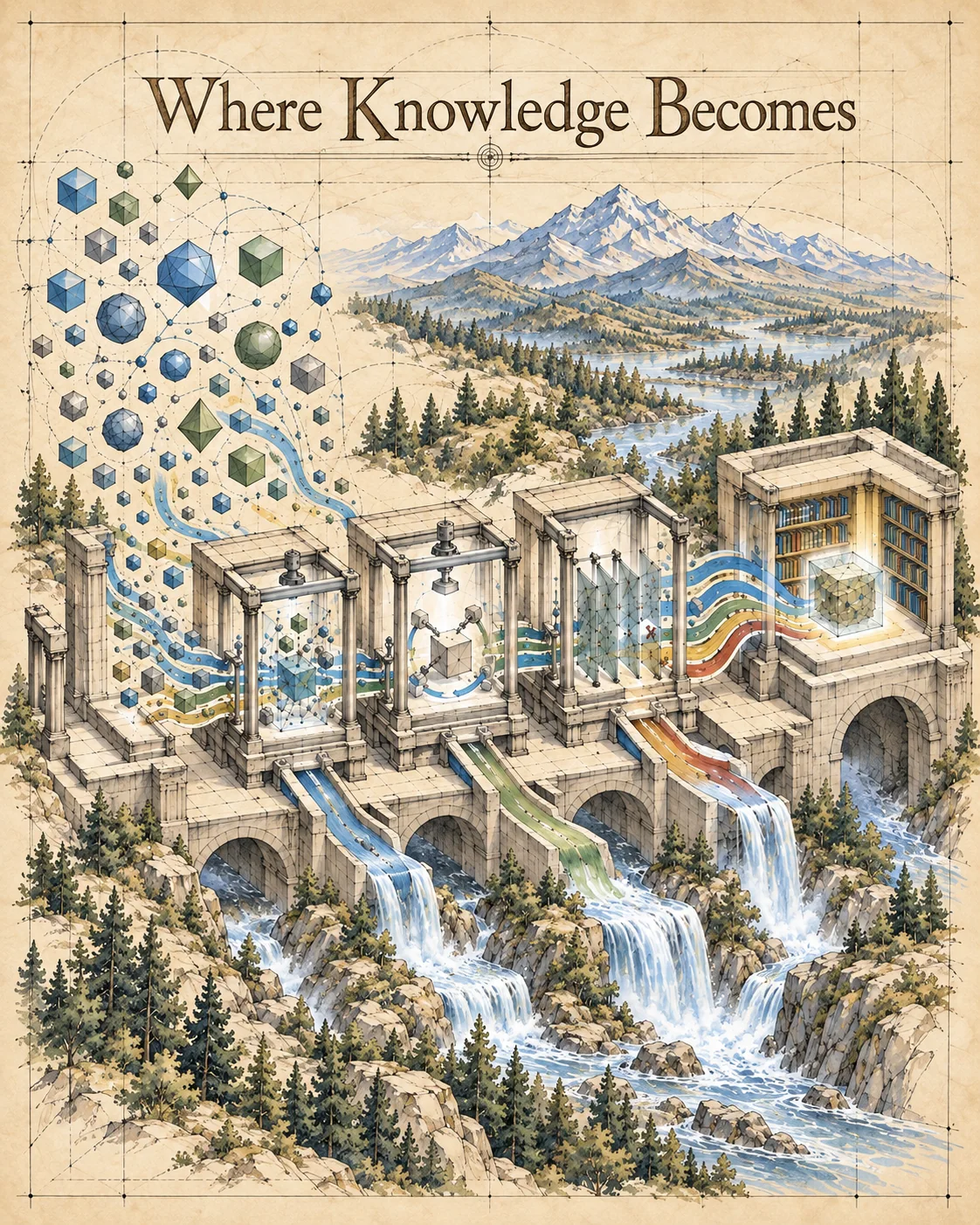
Where Knowledge Becomes
XXV. Explaining Love, Madness, and Death
A universal epistemology cannot survive by selecting only those domains in which explanation feels comfortable. If it is universal, it must continue when the subject becomes intimate, painful, visceral—when you are tempted to say:
not this.
These are precisely the places where mystery can become an exemption. Inexplicit knowledge can become sacred because you cannot articulate it. Intensity can be mistaken for explanation. A category can be protected because criticism feels like desecration.
1. Love Before Explanation
Love begins naturally. A newborn child does not arrive inside an abstract theory of kinship. If you become a parent, you do not ordinarily reason:
therefore:
Something more immediate happens. The child arrives. You hold them. Attention reorganizes. Threat becomes newly salient. Their cries are impossible to ignore. The future suddenly contains a person who did not previously exist. There is no need to oppose this to biology.
Genes are biological knowledge. Evolution is a process through which biological knowledge is created and retained. You arrive carrying inherited structures that preceded every explanation you will ever create. Those structures affect attachment, kin recognition, sexuality, care, protection, fear, development, memory, emotion. The biological basis is not an embarrassment to love. It is part of its causal history.
But biological knowledge is not you. The biological architecture helps create conditions under which attachment can occur. It does not specify what this particular attachment will become. The newborn is not merely an object of evolved care. The newborn becomes a person.
That is where the epistemic problem begins. The child changes, not merely physically. A preference appears. A word is learned. A fear develops. A joke becomes possible. A moral objection appears. You say something and discover that the child did not understand it as intended. Later the child understands too well. They acquire friends, books, enemies, private interests, memories you do not share, concepts you never used, technologies you did not grow up with, explanations you reject. The biological relation persists. The epistemic mind diverges.
You can influence a child's mind. Language enters. Stories enter. Values, warnings, habits, institutions, and inherited objective knowledge enter. But none of this produces identity.
The child reconstructs what reaches them. They misunderstand, criticize, reject, combine, forget, create. Eventually they contain explanations you could not have transmitted because you never possessed them.
Ordinary language about inheritance can hide that difference. A person can inherit genes, property, language, culture, stories, perhaps a family business. They do not inherit another person's epistemic mind. Your child is not your continuation. Your child is another person. Love survives that divergence. In some of its deepest forms, the divergence is what makes continued discovery possible.
The same structure becomes clearer when the relation is chosen rather than inherited. Suppose you fall in love. At first the available information may be absurdly thin: a face, a voice, a gesture, a sentence, a laugh, a way of looking away, a body, a shared joke. The compression can be extreme. The explanatory activity it generates can be enormous.
Who are you? Why did you say that? Why did that matter to you? What happened before I knew you? What do you want? What did that silence mean?
To love another person can become an attempt to reconstruct an epistemic mind you can never directly inhabit. You conjecture the beloved.
That conjecture is necessarily incomplete. The other person has an internal history that cannot be transferred wholesale. They possess inexplicit knowledge they may not be able to articulate. They have memories you did not experience. They can misunderstand themselves. They can change before you catch up.
Abstract it.
At time :
Person constructs a tentative explanation of person .
But meanwhile:
The object of explanation is creating new explanations. The target moves. That is why intimacy cannot become complete possession. No amount of shared experience makes two epistemic worlds identical. No amount of access makes the reconstruction final.
A person can remain interesting after decades. That does not require artificially preserved mystery or failed intimacy. The beloved is still creating the world you are trying to understand.
To understand a person is to conjecture a world that is still being made.
If the relation remains open, that conjecture remains criticizable by the person it claims to explain. That condition separates discovery from possession.
2. The Invented Beloved
You can love another person. You can also love an explanation of another person. The two are not identical.
Suppose:
Person constructs an explanation of person . That is unavoidable. No person accesses another directly. Now let criticize the explanation.
I do not want that. I did not mean that. That is not what happened. You are not listening. You keep telling me who I am.
At this point the explanation can change, or it can be protected. If you protect your model from criticism by the person it claims to explain, the relation changes. The beloved becomes an artifact inside your epistemic mind. They may become a projection or a role, a possession or rescue project, an imagined future, an answer to a problem that belongs primarily to you.
This is not a minor error. The explanatory object can displace the person. You can end up defending the abstraction against the very individual who supposedly gives it meaning. The structure resembles forms of evil. A person is compressed into a category. The category is treated as more real than the individual. Criticism becomes evidence for the category. The person disappears beneath the explanation.
Love does not protect you from this. Its intensity may make the error harder to see. The capacity to create astonishing explanations includes the capacity to create astonishingly bad ones.
The problem is therefore not simply that another person remains partly inaccessible. The problem is that you can fill the inaccessible region with an explanation of your own and then forget that you did so.
3. Where Love Stops
A good explanation excludes. That makes ordinary language inconvenient. You may say that you love your dog, a garden, the Earth, nature, creation. Those experiences can be real. They can reorganize attention, motivate sacrifice, become part of identity, generate objective knowledge, shape a life. Nothing here requires mocking or diminishing them.
But they are not the same epistemic relation. A dog is not understood as a universal explainer. A garden is not. An ecosystem is not. The Earth is not. The attachment exists in you. The representation exists in you. The meaning exists as objective and inexplicit knowledge instantiated in you.
But a representation can attribute properties to its object that the object does not possess.
The dog understands me. The forest is wise. The Earth is angry. Nature is healing. Creation intends.
These statements may compress powerful experiences. Intensity does not settle ontology. The boundary here is functional rather than biological. The boundary is open to criticism. If a nonhuman animal were shown to originate explanatory problems, create and criticize explanations, revise its criteria, and continue that process openly across domains, the classification would have to change.
Biology is not the boundary. Explanation is. That distinction matters because abstractions such as nature can acquire moral authority precisely when their epistemic status remains unclear. An ecosystem can be damaged. A species can disappear. Pollution can make environments dangerous. A technology can destroy conditions people depend upon. None of that is in dispute merely because the word nature is being decompressed.
But the physical environment, without knowledge, is not a sanctuary designed for human flourishing. Cold kills. Heat kills. Pathogens kill. Drought kills. Floods kill. Radiation kills. The atmosphere does not negotiate. The ocean does not care. You survive because biological knowledge embodied in your organism interacts with objective knowledge accumulated by people: shelter, agriculture, sanitation, medicine, energy, forecasting, engineering, water treatment, logistics, law, markets, communication.
Abstract it.
The structure is not:
It is closer to:
This produces no moral command to exploit nature and no command to preserve every existing environmental state. It does something prior to either judgment: it removes the supposed moral authority of the abstraction. Nature does not stand above you merely because it came first.
A physical environment is a problem space. Knowledge changes what transformations within that space are possible. Oil, uranium, and silicon become resources relative to knowledge of transformations. Knowledge can make a lethal environment habitable. It can also make a habitable environment lethal. The moral problem begins after the causal structure is made explicit, not before.
Now turn the same decomposition back toward another human being. Population categories made people look much smaller than they are: trait, diagnosis, demographic class, role, institutional status, score, type. The surface made comparison easy. The interior became residual noise.
The more seriously individuality is taken, the larger the person becomes: different histories, memories, representational forms, problems, inherited explanations, inexplicit structures, criteria, criticisms, future possibilities.
Each person can create an explanation that did not exist before. That does not make each person good. Open-ended explanatory capacity includes open-ended capacity for error. Cruelty can be inventive. Domination can be rationalized. Hatred can become explanatory architecture. Nothing in individual epistemic depth guarantees moral innocence.
But once another person is understood as a vast and largely inaccessible epistemic mind, the stranger changes shape. They can look shallow because the interface is thin: behavior, clothing, accent, role, one sentence, one conflict, one mistake. The thinness belongs to your access. Not necessarily to the person.
Curiosity, awe, admiration, sometimes love can follow from that change in explanation. No moral authority has to command the feeling. The person simply appears differently once the compression is visible. That is a moral consequence without a moral command.
Curiosity about another person can arise from understanding what kind of thing a person is.
That consequence will matter when love puts the thin interface under pressure.
4. Love and Epistemic Instability
Ordinary coordination permits ignorance. The cashier does not need to know the customer's childhood. The driver does not need to understand the stranger in the next car. The programmer does not need to know who wrote every library. The citizen does not reconstruct every mind inside an institution. Thin interfaces suffice.
Civilization depends upon this. Call it the abstract society. Objective abstractions allow radically different epistemic worlds to coordinate without becoming alike.
Love creates a different demand. You often do not want the thin interface. You want to know.
The same epistemic limitation that ordinary life allows you to ignore becomes emotionally acute. Another person remains inaccessible while their world matters intensely. You conjecture, criticize, reconstruct, fail, reconstruct again. Ordinary language notices the pressure: lovesick, obsessed, I cannot stop thinking about you, you are driving me crazy.
Love and madness travel together in language because love can expose the instability of trying to explain another person under conditions of extreme salience and permanently indirect access. That does not make love a mental illness. It exposes an epistemic pressure that ordinary coordination usually conceals.
And that pressure opens a wider problem. What happens when the explanations through which you navigate your own world stop fitting together? The world does not become incoherent when your explanations fail. Your explanations do. An expected arrow disappears. A contradiction becomes impossible to ignore. An authority demands attention to a problem you cannot make salient. A trusted relationship violates its apparent structure. A value collides with another value. A familiar person behaves in a way the existing model cannot absorb.
You can carry incompatible structures for years without conscious crisis. Then something changes. A contradiction becomes salient. An interpretation no longer works. You can no longer move through the old epistemic landscape as before.
Love can intensify this because the beloved may occupy many regions of your at once. Future plans, identity, memory, family, home, safety, sexuality, status, moral understanding, daily routine, and private language can all become connected to the same person.
The loss or transformation of one relationship can therefore require a reorganization much larger than the visible event appears to warrant. Romantic distress can feel cognitively total because the relationship was not represented in one place.
The boundary here has to remain explicit. This is not an explanation of schizophrenia, bipolar disorder, psychosis, depression, trauma, neurodevelopmental conditions, neurological disease, pharmacological effects, or mental illness generally. Those phenomena may involve biological and psychological structures not considered here.
The conjecture is narrower.
Some forms of psychological suffering may involve your struggle to move through a world whose important explanations, expectations, and criticisms have become difficult to reconcile within your epistemic mind.
That conjecture can fail. It can also coexist with biological explanation. Epistemic struggle is not a new diagnosis. Replacing one totalizing category with another would reproduce the categorical error. The point is only that explanatory conflict can itself become a problem inside an epistemic mind.
Love makes that instability visible because another person can become entangled with many parts of your world at once. Death makes the consequence irreversible.
5. Death of a Universe
A population statistic can say:
A biological description can say that the organism died. A medical description can identify the failed organ. A legal description can record the time. All of these descriptions can be correct. They do not contain the loss experienced by the person who loved the deceased.
The loved person was not merely one organism among billions. They occupied a unique region of your epistemic mind. They were a source of criticism, memory, surprise, habit, conflict, recognition, language, shared compression, future possibility.
Their world could never be fully accessed while they lived. Now something stronger has happened. It no longer develops.
The death of a person therefore includes:
Existing objective knowledge can remain: letters, code, photographs, buildings, music, stories, effects on other people. But the living process from which further explanation might have emerged has stopped.
The next joke does not appear. The next criticism does not arrive. The next unexpected change of mind does not happen. The next explanation that only this history might have produced is lost.
This does not mean that personhood is reducible to epistemology. It explains one part of what death destroys.
The same structure helps explain why you can mourn someone you never met. Call this parasocial. The label can be useful, but it can also hide the causal relation. A song can become attached to adolescence. A novel can reorganize a moral problem. A public figure can become an object of admiration, criticism, anger, imitation, or hope.
A person does not need to enter your home to enter your epistemic mind. Objective knowledge travels. The person who produced it may already occupy real structure inside your mind. Their death can hurt because what they made was already causally present in you.
Death then terminates something specific:
becomes impossible.
The uncomfortable opposite has the same structure. People sometimes celebrate the death of someone they experienced as a continuing source of destruction because they expect some harmful future action or output to stop. That does not make death morally simple. It makes the symmetry visible. You value or fear future transformations associated with people. Death changes that future.
Now remove even the indirect relation. A person dies whom you never knew. No song, book, friendship, public role, or story reached you. Ordinary experience registers almost nothing. That can make the loss appear categorically smaller. But low access is not low depth.
The stranger may have constructed an epistemic mind as expansive as that of the person you loved: different problems, jokes, fears, skills, inexplicit knowledge, memories, conjectures, criticisms, unrealized explanations. You did not experience those structures. That is a fact about your access, not necessarily about their value.
There are billions of people. You cannot intimately reconstruct billions of epistemic minds. Population abstraction returns because cognition is finite. Humanity, the public, consumers, citizens, workers, users, voters, patients, markets, demographics: the categories coordinate, and they compress.
The stranger becomes interchangeable at the interface. That need not be an ontological truth. The amount of objective knowledge through which one person can encounter another has repeatedly changed. Writing, printing, recorded sound, photography, film, telecommunications, digital networks, search, translation, artificial intelligence all change the practical surface of access.
Nothing says the present bandwidth is final. A large body of writing, recordings, images, correspondence, code, arguments, revisions, and artifacts can already be made searchable and comparable through artificial systems. Greater access to objective traces is not reconstruction of the person. But the unknown stranger is not intrinsically shallow merely because you lacked the interface.
Species extinction can feel easier to conceptualize than an unknown human death because the species is visibly unique as a category. Once it disappears, something irrecoverable has disappeared. That intuition contains a real epistemic structure. A species embodies biological knowledge: developmental programs, morphologies, physiologies, adaptive capacities, behavioral structures, relationships to ecological conditions. Extinction can destroy biological knowledge that may never be recreated in the same form. That loss matters.
The loss of a person is different. A person contains biological knowledge too. They also contain inexplicit knowledge generated through one evolved path-dependent life: skills, saliences, memories, perceptual distinctions, emotional associations, tacit criteria, unarticulated criticisms, half-formed conjectures, ways of seeing that may never have become explicit.
So:
while:
The distinction does not tell you which loss should matter more in every practical situation. It tells you that they are not the same kind of loss. A population abstraction can make one human appear replaceable. One among billions.
But epistemically:
Another person does not restore the trajectory that ended. The death of one person is not repaired by the birth of another.
6. Death as a Problem
Death is not merely something that happens to people. It is something people have made into a problem. An organism may possess elaborate evolved machinery for survival. A deer may avoid a predator. People also produce explanations of death.
Why do we die? What persists? Can a person survive the body? Can identity or memory continue? Can the body be repaired indefinitely? Can a mind move substrates? Should death be accepted? Is eternal life possible, and would it be desirable?
The proposed answers are diverse: soul, resurrection, reincarnation, heaven, ancestorhood, dissolution of ego, acceptance of nonexistence, legacy, children, art, cryonics, transhumanism, digital continuation. They are not interchangeable. Some contradict others. Some claim revelation. Some claim physical mechanisms. Some transform the problem rather than solve it.
But they share one feature. They are objective knowledge produced by epistemic minds confronting death. Calling an answer religious does not remove it from reality. Calling another philosophical does not establish it as correct. Calling either a consolation does not explain it away. The explanations remain available for criticism.
The soul therefore returns. The word can carry several problems at once. What makes the living person different from the corpse? What gives a person moral worth? What creates art? What persists after death? What preserves identity?
If the soul is invoked as an explanation, the same rule still applies. If it has causal consequences, those consequences enter reality. If it preserves memory, there is a dependency. If it guides action, there is a dependency. If it survives death, there is a claim about persistence. If it enters another world, there is a claim about transformation.
None of this refutes the soul. It refuses to protect it from criticism.
A revelation can become objective knowledge. A religious tradition can preserve objective knowledge. You can reconstruct it, criticize it, transform it whether you believe it or not. The epistemic question is not whether the idea feels sacred.
It is:
what problem does the explanation solve, and what follows if it is true?
Death does not create an exemption. It creates perhaps the hardest test. But a problem is not a promise of a solution.
Some transformations are forbidden by physical law. A perpetual motion machine is not waiting for better entrepreneurial execution. Knowledge cannot make a contradiction physically realizable. The laws of nature constrain the solution space.
So what about death? We know many causes of death: infection, cancer, trauma, organ failure, neurodegeneration, vascular disease, genetic disorders, radiation, poisoning, starvation, heat, cold. The list is long, but length is not mystery.
Many causes have already become partially soluble. Sanitation, vaccination, antibiotics, surgery, transplantation, engineering, nutrition, and public health prevent deaths. Knowledge changes the boundary. That does not establish immortality. It establishes something more modest.
We do not presently possess an explanation showing that death, in every possible form relevant to people, is a physical law. Current mortality therefore cannot simply be promoted into necessity.
The commitment is narrower:
Treat death as a problem unless and until a physical explanation shows that the relevant transformation is prohibited.
Particular causes of death are physical processes. Where those processes can be changed without violating physical law, preventing them remains a problem of knowledge. Perhaps some boundary will eventually appear. Perhaps personal continuity imposes a constraint we do not yet understand. Perhaps preserving the physical implementation of a person creates problems far deeper than repairing tissue. Perhaps the conjecture fails.
Those possibilities keep the claim provisional. Everyone has always died does not settle it. Induction does not become explanation because the subject frightens us. Death remains exposed to criticism.
7. When the Photograph Answers Back
People already resist death epistemically. We preserve the dead in photographs, letters, recordings, diaries, stories, clothes, recipes, messages, books, paintings, buildings, code, rituals, names, graves, archives.
The dead remain causally present through objective knowledge. A parent who has died may still participate in your decisions.
What would she have said? He would have laughed at this. Dad would have hated that. She told me never to do this.
These are internal reconstructions. They are not the dead people speaking. They are models constructed from retained knowledge, and they can be inaccurate, idealized, punitive, comforting, distorted, transformative. Human beings have always done this.
Artificial intelligence makes the structure more visible because it can externalize and animate the reconstruction. A photograph does not respond. A diary does not generate a new sentence when questioned. A recording does not notice that the listener is crying.
An artificial system can take preserved objective knowledge and produce a responsive surface:
That difference is psychologically enormous. A dead person's letters can be searched. Their recorded voice can be imitated. Their writing style can be modeled. A system can answer the question:
What would she have said about this?
It can generate:
I am proud of you.
Comfort, revulsion, longing, fear, violation, wonder can follow immediately because the technology presses on categories that were previously easier to keep separate: archive, simulation, person, memory, authorship, presence.
The confusion mirrors the wider confusion around artificial intelligence. Language suggests understanding. Style suggests identity. Responsiveness suggests agency. Familiarity suggests presence. But resemblance does not settle ontology.
The generated sentence is not the deceased person's next explanation. The system can recombine objective traces. It cannot thereby restore the unique epistemic trajectory that death terminated.
The distinction becomes more important as the simulation becomes better, not less.
The sharper simulation also revives an older problem: pollution. People can treat certain objective knowledge as though its mere presence contaminates an epistemic environment. AI-generated art, synthetic text, machine-made images, automated conversation—and now simulations of the dead—can provoke that reaction.
Where people express a desire to preserve responsive simulations of their deceased loved ones, the practice can be called creepy, unhealthy, grotesque, a desecration. Some applications may deserve severe criticism. A system can manipulate grief. A company can exploit attachment. Generated speech can be falsely attributed to someone who never said it. Consent can be violated. A simulation can be used to pressure the living.
These are real problems because they identify mechanisms: manipulation, commercial exploitation, false attribution, violated consent, psychological dependence, confusion between artifact and person. But the mere dynamism of preserved knowledge does not yet explain the condemnation.
People already preserve objective knowledge of loved ones. People already reconstruct abstractions of the dead. The responsive simulation makes that existing process more visible.
So the question becomes sharper:
What exactly has been polluted?
If the photograph is acceptable, why does responsiveness change the moral category? If the diary is sacred, why does querying the archive become profane? If you already imagine what the deceased would say, why does externalizing part of that process become intolerable? There may be good answers. They have to identify what changes. Creepy captures an observation. It does not finish the explanation.
The same distinction prevents an opposite mistake. Rejecting false personhood does not require rejecting useful preservation. A letter can change your life after the author is gone. A book can create a problem centuries later. A piece of music can reorganize someone who never met the composer. A recorded lecture can introduce a criticism after the speaker is gone.
An AI-mediated reconstruction can make objective traces searchable, comparable, translatable, responsive, connected to other objective knowledge. That can increase epistemic reach without resurrecting the person. The dead do not return merely because their objective knowledge becomes interactive. But the living may be able to encounter more of what the dead left behind.
The interface changes. The ontology need not.
8. Legacy Without Transfer
Mortality often turns you toward legacy. Children, grandchildren, a family name, a company, a work, a monument, a reputation, a contribution. The language often implies continuation.
My children are my future. My blood continues. My values will live through them.
Individuality does not permit that compression without criticism. The child is not you extended through time. The child is another person, freely and epistemically. They may inherit objective knowledge, biological knowledge, resources, problems, stories, property, institutions. They do not inherit your epistemic mind. The transfer is impossible in the strong sense. The child's future belongs to the child.
Legacy therefore has to mean something else. Objective knowledge provides the candidate. You can create something that survives your biological continuity: a criticism or theorem, a poem or private note, a design or program. A memory made explicit can travel too, as can a strange conjecture, a failed explanation carefully recorded, or a question nobody else thought worth asking.
Once externalized, the artifact can enter another epistemic mind. It can be reconstructed, misunderstood, corrected, combined, ignored, recovered later, translated, computed, fed into another technology. Its creator loses control over its reach. That is precisely what makes objective knowledge powerful.
Suppose you fear for your child's future. The temptation is to imagine control: enough money, the right school, the right values, the right institutions, the right inheritance, protection from the wrong influences. Some of these may solve real problems. But the child's future problem space cannot be possessed. Future knowledge cannot be predicted in its content. Future dangers cannot all be known. Future explanations cannot be supplied in advance.
The strongest legacy may therefore be less direct. Perhaps an idea you externalize becomes part of objective knowledge. Perhaps nobody notices. Perhaps an artificial system later ingests it. Perhaps another person encounters the idea inside a completely different problem and connects it to another explanation. The combination may eventually contribute to a technology, institution, criticism, or medical insight that changes conditions affecting people you care about.
No one may know the genealogy. The causal path may be impossible to reconstruct. This is not a prediction. It is a statement about the open-ended reach of objective knowledge. The effect does not need to preserve your name, resemble your intention, or remain inside your family. Your child cannot inherit your mind. But they can inhabit a world partly transformed by knowledge you helped make objective.
Now widen the scale. Billions of people means billions of evolved epistemic histories: different distributions of inexplicit knowledge, skills, memories, perceptual structures, problems, mistakes, unrealized conjectures, explanations waiting to become explicit.
The number itself is almost useless. You cannot apprehend billions, let alone billions of individual lives. Population abstraction returns because your access is finite. But the present limit on that access is not obviously a physical law. Your ancestors encountered fewer objective traces from fewer people. You can encounter vastly more. Future people may encounter more still.
Artificial intelligence may increase the practical depth with which one person can access objective knowledge created by many others. Not because AI merges minds. It may do the opposite. A letter hidden in an archive can become searchable. A forgotten essay can become relevant to a new problem. A language barrier can become smaller. An obscure criticism can be connected to a distant domain. A person's scattered artifacts can become a coherent surface for inquiry.
The possibility is already present. Whether we choose to build toward it is another question. Mortality makes the underlying asymmetry harder to ignore. Inexplicit knowledge can be rich, effective, beautiful, powerful. It can guide a life. It is also vulnerable because it is physically instantiated in a person. When the person dies, much of it may disappear.
Explicit objective knowledge has another possibility. It can migrate.
Brain to speech. Speech to writing. Writing to book. Book to database. Database to model. Model to another person. Person to code. Code to institution. Institution to criticism. Criticism to new explanation.
The substrate changes. The knowledge changes too. No transmission is perfect. Every reconstruction can introduce error. But objective knowledge can travel beyond the body that first made it explicit. That gives externalization a practical significance mortality makes impossible to ignore. Not every thought should be preserved. Not every draft is good. Not every idea deserves attention. The point is not indiscriminate accumulation.
The point is uncertainty about future relevance. You cannot know in advance which strange criticism, private observation, failed solution, aesthetic experiment, technical trick, moral discomfort, or obscure question will later become useful inside another problem.
There can be personal value simply in getting an idea out of your inexplicit mind and onto an objective surface. Here we add mortality, not as an ought but an is. Sometimes the surface is the only thing that remains.
The tragedy is not only that a person dies. It is that knowledge can die without ever becoming available to anyone else.
9. What Survives
Knowledge is physically instantiated, so no particular copy is indestructible. Books burn. Servers fail. Languages disappear. Archives are lost. Civilizations collapse. Memories decay. There is no need to call knowledge eternal.
Its remarkable property is different. Knowledge can migrate between substrates. It can be copied, reconstructed, translated, compressed, decompressed, re-embodied. An explanation can outlive every person who first carried it. It can disappear for centuries and be recovered. It can enter domains its creator never imagined. It can become part of the inexplicit knowledge of someone who never learns where it came from.
This gives objective knowledge an unusual durability. You are finite. The reach of what you create need not be. That is not personal immortality.
The person you love is not valuable because they are a perfect instance of humanity, because you possess them, because they continue you, or even because you are trying to understand them. You never fully do.
Love can instead be understood, in part, as sustained engagement with an epistemic mind whose depth exceeds your reconstruction and always will.
Nothing here explains love. Biology matters. Sexuality matters. Attachment, culture, memory, beauty, physical attraction, history, objective knowledge, inexplicit knowledge, the beloved—all remain part of the problem.
Nothing here explains madness. The relationship between epistemic conflict and mental suffering remains largely unknown.
Nothing here explains death away. A grave remains a grave. No epistemology converts grief into an intellectual exercise. No argument restores the next sentence a dead person would have spoken. No theory makes the loss less real by placing it inside a causal structure.
That was never the purpose. The purpose was to deny these phenomena exemption from the same critical treatment as everything else.
Here we pushed the epistemology somewhere less comfortable: into love, confusion, grief, death. The result is not that these things have become simple. The opposite.
Love becomes stranger when the beloved is understood as an evolving epistemic mind that cannot be possessed. Humanism becomes deeper when curiosity about people follows from what people are rather than from inherited moral wisdom. Madness becomes a problem about the stability and movement of epistemic minds without becoming reducible to simple explanations. Death becomes more terrible when a person is understood not as one biological unit among billions but as an irreplaceable evolved trajectory containing inexplicit knowledge and unlimited, now unrealizable epistemic possibility. And legacy changes.
That may be the most durable contribution available to a finite epistemic person. Not continuation of the self. Not control over the future. Not possession of descendants.
Objective knowledge. An idea placed into the world. A criticism made available. A problem articulated clearly enough that another person can inherit it. A strange connection preserved long enough to meet a future mind.
Billions of people are alive inside that openness now, under widely varying constraints. Each carries biological knowledge older than civilization and objective knowledge accumulated across millennia. Each carries an internal landscape no one else can fully reconstruct, and knowledge that has not yet become objective at all.
Death can close that path. But objective knowledge can continue beyond the person who created it. A problem made visible can enter another epistemic mind, encounter explanations its creator never knew, and become part of something neither person could have imagined.
That possibility does not begin after death. It is already present whenever you encounter the knowledge left by others. You inherit words, tools, explanations, materials, and unfinished problems. You criticize them, rearrange them, discover new relations, and sometimes bring something into the world that did not exist before.
The components may be familiar. The explanation may be new.
That is where the next problem begins.
How can what already exists become an invention that did not?