
One Reality, Many Worlds
VI. The Black Rabbit Hole
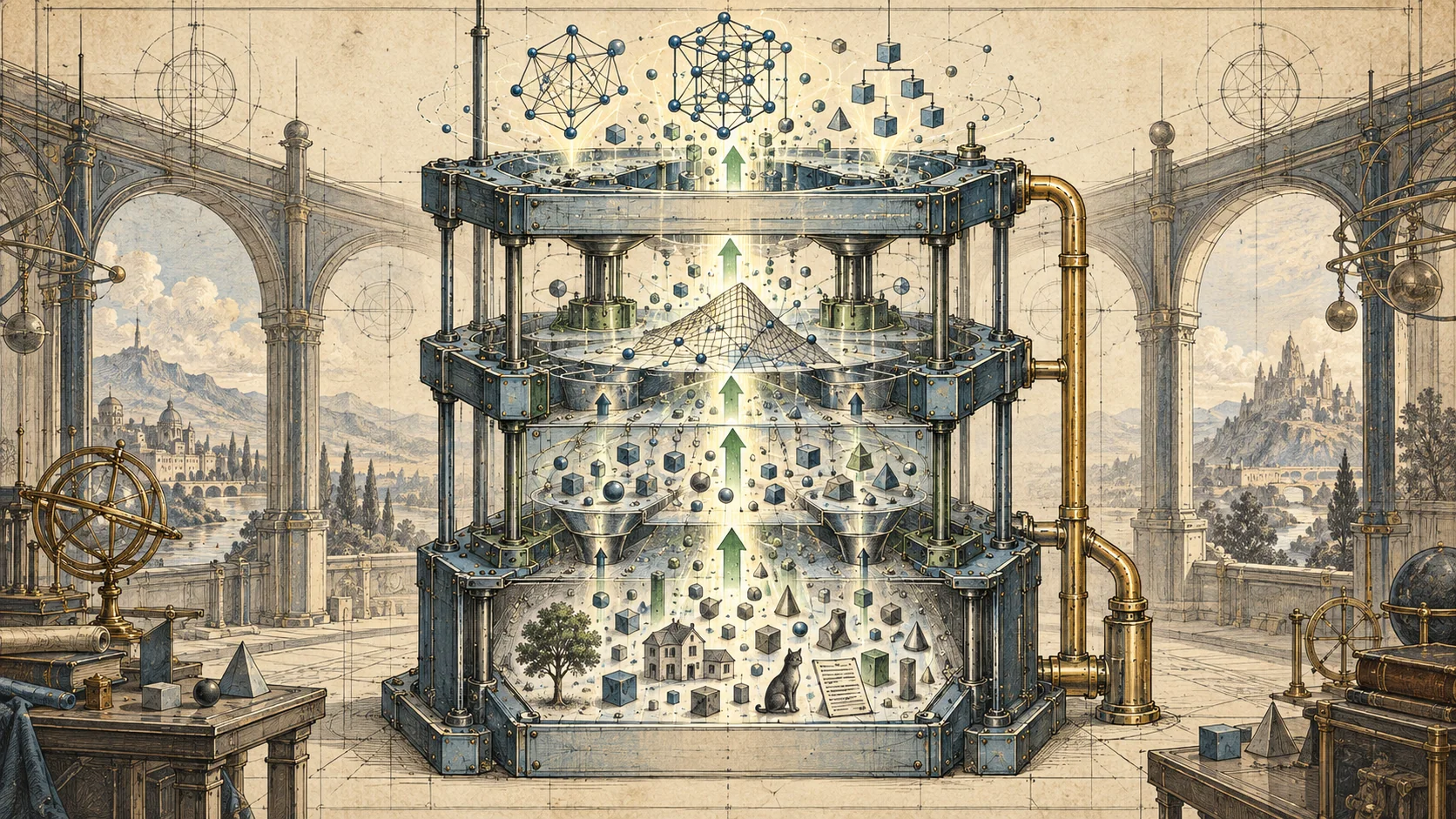
You cannot leave the locus of your own mind, but you can still move toward another person's world through conjecture, communication, and criticism. You can ask what problem the other person is trying to solve, construct a tentative model of their world, allow them to criticize it, and sometimes return with an error in your own understanding exposed.
If that's true, the distance between minds is enormous.
People can share a language, a country, a family, even decades of common history, yet inhabit profoundly different experienced worlds. Religious beliefs, conspiratorial explanations, and political convictions can remain resilient in the face of contrary observations. At the same time, you readily experience your own inner life as deep and complicated while strangers, opponents, and out-groups appear comparatively simple.
There is only one reality.
The explanation developed here does not require many realities. There is one reality. But you do not encounter it whole or without mediation. Perception and thought select, organize, retain, and omit. They make some distinctions available, some problems visible, some expectations natural, and others difficult even to formulate.
Call the resulting structures abstractions. They are not intellectual decorations placed on top of an otherwise direct encounter with the world. Mediation begins in perception itself and continues through inexplicit expectation, learned salience, concepts, language, memory, social knowledge, theories, institutions, and explicit explanation.
These abstractions are real because they have causal effects. They can be true, false, partial, useful, misleading, incoherent, resilient, or mutually incompatible, yet still alter what you notice, remember, trust, fear, attempt, and criticize. Most are not available to introspection as explicit propositions. They become visible when some encounter, contradiction, criticism, or problem forces them into view.
That is stronger than saying only that abstractions are real. It says that experienced reality is mediated through them, including at the level of perception.
Relativism is false.
The claim is not relativist. The abstractions differ, but the reality constraining them does not multiply with the observers. Every abstraction remains fallible within the same reality.
The universal epistemology used here must submit to the same rule. The claim that persons construct evolving worlds of knowledge is itself a constructed explanation. So is evolutionary epistemology. So is the distinction between reality and representation. None becomes exempt from criticism because it appears superficially foundational. Realism does not grant certainty. It gives criticism something beyond the abstraction to answer to.
Compare that idea.
Let represent mind-independent reality and the organized world through which individual encounters it:
But is not unreal. It is instantiated in the person and changes what that person can do. A representation can therefore be false about what it represents while remaining real as a cause. A conspiracy theory can be false about its referent and still organize suspicion, memory, and action. A religious doctrine can contain false factual claims while still connecting morality, identity, suffering, family, ritual, community, and purpose. A political abstraction can misdescribe institutions while still shaping alliances, moral judgment, and perceived threats.
The distinction matters because the same error can occur at many levels: a psychometric construct becomes personality, a population category becomes the person, or a social statistic becomes a causal mechanism. In each case a representation stops being treated as a selective structure and begins to stand in for the thing represented. Universal epistemology would repeat the error if it were treated as direct access to reality rather than as a tentative explanation of how access works.
Mediation begins before explicit belief. We do not first receive raw reality and then voluntarily place concepts over it. A face does not appear as an uninterpreted distribution of wavelengths and only later become a face. A familiar voice, a threat, and another person already arrive through perceptual systems shaped by biological history and individual development.
Develop the abstraction.
The sequence is closer to:
Reality constrains this process continuously. A perceptual system cannot freely invent a cliff where no relevant physical structure exists and remain indefinitely successful in acting on that invention. But constraint is not unmediated access. The experienced world is already selected and organized.
Most of that organization remains inexplicit. It operates through learned salience and expectation, embodied skill and tacit causal structure, and perceptual categories bound up with trust and emotional orientation. You normally do not think, I am applying abstraction A, which depends on assumptions B, C, and D. You experience: this is what is happening.
And then reality kicks back.
A failure can change that. A familiar solution stops working. A prediction is violated. Two trusted sources conflict. A relationship produces an unexpected response. What had functioned invisibly can now become a problem. Criticism therefore does more than test explicit statements. It can expose the structure through which the statement first appeared obvious.
That general claim becomes concrete when we look at a representation designed precisely to make different people comparable. Population psychology often places persons into a common coordinate system:
The transformation is useful because comparison requires commensurability. It is also a compression: only differences expressible in the chosen measurement space survive. The rest of your organized history is outside the representation by design.
That does not make a trait score, population distribution, or longitudinal model false or useless. It tells us what kind of knowledge the representation contains. A trait score can locate a person relative to others on a defined dimension. A population model can describe regularities in a sample. A longitudinal model can describe change over time. None of these, merely by existing, contains the developmental history that produced your present organization of problems, expectations, distinctions, skills, trust, and salience.
The epistemic difficulty appears when the common representation is applied back to you. Population regularities and individual histories are different objects of explanation. Your membership in a population does not by itself supply the causal bridge from a group-level relation to your development. That bridge has to be discovered rather than assumed.
This creates a conjecture that can fail. If increasingly fine-grained explanation converges on the same stable causal architecture across persons, then the strong individuality thesis weakens. If similar surface scores and behaviors repeatedly resolve into different problem histories, causal pathways, and person-specific dynamics, the thesis gains corroboration.
The issue cannot be settled by declaring individuality in advance.
The common representation has now done something more important than merely classify. By seeing exactly what it preserves, we can see exactly what it leaves open. The problem shifts from how people vary inside a shared measurement space to what kind of thing the singular person must be if every common representation compresses part of the history that produced them.
Explain.
The evolutionary story begins with biological knowledge. Genes embody inherited solutions to recurring problems of organism construction and survival. They participate in constructing sensory, memory, motor, affective, attentional, and learning systems, including a brain capable of language and abstraction. This shared biological knowledge gets you started without specifying the semantic content of the person you will become. The future world of meanings, problems, and explanations is not present in miniature inside the starting biology.
Development therefore cannot be described simply as the accumulation of inputs. At any moment you possess some existing knowledge . That knowledge makes certain problems visible and others invisible. You construct tentative solutions. Those solutions encounter criticism from reality, action, other people, contradiction, surprise, and later knowledge. Some are retained, some revised, some abandoned. The retained structure changes the starting point for what happens next:
The crucial relation is not merely that knowledge changes. It is that changes which future problems can exist for you. Earlier knowledge alters the environment in which later knowledge develops. That recursive dependence is the mechanism of epistemic individuality.
Give me an example.
Two children can begin from biological starting points that are almost indistinguishable for ordinary human purposes and still construct very different regions of experience. Both hear music. One becomes curious about why a melody sounds unfinished. The curiosity becomes a problem; an explanation about harmony offers a tentative solution; experiment reveals where the explanation works and fails; a new distinction becomes audible. Years later the person hears tension, phrasing, modulation, and structure that the other child does not notice. A region of the person's world has been constructed.
The second child encounters a programming puzzle. A distinction between state and process becomes salient. Debugging becomes a skill, then a style of questioning that later enters mathematics, work, perhaps even interpersonal reasoning. Neither trajectory was contained in the initial biological difference. Each emerged because earlier knowledge altered later problem selection. After twenty years, the two people can stand in the same physical room and encounter different problems in the same event.
That is the relevant meaning of path dependence. It does not mean that tiny differences must explode or that trajectories cannot converge. It means that retained knowledge changes what can happen epistemically next.
Abstract that path.
A difference in knowledge changes the next problem; a different problem invites a different conjecture; a different conjecture encounters different criticism; the retained result changes the next epistemic environment. Over a lifetime, the sequence compounds.
Human abstraction makes the resulting space open-ended in a further sense. People can construct mathematics, moral and legal systems, and programming languages whose objects and rules need not have existed before those abstractions were created.
More important than any list is the recursion: abstractions can operate on abstractions.
A programmer can create a language used to build another language. You can form a theory about another person's theory about an institution whose rules were themselves produced from abstract legal concepts. The next problem need not be available inside the conceptual world that existed before the new abstraction was created.
There is therefore no known fixed upper bound on the possible organization of an epistemic mind. This gives precise content to the metaphor that you can become a universe unto yourself: not a separate reality, but a vast, historically evolved attempt to explain and navigate one reality.
Most of that world is not explicit, is not explained.
It includes skills that cannot be fully verbalized, patterns of salience, anticipations, emotional associations, embodied expectations, implicit distinctions, memories whose significance is only partly available, and causal expectations revealed only when violated. You can be unable to explain why something feels obvious even when that feeling has a developmental history. The explanatory structure is larger than introspection.
Criticism can make part of it visible. Ask why a source is trustworthy and an inherited institutional model may appear. Ask why a behavior counts as disrespect and a tacit moral category can become explicit. Ask what observation would change your mind and you may discover that the theory had no imagined failure condition. The criticism tests the explicit proposition, but it can also expose the abstraction that made the proposition feel immediate.
When such an abstraction becomes deeply embedded, you may stop experiencing it as a model at all. You do not experience my model says X. You experience obviously X.
Call this manifest truth: an abstraction whose mediating role has disappeared from experience and come to represent reality.
A manifest conviction need not be false. The error lies in treating immediacy as evidence that mediation has vanished. The abstraction can be hardest to notice precisely when it operates most fluently.
This also explains why large beliefs can be resilient. A belief is rarely an isolated sentence. It may be connected to family and identity, source credibility and institutional trust, or suffering and purpose. The particular network differs by belief, but the causal consequence is the same: criticism aimed at one visible proposition can encounter a much larger structure.
A sufficiently flexible structure can then route around anomalies. An observation may be reinterpreted, rejected because of its source, or absorbed into a larger story. This is not peculiar to conspiracy thinking. Any explanatory structure flexible enough to accommodate every possible result can protect itself. The important distinction is between resilience produced by explanatory depth and resilience produced by unlimited flexibility. Only the latter makes failure conditions disappear.
Religious belief, conspiratorial thinking, and political polarization can therefore exhibit similar structural features without becoming equivalent in truth or content. A religious belief can be embedded in moral, familial, existential, and communal meaning. A conspiratorial model can interpret criticism through the theory itself. Political disagreement can place the same observation inside different networks of trust, history, causation, identity, and moral salience. In each case the disagreement may extend far beyond the visible proposition because the proposition is intelligible only inside a larger epistemic architecture.
That is why adding facts can fail to resolve a disagreement. The facts do not enter an empty mind. They enter an already vast evolved world.
The same mechanism becomes more consequential when a manifest truth is joined to authority. Authority need not operate only by issuing commands. It can operate by treating certain propositions as prior to criticism: any reasonable person can see this; decent people know this; this is simply reality.
Abstract the transition.
A rival explanation is no longer encountered as a rival explanation. The dissenter is reclassified as irrational, immoral, ignorant, dangerous, or unfit to participate. The abstraction is then protected from the criticism that might have exposed its hidden assumptions.
The same ontology explains a quieter interpersonal error. Your inner world appears rich because you inhabit it. Another person's appears thin because you encounter only a surface. You have direct access to your memories, unfinished problems, and inexplicit expectations. You encounter the other person through speech, behavior, and occasional disclosure.
Abstract the comparison.
but not:
The sparse thing is usually your abstraction of the other person.
Social labels make the compression easy to see. People close to you are permitted complexity because you know their exceptions, histories, contradictions, private failures, peculiar interests, and changing moods. An outsider may be compressed to conservative, religious, or conspiracy theorist. A label can serve a narrow descriptive purpose. It becomes an epistemic error when the compression is mistaken for the person.
Biological differences do not repair that inference. People differ in processing speed, memory, and sensory or attentional capacities. Those differences can matter. Ordinary human minds nevertheless display open-ended explanatory generality, and these implementation differences do not by themselves establish that one person's epistemic mind is categorically richer than another's. A slower processor is not thereby a shallower explainer, and weaker recall does not by itself imply a barren internal world. Writing, software, and AI can also externalize or extend some capacities, further loosening the link between a particular implementation difference and the possible depth of a person's explanations.
Nor does the epistemic process occur only during science or philosophy. A conversation creates expectations; a disappointment creates a problem; a hobby generates new distinctions. Each retained solution can change what becomes salient next. Over years, ordinary life produces an enormous developmental history even when little of that history is ever rendered as explicit theory.
This reverses the usual evidential burden concerning strangers. A person who has spent decades perceiving, learning language, solving practical problems, forming relationships, remembering, imagining, failing, and revising expectations is predicted to possess substantial hidden structure. Depth is not truth, and complexity is not explanatory quality. A vast epistemic mind can contain enormous error. But lack of access to another person's depth is not evidence that the depth is absent.
Reconsider the psychological case.
Now the objective knowledge supplied by the psychological case can be reconsidered without asking it to do more than it was built to do. A population model can be accurate at the level for which it was constructed. A trait score can locate a person on a common dimension. A group-level regularity can describe a sample. Such knowledge can support comparison, prediction, and further inquiry. What it does not contain merely by being objective is the person's full causal and developmental architecture.
The person-level account changes the explanatory demand. The population abstraction need not explain the whole person, and its failure to do so does not make it useless. The sharper question is what explanatory work the representation performs and where that work ends.
The individuality conjecture remains open at that boundary. If increasing explanatory resolution repeatedly reveals different path-dependent histories and causal organization beneath similar surface scores or behaviors, the thesis survives.
What??
Biological knowledge evolves organisms capable of perception, memory, abstraction, criticism, and further knowledge creation. From there, retained solutions alter future problem situations; new abstractions alter salience; criticism can expose structures that had previously operated invisibly.
This is how people can share one reality while inhabiting profoundly different experienced worlds. It is also why disagreement can remain deep even when language, country, workplace, family, or decades of history are shared. Visible overlap does not reveal the full networks of memory, trust, morality, causation, identity, and explanation that give an observation its meaning.
The asymmetry of other minds follows from the same cause. Your own world is available to you in immense detail. Another person appears through a compressed surface. The temptation is to mistake your model of that person for the person themselves. My inner world is rich; yours is barren then looks like a discovery about the other person when it is often a discovery about the poverty of your model.
None of this weakens realism.
It makes realism necessary to the argument. If there were only private realities, criticism would lose its discriminating force. Because there is one shared reality, every epistemic mind remains answerable to something beyond itself. People can be wrong. Belief systems can be wrong. Institutions and cultures can be wrong. Universal epistemology can be wrong.
The process therefore remains:
Reality is the ultimate constraint, and no individual possesses it whole. The epistemic landscape is vaster than you imagine, much of it is inexplicit even to the person who inhabits it, and the map you carry of another person is much smaller than the territory.
If every encounter with another person is mediated through your own evolving abstractions, and if the abstractions most in need of criticism may be precisely those experienced as reality itself, then the problem is not merely whether epistemic distance can be crossed. It is how criticism can reveal the invisible abstractions on both sides of the crossing.