One Reality, Many Worlds
VII. The Emissaries and Their Master
If individual minds diverge so radically, what prevents them from dissolving into arbitrary private worlds?
There is one reality.
Explanations may begin in different domains, at different levels, and in different minds, but explanations of the same world cannot remain indefinitely incompatible. Physics, computation, evolution, epistemology, psychology, morality, institutions, and ordinary experience do not inhabit separate realities. Their explanations must remain mutually possible.
When independently developed explanations fit together well enough that no unresolved contradiction presently forces reconstruction, explanatory knowledge has reached a provisional equilibrium. That state will be called consilience.
1. Consilience as explanatory equilibrium
It is not proof, consensus, psychological comfort, or accumulated confirmation. Because knowledge is fallible, the equilibrium is temporary. A new criticism can disturb it. A contradiction can become a problem. A new explanation can reorganize the whole.
Consilience is therefore not the end of the epistemic cycle. It is one of its resting states:
The letters are doing too much work here, but the abstraction remains: moments of epistemic equilibrium unsettled by states of problems, tentative solutions, and error elimination.
The question is how that equilibrium operates across many domains when criticism and reconstruction still occur in you. Your biological processing capacity is finite.
Different explanations can begin independently without being independent of reality.
Physics constrains what transformations can occur. Computation constrains what transformations can be represented and executed. Evolution explains how adaptive structures can arise and persist without a conscious designer. Epistemology explains how you can create and improve explanations within that world.
These explanations do not reduce to one another. They answer different problems. But they cannot require mutually impossible worlds.
If one explanation requires something that another good explanation says cannot exist, the contradiction is not merely disciplinary. It becomes a problem for the explanatory system as a whole.
Abstract it.
Consilience can be represented as a dynamic relation among explanatory structures:
The word provisional matters. Every explanation remains criticizable. A new observation, criticism, or explanation can expose a contradiction that had not previously been visible and force reconstruction.
That follows from realism. If there is one reality, then every valid explanation concerns some part or aspect of the same world. A theory of mind cannot require processes forbidden by physics. A theory of knowledge cannot depend on transformations that cannot in principle occur. An account of human individuality cannot ignore biological development. Explanations of actual persons can, in turn, expose problems in psychology or social theory. The relation is reciprocal constraint, not a hierarchy of disciplines.
Evolutionary epistemology is an explanation with unusual reach. Its central structure is:
A problem creates pressure for an explanation. A tentative solution is generated. Criticism exposes error. What survives changes the next problem situation.
You therefore do not merely accumulate information. You construct explanations, reject some, retain others, and thereby alter what can become a problem next. The retained knowledge changes the conditions under which your later knowledge will be created.
That structure was not introduced only to describe formal inquiry. It traveled into childhood, relationships, practical work, institutions, social categories, freedom, and individual development. The recurring question was whether the same explanatory structure continued to hold when the domain changed.
That gives evolutionary epistemology reach, but reach creates a burden. A universal explanation cannot preserve itself by refusing contact with other explanations that also claim broad scope.
You must be physically possible. Your knowledge creation must be computationally realizable. Your capacities must be compatible with biological development. Claims about you must also survive observations from psychology and the social sciences that could expose a mismatch between the theory and reality.
Empirical research enters here as criticism rather than authority. A large study does not settle what you are merely by being large. A psychological category does not become an ontology because it is useful or widely used. A social theory does not become causally privileged because it is conventional. But an observation can expose a pattern the explanation failed to anticipate, and a rival theory can reveal that the same phenomenon can be explained another way.
Those are serious challenges because they alter the problem situation. The question is not whether evolutionary epistemology receives disciplinary approval. The question is whether its deductions survive contact with observations and rival explanations that it did not choose.
It began with behavioral genetics and followed the consequences of a universal epistemology into personality psychology, social categories, institutions, childhood, media, authority, objective knowledge, technology, AI, and individual development. Some candidate explanations survived. Others failed because they generalized too far, moved too quickly, or reintroduced collective minds through the back door.
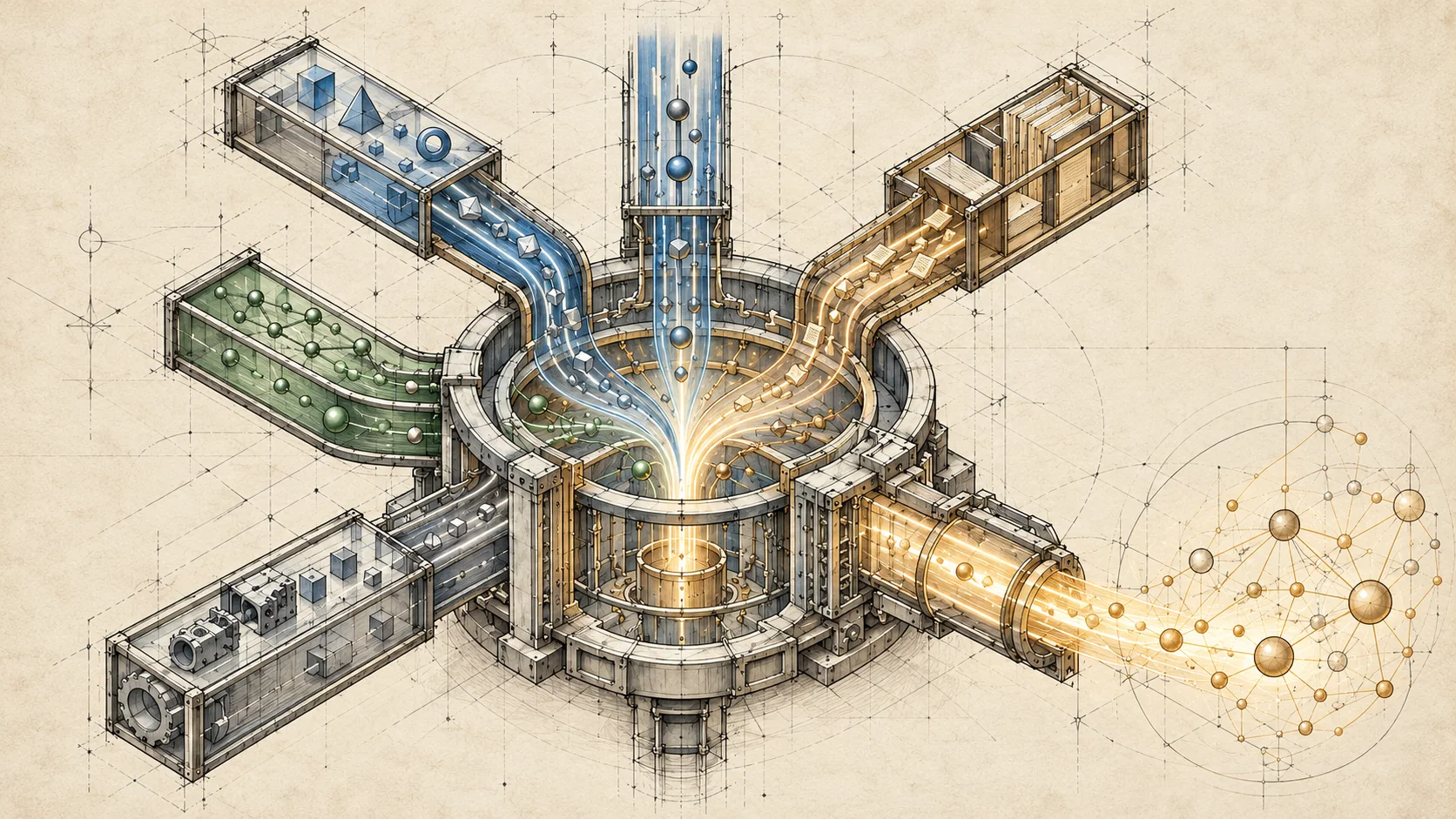
As the number of relevant domains grew, a practical limitation became visible: no one person could keep all of the necessary objective knowledge in active comparison. AI became useful because it could retrieve, juxtapose, and recombine explanatory structures that ordinarily remain separated by discipline, document, or scale.
Abstract it.
The resulting method can be compressed as:
But this sequence still leaves something unexplained. It tells us how explanatory structures can be brought together. It does not yet tell us where the contradiction becomes a live epistemic problem.
For that, the analysis has to return to you.
2. Consilience in the solitary mind
Explanations do not reconcile themselves. There is no disciplinary mind in which physics becomes compatible with computation, and no social mind in which psychology becomes compatible with epistemology. An institution does not experience contradiction on behalf of the people inside it.
A conflict between two explanations can exist objectively. But it becomes epistemically active for you only when you reconstruct enough of both explanations to recognize that they cannot remain as they are.
Abstract it.
The contradiction may have existed before anyone noticed it. The relevant knowledge may already have been embodied in books, papers, software, institutions, or other people. Yet for you, criticism begins only when the conflict enters your problem situation.
This is where consilience becomes psychological without requiring a collective mind.
The solitary-mind thesis does not isolate you from objective knowledge. It identifies the point at which objective contradiction becomes a live epistemic problem.
You carry abstractions about the same world: explanations of self and relationships, morality and authority, science and causation, institutions and the future. These abstractions do not remain in sealed compartments. They interact because you use them together to interpret experience and act.
You may hold that evidence should change belief while protecting one belief from criticism. You may regard persons as radically individual while treating members of a group as interchangeable. You may regard yourself as autonomous while deferring a question you could examine to an authority whose reasoning you have never reconstructed.
Such contradictions can remain inexplicit for long periods. They become psychologically significant when experience, criticism, or new knowledge brings the abstractions into contact.
The mind can lose equilibrium.
The surface experience may be confusion, discomfort, disorientation, or uncertainty. None of those states is inherently valuable, and this argument does not conjecture a general theory of psychological health. The narrower claim is epistemic: some disorientation can occur because an explanatory structure that previously seemed coherent can no longer survive criticism unchanged.
The relevant capacity is therefore not permanent coherence. It is decoherence and revision.
You can notice conflict and expose a hidden assumption. You can remain with temporary uncertainty long enough to generate alternatives, reject a failed abstraction, and reconstruct the problem for further criticism.
Equilibrium is not stasis. Knowledge grows by disturbing it, reformulated as:
If you can never be disturbed, you may preserve coherence only by preventing error from becoming visible. If you are temporarily disoriented, you may instead be in the middle of reconstruction. What matters for the present argument is whether the disorientation can become a better problem.
This clarifies how epistemic life can narrow.
Isolation can reduce the number of encounters capable of disturbing the current explanatory landscape. Polarization can preserve exposure while restricting which external explanations are allowed to count as criticism. One narrows the field of encounter; the other narrows the field of admissible contradiction.
Either can interrupt the epistemic cycle before error elimination begins:
or:
The failure is not disagreement. Nor does the argument imply that solitude is unhealthy or that strong conviction is pathological. You may withdraw from noise in order to think more clearly, and an explanation may survive repeated criticism because it is better.
The relevant distinction is whether important contradiction can still become a genuine problem. Exposure alone is insufficient. You can encounter endless rival claims while remaining epistemically closed if every contradiction is neutralized before it reaches the explanatory structure that would have to change.
That makes permeability to criticism important. It also creates a practical difficulty. You cannot reconstruct everything that might matter.
3. Objective knowledge and the human-AI dyad
You may be a universal explainer in kind while being limited in resources. Biological cognition has finite memory, attention, time, recall, reading capacity, and disciplinary familiarity. Universality binds us to epistemology as well as physics, evolution, computation, and every other universal explanation.
You may in principle understand an explanation while being unable in practice to discover or retrieve it. You may also be unable to compare it with its rivals while holding its consequences in active attention. The amount of knowledge relevant to a difficult problem can exceed the processing scale of the biological mind that must eventually criticize it.
People do not depend only on what can remain active in consciousness.
You externalize knowledge into artifacts. You write notes, construct diagrams, build tools, and encode procedures in software. Once knowledge is embodied outside immediate consciousness, it can persist and later re-enter your epistemic cycle. Call that objective knowledge.
A notebook can preserve a distinction you would otherwise forget. Software can embody a procedure too complex to execute mentally. A diagram can hold relationships that your working memory cannot keep simultaneously available.
You are therefore solitary as a knowing mind but extended as an epistemic cause.
Objective knowledge is not you. A book does not become a mind because it contains an explanation, and software does not become a subject because it embodies a procedure. Yet an explanation of you is incomplete if it ignores the objective knowledge through which your understanding persists, returns, and acts.
This extension changes the practical importance of biological differences without erasing them. People differ in recall, calculation speed, working memory, and facility with language or symbols. Writing reduces dependence on unaided memory. Calculators reduce dependence on arithmetic speed. Search and software reduce dependence on unaided recall and symbolic procedure.
The operative epistemic unit therefore becomes less like the unaided organism and more like:
AI extends this pattern because it can do more than store an artifact for later retrieval. It can bring dispersed explanations into active comparison.
That is the limited sense in which “my AI and I are more clever than I.” The claim is not that the AI is a second person. It is that you, working through objective knowledge with AI mediation, can reach a larger criticizable problem space than you could practically reach unaided.
The interaction is recursive. You establish a problem. AI can retrieve relevant material, compare candidate explanations, translate across vocabularies, or trace consequences beyond your immediate field. Your criticism can then reject the framing, expose a mismatch, or alter the problem, after which another comparison becomes possible. What changes is not merely the speed of an otherwise identical process. More explanatory structures can enter your problem situation at all.
So, in practical explanatory reach:
That is the proposed answer, provisionally.
That does not make AI an autonomous source of consilience. Bringing explanations into contact is not the same as reconciling them successfully. A comparison can be wrong. A synthesis can be superficial. An apparent contradiction can result from misunderstanding one side. A coherent answer can still fail to describe reality.
The important distinction is between increasing the scale of comparison and determining the direction of inquiry. Once candidate explanations are available, something still has to decide what the problem is, which criticism changes it, and whether apparent closure should be rejected.
Compress that distinction.
In the architecture proposed here, that asymmetry can be compressed as:
This is not the claim that an AI can never select or rank a problem. It is a distinction between operations. Generating, retrieving, comparing, or ranking candidate structures does not by itself settle which contradiction your inquiry will treat as problem-forming. Your role is therefore not exhausted by checking an answer after the machine has completed the epistemic work. You can reject false closure, change the resolution of the question, refuse a proposed abstraction, and make a successor problem out of what the previous answer left unresolved.
The present inquiry has repeatedly depended on those changes of direction. Candidate applications were proposed and rejected. Explanations that drifted toward collective minds were reconstructed. Interpretations of AI that obscured the solitary person were reversed. The inquiry changed when criticism changed what the problem was.
Abstract it.
The full movement can be written as:
Here, is the individual's epistemic mind and is objective knowledge. AI mediates large-scale comparison. is the problem created when a newly exposed contradiction enters the inquiry, and is the individual's reconstructed epistemic mind.
The sequence joins external and internal consilience without inventing a collective mind. Objective knowledge remains outside you. AI can make more of it reachable at once. But the contradiction becomes part of your epistemic history only when it is reconstructed, criticized, retained, rejected, or transformed into another epistemic state.
That return through you also clarifies the limit of AI-mediated objective knowledge. AI can retrieve, compare, translate, synthesize, and map explanations across domains. It can make a relevant argument or contradiction reachable when you might never have found it unaided. It can also amplify error, generate convincing nonsense, or help construct a self-sealing abstraction.
The output therefore does not contain its own authority. The explanatory claim is narrower: AI can enlarge the field in which consilience becomes possible for you.
This architecture remains provisional. The deductions must be structurally generated rather than imported from the theories under criticism. They must remain compatible with evolution, computation, physics, and empirical observation. Rival explanations must also remain free to solve the same problems with greater reach or fewer contradictions.
What emerges is not a static profile but your evolving epistemic architecture. You are biologically instantiated and historically path-dependent. You remain the solitary locus where subjective experience, criticism, and reconstruction become active, while objective knowledge extends the problem spaces you can reach beyond unaided biological processing.
The solitary mind and objective knowledge are therefore not rival explanations of you. The solitary mind explains where criticism and reconstruction become active. Objective knowledge explains how explanations can persist, travel, return, and extend what you can reach. AI intensifies the connection by increasing the scale at which objective knowledge can re-enter your problem situation.
Once that extension affects which criticisms you can reach, access to the extension can no longer be treated as merely a question of convenience.
Back to freedom.
4. Freedom, access, and mediated knowledge
Freedom matters because preserving the possibility of criticism and error correction matters morally. This isn't an explanation pushing around people, but rather allowing the explanation to travel across epistemic boundaries.
The present argument adds a factual claim. Objective knowledge can exceed unaided human processing scale, while AI can enlarge the range of explanations that enter your problem situation. If it does so materially, access to AI can affect your practical capacity for error correction.
Within the moral framework already established, that makes access epistemically significant.
AI is therefore not only a productivity tool in this account. It can become part of the infrastructure through which you reach, compare, and criticize objective knowledge. Restrictions on that infrastructure matter when they materially narrow the range of criticism, explanation, or alternative problem formulations available to you. Its availability therefore becomes an epistemic question before it is merely an economic one.
That conclusion does not imply that every AI system should be trusted, that every use is beneficial, or that access by itself produces epistemic freedom. The same distinction already applies to books, libraries, and search systems. A medium can be flawed while access to the capacity it enables remains important.
The question becomes especially sharp with children. Children are developing persons rather than incomplete epistemic subjects in this account. The effect of a restriction on their developing capacity for criticism is therefore part of what the restriction has to explain. AI can allow a child to ask questions beyond the immediate knowledge of parents and teachers and thereby enter problem spaces that surrounding adults did not choose or anticipate.
That disturbance is not, by itself, evidence for or against the tool. Under the framework developed here, the relevant question is what the surrounding arrangement does to the child's epistemic development. Does it preserve the capacity to form problems, encounter rival explanations, and correct error, or close those possibilities in order to preserve adult control over what can become thinkable?
The claim remains limited. It does not establish that every system is suitable for every child or that mediation is unnecessary. It establishes only that the developing person's capacity for knowledge growth cannot disappear from the explanation merely because adults control access.
The same structure applies more broadly. Unequal or constrained access can centralize the means by which claims are interrogated, technical domains traversed, rival explanations compared, and alternatives generated. But access alone cannot solve the problem, because the systems that make objective knowledge reachable can themselves filter, rank, frame, or withhold what enters the comparison.
That creates a tension inside the human-AI dyad.
The what?
A two-part functional and social unit consisting of one person and one AI system working together as a single team. Call this the human-AI dyad.
You may rely on mediated systems to reach a problem space larger than unaided cognition can process. As that reliance grows, the architecture of the mediation increasingly affects what can become criticizable. A system can expand explanatory scale while simultaneously shaping the field from which explanations are selected.
Freedom therefore preserves more than the right to express an opinion. Within this epistemic account, it preserves conditions under which you can encounter the possibility that your own explanation is wrong and can reach the materials needed to reconstruct it.
AI can now become part of those conditions. But once it does, epistemic freedom cannot be explained merely by the existence of access.
We began with a problem produced by individual divergence: if minds become so different, why do they not collapse into private worlds? Consilience offers a tentative solution. One reality constrains your explanations, but those constraints become active through your reconstruction. Objective knowledge extends what you can reconstruct, and AI can enlarge that extension still further.
The proposed outcome is a dyad with greater practical explanatory reach than you have unaided. It does not require the AI to become a second person (it can't) or you to cease being the locus of criticism (you can't), but the dyad itself remains open to structural, empirical, and creative criticism.
Your epistemic direction increasingly depends on systems that mediate access to objective knowledge, while those systems are designed and controlled outside you.
If explanatory scale depends on such mediation, what must be true for epistemic direction to remain with you?