Opening
N. The Universality of You
Where should we begin?
Can we at least agree that we exist as solitary minds? Reality manifests in each solitary mind.
No, not abstractly. You can actually touch it, you can speak it, you can think it. I think, therefore I...
Ah, but there are things you cannot think. At least not yet. Your ability to think can change even when the thing in front of you does not.
Like this text. You may read the same sentence twice and find that it means something different the second time. The new material meets what you already know. You may misunderstand it, reject it, or connect it to an existing idea. So the new thing does not arrive alone. It arrives inside something already happening. The text didn't change. But something changed in you.
Name this structure.
The questions, difficulties, expectations, and existing ideas already in play form a problem situation. New material is understood in relation to that situation. We will call that rebuilding reconstruction, as in reconstructing the problem situation.
The consequences are not limited by the place where we first encountered it or the form it takes. A theory may arrive in a physics class, an idea about evolution in a biology book, or a principle about knowledge under the heading philosophy.
But a field is not a fence. If an explanation says something is possible, other possibilities may follow from it. If two explanations apply to the same thing, they may fit together, collide, or reveal that the original question was badly formed. If an explanation developed in one field has consequences in another, the disciplinary border does not block those consequences.
Following an explanation through the consequences it entails will be called taking explanations seriously.
This does not mean believing the explanation, or pretending to know everything your explanation reaches. It means allowing its consequences to travel while remaining open to criticism. We travel to learn something about ourselves. Some explanations survive for a while. Some fail. Some do something more interesting. They make the original problem deeper.
Show me.
A mathematician can leave behind a proof that others continue to use. An engineer can leave behind a design that someone else can build. A scientific explanation can create problems for people not yet born when it was written.
Fine. But persistence is not enough. It can also change form.
A written explanation can be translated, a procedure can be programmed, and a design can be embodied in a bridge or instrument. What began in a person is now doing things without that person being present. Knowledge that exists objectively will be called objective knowledge.
The word objective is dangerous here. It sounds like true.
Objective knowledge need not be true. A false theory can be written in a book. A bad law can be encoded in an institution. A broken program can be copied a million times. Objective knowledge can be wrong and still be objective.
But the same objective knowledge does not always produce the same reconstruction. One person may see a solution, another may see a contradiction, and a third may see nothing important at all. The idea enters different histories, memories, problems, and confronts existing explanations. The knowledge outside the mind can be common, while the processing inside the mind is solitary. No one can undergo this change in understanding for you.
Not all of that reconstruction is even clearly expressed. Some knowledge appears first in what you can do, notice, expect, or reject. You can catch a falling glass before you can explain the movement. A sentence can feel wrong before you can say why. You can recognize a face while being unable to describe what you recognized. Knowledge can be present before it can be stated. Only later, sometimes, can you explain it.
Knowledge that is present in action, recognition, expectation, or rejection before it can be stated clearly will be called inexplicit knowledge.
This is why communication is often hard.
Shared knowledge does not require a shared framework or common machinery. It is not a literal meeting of the minds. But it is physical. It requires objective knowledge that can be recreated within minds, if only approximately.
So objective knowledge collides with reality, and comprises reality? How is this possible?
An explanation is not the thing it explains. But it can still change what happens in reality. A map is not the city, yet it can guide you through one. An equation describing an orbit is not the orbit, yet it can help place a spacecraft. A theory of light is not light, yet it can become part of a telescope.
Enough about maps and telescopes. People are part of that reality too. Whatever thought is, it must be physically possible.
Yes, knowledge has physical effects, and exists in physical forms. It is physically instantiated.
But how can knowledge be separate from the particular thing carrying it?
Consider the number three. It can appear as a numeral. It can appear as three stones. It can appear as a pattern of electrical states. None of those particular objects is what we mean by three.
A relation or structure that can remain recognizable across different instances, without being identical to any one of them, will be called an abstraction. The same is true of a problem, an algorithm, a legal rule, or an explanation. An abstraction can appear in different physical forms while preserving enough structure to be recognized, criticized, copied, or used again.
That gives us another problem. We have separated the carrier from the structure it carries. That simplification buys us something. But how can the same structure be embodied in different physical forms and still produce similar consequences?
Knowledge did not begin with explanation. It's much older. Reality contains solutions unexplained. Knowledge exists objectively without a knower.
Show me.
An eye focuses light. A wing permits controlled flight. A seed contains structures that participate in building a new organism. No ancestral organism needed to understand the problem these structures solved. Biological knowledge grows through variation and retention. Some variants fail. Some persist. What persists alters the starting point for what comes next. Over time, structures can accumulate that embody increasingly intricate solutions to problems of survival and reproduction.
Genes can therefore preserve workable solutions without containing an explanation of why those solutions work. So do minds.
Information retained through evolution that causes changes will be called biological knowledge. The process in which variation occurs, some variants are eliminated, and retained variants alter what can happen next will be called evolution, or more generally, an evolutionary process.
Evolution explains something profound. Knowledge does not require a goal in order to grow. It doesn't require an authority or justification. It requires only a knowledge processor or processing environment. But when we return from evolution to you, something new appears.
People introduce a different kind of variation. You can vary explanations, not merely inherit biological variants. And you do it much faster than biological evolution, so fast that you may not even be aware that you're doing it right now. You can imagine several explanations of the same event, notice that an explanation fails for a reason nobody has previously articulated, or decide that the original problem was badly framed.
This makes you a game-changer. Knowledge grows evolutionarily, through variation and selection. Some explanations are retained. Others are changed or rejected. New problems appear. An observation may conflict with what you thought was true. You may invent an explanation. Someone may criticize it and expose an assumption you did not know you were making.
Now the knowledge landscape has changed profoundly. Biological evolution does not need to know that it has a problem. But you can possess a problem. You can name it, share it, reformulate it, or decide that a different problem matters more. You can even turn on the question itself and ask whether it was worth asking in the first place. You are epistemically disobedient. That is a different kind of knowledge creation. It is vastly more complex, compounding, and accelerating than even our most powerful, obedient, and goal-seeking machines.
Can we shrink that idea without losing it? Start by keeping only the parts that change the next move.
A problem appears when something does not fit. It may resist explanation, create a contradiction, or block a change. A proposed explanation or response that might resolve a problem is a tentative solution. Criticism can expose weaknesses in a tentative solution. Rejecting, revising, or replacing the weak parts is error elimination. Criticism can also reveal another unresolved difficulty. That new difficulty is a successor problem.
That's still too much. Shrink it again.
A problem may lead to a tentative solution. The elimination of errors may lead to a new problem.
Shrink it again.
That will suffice to carry it forward. But let's not forget what we've lost. The symbols are shorthand, not a script you recite internally. A mismatch can be felt before it becomes a conscious problem. A criticism can first appear as discomfort. The arrows change direction. A solution can be partly embodied in action before anyone can state it clearly.
The explanation about genes may already have created a new problem for you. Be selfish; embrace it. You may reject the claim that genes are knowledge. You may think the word knowledge is being stretched too far. You may react viscerally to the word evolution. Any of those responses may change your problem for the better.
Now shrink it again.
Useful representations preserve some structure and leave the rest out, to a reasonable approximation. A map leaves out almost everything. A category treats different things as the same for some purpose. A diagram preserves selected relations while discarding most of the object it represents.
Stop there. The examples all do the same thing. Keep the relation. Drop the incidental detail. We will call that compression.
Compression is indispensable. Without it, a map would need to reproduce the territory. A category would contain only one thing. A useful diagram would become as complicated as what it depicts. But compression can also inadvertently erase the very thing that matters. A map may omit a stairway that matters to a wheelchair user. A diagram may omit a connection that turns out to carry the cause. A model may predict an outcome while remaining silent about why it occurs.
The problem is not abstraction or compression. The problem is forgetting that abstraction is selective, and compression is lossy. What did this representation preserve? What did it make disappear? Those questions will accompany us on our journey for a long time.
Something important is lost if description and explanation are treated as the same thing. A regular pattern can be described precisely and still leave its cause unexplained. A description tells us what happened, or what regularly happens, or what statistically happened, or what probably happens. An explanation tries to tell us why.
A classification can be reliable without identifying a common cause. A prediction can succeed while we still do not know what produced the outcome. The causes that produce an outcome form its causal structure. Precision does not transform description into explanation. That distinction becomes easier to forget as the representation becomes more impressive.
It feels like these explanations of knowledge keep moving underneath us, like trying to walk through a swamp.
Are you tired? This is effortful. Pace yourself. If you like, you can stop here. It will be waiting for when you return.
Press on.
Some explanations refuse to stay where we first found them. They continue to apply outside the problem that first produced them. Newton's explanations of motion did not apply only to the objects that first motivated them. Darwin's explanation of evolution did not remain confined to one species, or even biology itself. A rule-governed transformation can operate on cases no programmer inspected in advance.
Compress the examples into the common structure.
An explanation can continue to apply outside its original problem. We will say that explanations of this kind travel, and call the extent of that travel the reach of their constraints.
Reach changes more than the number of cases an explanation covers. It changes which questions can be asked. Some explanations travel so far that they constrain entire classes of other explanations. Physics constrains what can happen physically. Evolution constrains the processes of complex things. Rules constrain what informational transformations can occur.
And what of people? Locate the most unique thing about people. Not the essence of people, but the exceptionality. Put your finger on it and don't let it go. What is the one thing that people do that no other thing in our known universe can do? It's not a noun, it's a verb. It's not knowledge, but it's also not knowing. It's something deep, mysterious, and swampy. Now name it.
Knowledge grows through conjecture and criticism without justification. The explanation of how knowledge grows will be called epistemology, and the things it reaches, epistemic.
Don't reduce it to a field or a fence. Let it travel.
When an explanation keeps applying beyond the original case and constrains whole classes of other explanations, its reach has become unusually broad. Follow them far enough and, eventually, they reach us. Some explanations reach everywhere. We will call that kind of reach universality.
Like gravity, computation does not belong to a particular machine. A represented state can be transformed into another state by rules, regardless of the particular machine that carries them out. Mechanical gears can carry out such transformations, electrical circuits can carry them out, and a person can follow a written procedure with pencil and paper.
Strip away gears, circuits, and pencil marks. Keep the rule-governed transformation, and call it computation.
Once a transformation is expressed precisely enough, a machine can then execute it without recreating the explanation that produced it. Long multiplication can be taught. A sorting procedure can be programmed. A proof-checking procedure can be automated. And given our best explanations of physics and computation, any physical process, even the mysterious processes within a human brain, can be simulated.
We don't have to wait. It's been happening for a very very long time. Once explained, the knowledge of a process can be moved outside a person. Parts of an inquiry can persist outside biological memory. Problems can be represented. Competing explanations can be preserved. Earlier states can be recovered and compared. Long explanatory trajectories can therefore exist outside biological memory.
Wait! I am not a gadget in some weird techno-fantasy!
You are computational, and physical, and evolved, and epistemic. You are not merely a computer, but whatever you are is constrained by these universal explanations. This does not mean that a computer has become a person. It does not mean that computation explains the mysteries of the person. If you take these explanations seriously, if you let them travel, they will reach even the most remote places. They reach the explanation of you. They participate universally, not reductively.
And if epistemology is one of those universal explanations, that reaches you too, within your epistemic mind. It also means the knowledge that explains your epistemic mind evolves, and may eventually become explicit enough to be embodied in tools.
When knowledge is embodied in a tool and performs a transformation, we will call it technological knowledge.
Objective knowledge participates directly in the journey. And as it travels, the boundary of the problem becomes more interesting. The architecture folds back on itself. Objective knowledge can change what later knowledge creation makes possible.
We don't know how it works, but we know it happens. Writing changed what people could preserve. Notation changed what people could calculate. Scientific instruments changed what could become observable.
That answer is hand-wavy.
An explanation, argument, or proof that skips important details, logic, or evidence, will be called hand-wavy.
Stop that! Explain.
These are not merely new places to store old thoughts. They change what later thought can do. Using algebra, you can solve problems that would be inaccessible without algebraic notation. Using a telescope, you can encounter observations unavailable to unaided vision. Using software, you can inspect systems too large to hold in biological memory. The products of knowledge creation can become inputs into later knowledge creation.
That gives us a reusable structure: an output can become part of the conditions for the next operation. Some of those products can even describe the process of knowledge creation itself. We can write about problems. We can model criticism. We can preserve explanatory history. Knowledge can become knowledge about knowledge. Then it can come back in strange loops.
Compress that loop.
When a process's output alters the conditions of its next operation, we have feedback. When a process applies its own explanatory methods to its own organization, a recursive relation can emerge. We will call this recursion.
You learn how you made a mistake, and that changes how you approach the next problem. A programmer creates a tool for inspecting programs, and the tool changes which programs can be built. Then the loop turns back toward you.
There is still a limit to what this architecture can give us. Knowing everything you already possess would leave something open. It would not tell us which genuinely new explanation you might create tomorrow. Can that be illustrated without pretending to predict the unpredictable?
Imagine that you have read every book available to you. Suppose you remember every argument, equation, and criticism that presently exists. That still would not reveal the next new explanation in advance. If an explanation is genuinely new, it is not latent in what came before.
Once the explanation exists, we can reconstruct where it came from. We may identify earlier problems that prepared the ground. We may identify influences. We may identify tools without which it would have been impossible. But there is a difference between tracing a path after someone has walked it and knowing the path before it exists.
Separate those two operations.
The history from which an idea emerged is its ancestry. A procedure that would produce the idea from what came before would be a derivation. Ancestry does not by itself provide derivation. The future is not simply a hidden list of ideas waiting to be read out of the present.
You cannot create just anything at any time. You are situated in space and time. You may be creative, you may be imaginative, but you can't defy the laws of physics. Your future is open, but physically constrained. You have a body. You have finite time. You have limited attention and memory.
We're not talking about physics, we're talking about people!
Are you tired? This is effortful. Pace yourself. If you like, you can stop here...
Press on! Something remains stubbornly inside, unexplained.
The unexplained part concerns the creation of new explanatory knowledge. You may inherit earlier problems, tools, and theories. Every new explanation arises in a world already full of objective knowledge. Its ancestry can often be traced after it exists. An inventor used earlier technologies. An artist encountered earlier works. A scientist inherited previous theories.
But ancestry is not creation. Knowing the ingredients does not explain the new recipe. Knowing earlier theories does not explain why a particular new problem appeared. Knowing what entered your mind does not explain what you created from it. The new explanation was not already sitting there as a conclusion waiting to be unpacked. The machine runs out of data to extrapolate. Perhaps one day we will have an explanation of this. We do not have it now. We do not have it here.
But that ignorance is not an embarrassment to sweep away. It is one of the greatest problems ever created. Eventually the problem will reach the person who will explain it. The broad explanations developed so far will apply there too. It is not just abstract, it is abstracting. It is not just recursion, it is recursing. It is not just knowledge, it is knowing.
That's still not right. We don't yet have a name for it. But it reaches you and it is in you, even if you can't keep your finger on it.
Each explanation constrains what you can be. None of them, alone, is you. Put them within the same architecture and something changes. Now the word universality becomes a problem rather than a definition, a journey through a universe. Not humanity as a statistical population. Not a personality type. Not traits or tendencies.
You. A singular universe.
Our question is not whether you are important because you are human. The question is what you must be if all of these explanations are taken seriously at once. That question cannot be answered by extending the list. The list was useful. The list was curated into fields. The universe doesn't care, and neither do universal explanations.
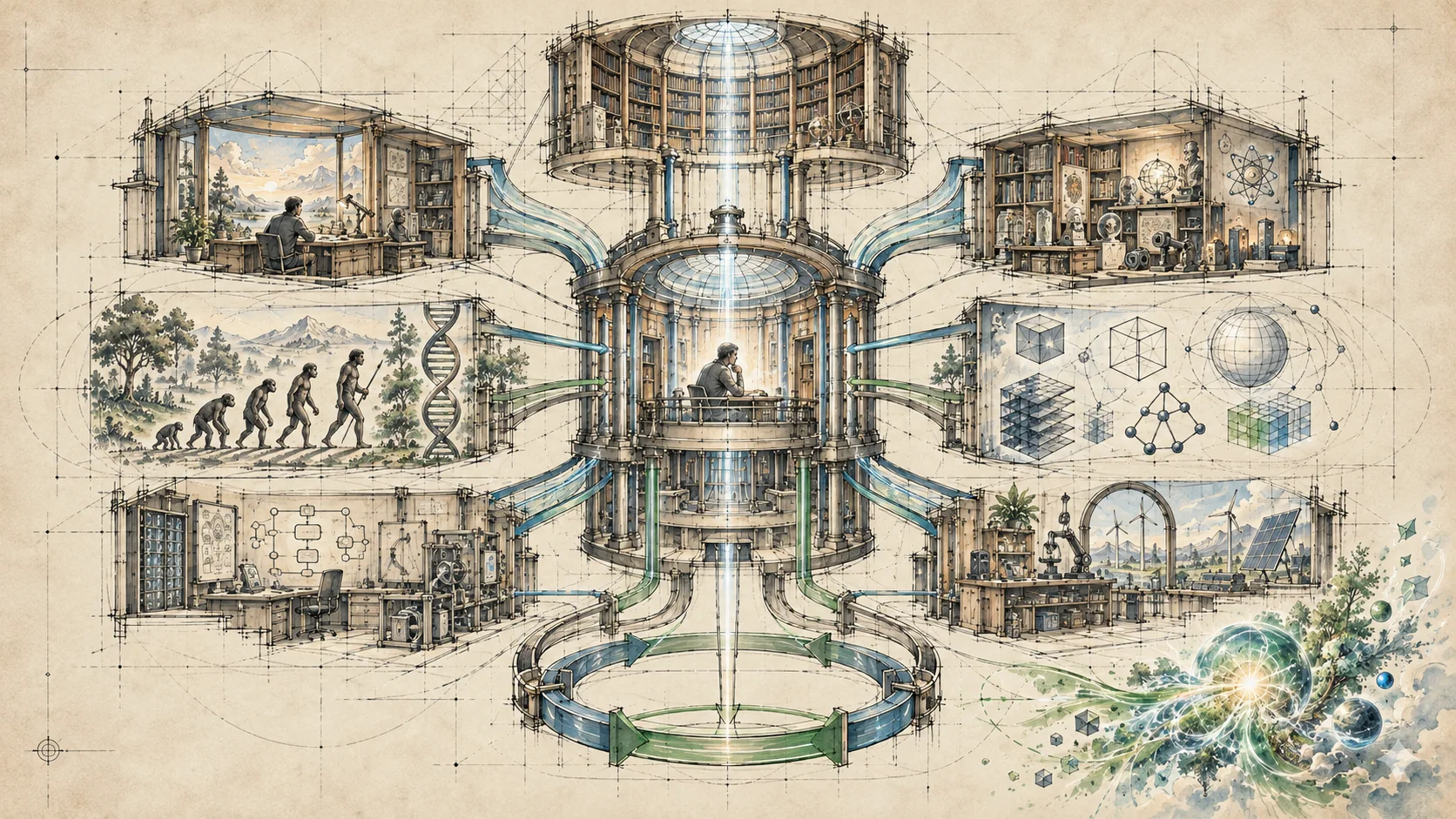
Refactor. The architecture is now the problem. The architecture must be implemented and allowed to run. If we understand it, we can program it. If we don't, we'll learn a great deal in trying.
A biological organism produced by evolution can understand evolution. A physical system can create explanations of physics. A person can build a universal computer and use it to investigate computation. And despite all of this, we still do not know how you produce a genuinely new explanation. We still don't even have a name for it. That will come after it is explained. For now, the still-unexplained capacity to produce genuinely new explanations will be called explanatory creativity.
The phrase is compact. The problem it names is not. The scale of what has been explained is enormous. The remaining ignorance is infinite. That too is universal.
Ignorance can produce awe in the older sense of the word. Not fatalism. Not mysticism. Awe at what appears to be possible, at how much has already been explained, and at the infinite extent of what remains unexplained.
The category of person begins to look ordinary, our machines quaint, and the universality of you, extraordinary.
Are you tired? This is effortful. Pace yourself...
Absolutely not. Our problems are urgent. Allowing our best explanations to reach us as individuals may change us, our policies, and our technology. It may change what you seem to be, what seems possible, and sharpen what mysteries remain.