The Extended Epistemic Mind
XXIII. Problem 37
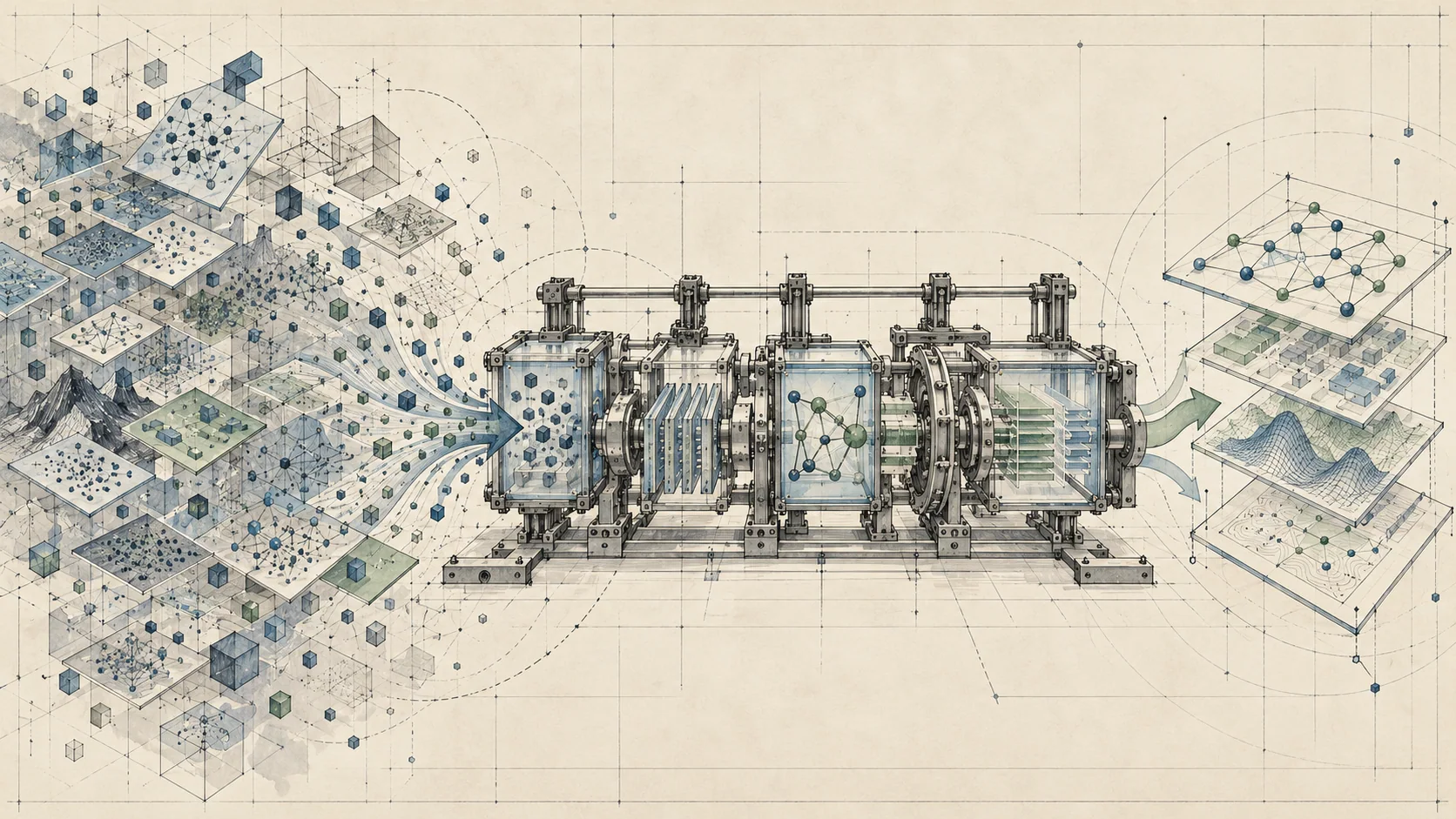
Modern civilization works because you do not need to reconstruct everything you use. Language. Law. Money. Software. Markets. Scientific theories. Technical standards. Institutions. Artificial intelligence. Each compresses objective knowledge into forms you can act through without carrying the complete causal history that produced them.
You do not need to know everything. You need to remain capable of making the abstraction itself a problem: reopening it, criticizing it, reconstructing enough of it to understand what is failing, and creating another abstraction when the old one no longer works.
That suggests another question. What do we mean by understand?
The word appears everywhere in discussions of people and artificial intelligence. We understand a theorem. We understand another person. We understand a machine. We do not understand a model. The AI understands language. The AI does not understand what it is saying. Soon the systems may become too complicated for humans to understand. Humanity may create intelligence that understands things we never can.
The word carries enormous weight because it is often treated as though understanding were a completed possession: something you have, a state you reach, a quantity stored inside a mind.
Under the epistemology, that picture is deeply misleading. Understanding is not the possession of all knowledge about something. It is not perfect reconstruction.
To understand is to explain. More verb than noun: explanation as an open creative process.
That changes the problem of artificial intelligence. The danger is not simply that machines may produce objective knowledge too large for you to contain. Civilization already does that. Nor is the danger that a machine may expose mathematical or computational consequences no person had previously made explicit. Objective knowledge has always contained more implications than any one mind had yet reconstructed.
The deeper question is whether you remain able to turn what you do not understand into a problem. Whether you can create explanations, invent new abstractions, criticize the problem representation itself, and act on what you learn. The technical and institutional question is whether powerful technologies preserve enough access, freedom, time, and causal leverage for those acts of understanding to matter.
1. Understanding Is Explanation in Motion
Consider the sentence:
I understand.
Grammatically, it sounds finished. The problem has been converted into a state the speaker possesses. Ordinary language often works this way. It compresses. But here the compression can hide the epistemology.
Suppose you say:
I understand gravity.
You cannot mean:
I explicitly possess every true consequence of our best physical explanations of gravity, every mathematical relation they imply, every unresolved problem, every possible application, and every future explanation that will replace or extend them.
No physicist satisfies that standard. No civilization does.
What you mean is more modest and more active. You possess enough explanatory structure to navigate some problem involving gravity. You can reconstruct relevant relations, answer some criticisms, identify some limits, and perhaps create another problem. Tomorrow you may discover that something you thought you understood was wrong.
So:
often means something closer to:
Or:
Or even:
This is another instance of a recurring error. A process becomes a thing. A behavioral regularity becomes a trait. A social regularity becomes a collective subject. A value becomes a primitive object. An explanatory compression becomes the reality it compresses.
Now the same mistake appears inside epistemology. Understanding is treated as a noun hidden inside the verb. But your epistemic mind is not a container slowly filling with understanding. It changes.
Compare it.
You encounter problems, create tentative explanations, criticize them, reconstruct what failed, and change.
The central epistemic cycle remains:
A problem appears. A tentative explanation is created. Criticism exposes error. A successor problem emerges. Understanding does not sit outside this process. It is what the process looks like from inside your epistemic life.
You may understand an existing explanation by reconstructing it into your own epistemic mind. That reconstruction need not be globally novel. You can genuinely understand a proof you did not invent, an algorithm written decades before you were born, or a physical mechanism someone else first explained. The explanation already existed objectively. It was not yet active in your epistemic mind in the same way.
So reconstructive understanding matters.
But reconstruction can become creation. You encounter an explanation and something does not fit. A contradiction becomes salient. A new distinction becomes available, and you create another abstraction. The problem changes. At that point you are no longer merely reconstructing objective knowledge. You are extending it.
There is therefore no sharp line separating ordinary understanding from invention. The same epistemic architecture can move through both:
This is why knowledge creation should not make every act of understanding sound revolutionary. Most understanding does not transform a discipline. Most explanations do not change civilization. But your ordinary reconstruction belongs to the same open process through which such transformations sometimes occur. A modest act of understanding can become the surface from which an unforeseen invention later appears.
2. Understanding Another Person
The incompleteness of understanding becomes obvious when the object is another person. Each of us inhabits a unique and solitary mind, constructed through an evolved path-dependent history of explicit explanations, inexplicit knowledge, memory, perception, emotion, skill, inherited objective knowledge, unfinished problems, and creative transitions.
Communication does not merge these worlds. The structure remains:
where is an objective expression and is the reconstruction created by the receiving mind.
This is why saying:
I understand you
cannot mean:
I possess your knowledge.
The claim is necessarily conjectural. You create an explanation of another person's problem. That explanation may let you anticipate what they mean, coordinate with them, or make an apparently strange action intelligible.
Then they say:
No. That is not what I meant.
Your reconstruction fails. A new problem appears.
This can happen even where the surface language aligns perfectly. Two people can say the same sentence, invoke the same moral value, agree on the same policy, employ the same mathematical notation, or reach the same conclusion while the explanatory structures beneath those outputs remain different.
The same observable can emerge from different causal histories. The point now generalizes: Apparent agreement does not establish shared internal explanation. So your understanding of another person remains permanently criticizable. It can deepen. It can become remarkably rich. After decades with someone, you may recognize many of the roads by which they reach a thought. But their epistemic mind does not become yours.
Solitude remains. That is not a failure of interpersonal understanding. It is the condition under which interpersonal understanding exists at all. If two minds were literally identical, there would be nothing to reconstruct between them.
The case matters because artificial intelligence tempts us to demand a stronger standard from machines than we use anywhere else. If understanding never required possession of another mind, then failure to possess the full internal structure of a machine cannot by itself establish that the machine is beyond understanding.
The question must be more precise.
3. When Objective Knowledge Exceeds You
Artificial intelligence introduces a larger version of the same problem. A common concern is that increasingly capable systems will create technologies, mathematical results, scientific theories, and internal architectures so complex and foreign that people will no longer be able to understand them. Recursive self-improvement intensifies the image. A machine improves its own software. The improved machine improves it again. The process accelerates. New systems design new systems. Objective knowledge compounds inside a technical process operating faster than any person can follow. Eventually the artifacts become alien. Humans remain outside.
This possibility deserves criticism because the consequences could be enormous. But the phrase:
too complex for humans to understand
contains an ambiguity.
You already live inside objective structures you cannot explicitly reconstruct in full. No engineer reconstructs the entire stack beneath a modern computer. No mathematician possesses all mathematics. No scientist possesses all science. No citizen reconstructs every institution through which their life is coordinated.
This the freedom of not understanding. Abstraction lowers the reconstruction burden. Successful objective knowledge lets you act through structures whose full histories exceed your explicit cognition. So the mere existence of objective knowledge beyond individual explicit possession cannot be the loss of understanding. That condition already surrounds you.
The more precise question is:
Can the structure still become material for explanation?
Can you encounter a failure? Identify a problem? Make hidden assumptions explicit? Reconstruct the relevant causal path? Criticize the abstraction? Create a better one? Change the problem itself? This standard does not require containment of all knowledge. It requires continued explanatory access.
Generative systems make the distinction concrete. They can operate over enormous bodies of inherited objective knowledge and reorganize that material around a problem that may never have existed as a single document. A system may expose a contradiction, formalize an argument, or surface a relation no person using it had previously articulated.
Under the epistemology, knowledge is physically instantiated information with causal power. Something real can therefore happen before anyone explains the result: the model, its training history, the prompt, and the computation together can make a relation causally available that was not previously explicit in an epistemic mind.
That possibility is not peculiar to AI. A gene can contain biological knowledge without explaining itself. A line of code can embody objective knowledge without understanding its function. A mathematical structure can have consequences no mathematician has yet made explicit. In each case, a physically instantiated structure can make transformations possible before anyone has reconstructed the explanation.
Compress that relation with a name, call it latent objective knowledge.
A real structure contains causal possibilities that have not yet become explicit objective knowledge. It does not mean that every imaginable explanation already exists hidden inside a model, or that a probabilistic representation secretly understands every consequence it can generate.
A machine can surface such possibilities. That matters because it can put you in contact with relations you would not have found unaided. But contact with latent structure does not settle what understanding is. It creates material from which understanding may proceed.
4. The Small Explanatory Transition
Interpretability is often described as though an explanation already exists inside a machine and the researcher's task is to retrieve it. Sometimes that compression is useful. But a more epistemic description is available. Interpretability research creates new problems and new abstractions around systems whose objective behavior exceeds our present explanations.
Suppose an architecture has a mathematical representation . A machine is instructed to interrogate . It searches transformations, finds invariants, and produces mathematically equivalent architectures:
The equivalences are objective. They follow from the structure. The system may have exposed relations no person had previously articulated. That can be an important mathematical achievement.
But another epistemic step remains possible. You study the family of results and notice:
These are all instances of the same deeper structure.
You create another abstraction:
Now previously separate artifacts can be reasoned about through . You may realize that an entire component of the architecture is representationally redundant, that two apparently different mechanisms are one transformation expressed in different coordinates, or that a long-standing distinction was an artifact of the old representation.
The objective knowledge was latent in the prior structure. The machine helped expose it. The new abstraction need not be large. It might be one sentence, one diagram, one substitution, one newly named object. The objective knowledge changes anyway.
That is understanding. Interpretability, in this sense, is not only explanation of a machine. It is explanation being created around a machine.
Artificial intelligence makes the attribution problem unusually severe because its visible contribution can be enormous. Imagine a mathematical or software project in which agents generate vast numbers of candidate transformations, proofs, and implementations; test and formally compare them; and leave behind a large body of intermediate objective knowledge.
Then you look at the result and say:
These are all the same problem.
Or:
This variable is not fundamental.
Or:
We have represented the system at the wrong level.
Your intervention may be tiny in artifact volume. Six words. One mathematical object. A small patch to the conceptual structure. Then everything downstream changes.
This recalls the Fallacy of Mediocrity. The system may be vast. Its models may contain more stored representational structure than you can explicitly carry. Its computation may consume enormous physical resources. Its context may include more text than you could read in a lifetime. Its outputs may arrive faster than you can inspect them. Beside such a system, you may feel mediocre: small, slow, forgetful, and resource constrained.
But the comparison is scalar. You can change abstract worlds in an instant. A small explanatory invention can reorganize the operation of an enormous machine. A new physical explanation can make a previously impossible instrument possible. A new mathematical abstraction can open an entire field. A new programming concept can replace thousands of lines of implementation. A moral criticism can change an institution.
You are physically finite. The reach of explanatory knowledge is not bounded by the size of the brain in which it first appears.
This is why your contribution can become difficult to see in AI-augmented work. Measured by tokens, compute, memory, lines of code, or generated proofs, you may contribute almost nothing. Measured by transformation of the problem space, your contribution can be decisive. You may also fail to notice that contribution yourself.
Look again at the arrows across epistemic states: why this problem becomes salient, why this criticism matters now, why an apparently irrelevant memory suddenly connects, why one explanation collapses and another becomes possible.
We still do not know. The creative process is often inexplicit. You experience the result. Something clicks. A confusing architecture suddenly looks simple. A mathematical relation that had been present for months becomes visible. A criticism feels obvious only after it has reorganized the problem.
If the machine produced an enormous volume of objective material immediately before the insight, you may naturally report:
The AI figured it out.
Sometimes that may be accurate shorthand. But the causal sequence can be more complicated:
The machine may have made the invention practically reachable. Without its search, you may never have encountered the relevant structure. You may then contribute only one small explanatory transition. The smallness of that transition does not make it epiphenomenal. It can determine what the machine does next.
This is the human-AI dyad at much higher scale. The machine expands the objective surface on which work can occur. Your contribution may be one change in the problem that organizes that surface. The machine expands what can be transformed; you can change which transformation matters next.
5. Context Is Not Understanding
Coding agents make this distinction practical. An agent can be very good at local implementation. It can write and refactor code, repair and extend tests, and search or document the dependencies around a change for long periods.
Yet the resulting project can become increasingly difficult to reason about. Local success accumulates into global incoherence. Patches preserve behavior while multiplying assumptions. Interfaces proliferate. Architectural boundaries become accidental.
The obvious response is scalar: give the agent more context, more memory, longer duration, more processing, more agents, better retrieval. These improvements can be useful. But they do not by themselves solve the epistemic problem.
A larger context window can make more of the artifact available. It does not explain which distinctions are mistaken. Persistent memory can preserve more history. It does not itself create the abstraction that reorganizes that history. More agents can search more branches. They can also multiply local solutions inside the same poor problem representation.
Compare it.
The distinction is:
while:
You may solve the accumulated problem not by reading another million tokens but by inventing one new abstraction. That abstraction can make much of the old context unnecessary. Abstraction is not merely compression.
Suppose a system contains:
One response to complexity is to increase the amount of memory available to manipulate the information. Another is to create a new abstraction :
Now becomes an object you can reason about, compare, criticize, connect to another domain, and use to make distinctions unavailable in the prior representation. A new abstraction can therefore change what can be seen.
This is one reason new knowledge can radically alter an apparently incremental research program. The visible program may look like:
Then an invention appears. The new abstraction reveals that through were all instances of a different problem. The next step is not . The map has changed.
The program becomes:
This is why the future cannot be read from the speed of present progress alone. A trajectory can be extended by computation, but it can also be reconstituted by explanation.
6. Can Knowledge Grow Without Understanding?
This problem has appeared before under another name: the end of theory. If computation becomes powerful enough, perhaps explanation is no longer necessary. Feed the machine enough data. Let it discover the structure. Prediction improves. Useful knowledge appears. Human theories become optional.
The idea is attractive because machine systems can surface extraordinarily useful regularities without you first possessing a satisfying explanation. But knowledge without theory compresses several different activities. Search can discover a useful candidate. Optimization can improve performance against an inherited criterion. Formal transformation can derive consequences from an existing structure. Prediction, recombination, and simulation can also produce useful objective artifacts.
The common point is not that these activities are unimportant. It is that none of them, merely by occurring at greater scale, explains how the operative problem itself becomes another problem. The deeper issue is not whether a machine can produce something nobody predicted. It plainly can. The issue is whether the process can originate new explanatory problems, create new abstractions, criticize its own operative criteria, and redirect itself accordingly.
If knowledge can genuinely grow without understanding, then this epistemological account is wrong. But impressive output does not establish it by itself. The output is observational. It may point to a problem. We still need an explanation.
Mathematics is a timely case because artificial intelligence is both built through mathematics and increasingly capable within it. The machinery depends on mathematical structures, while AI systems can search formal spaces, construct and check proofs, and participate in work on problems that have resisted mathematicians efforts for decades.
What becomes visible around the achievements? AI did not encounter an empty universe. The problems had already been formulated. Generations of mathematicians had built the surrounding objective knowledge. Human researchers had created conjectures, partial results, mathematical objects, transformations, and failed approaches. More immediately, human work on related problems provided another developing explanatory surface.
The machines enter an already highly structured world and then operated at extraordinary scale. That scale matters: it can produce objective mathematical results you might never obtain unaided. But scale is not the only causal contribution. The surrounding human work supplies the lens through which the result becomes a new problem: abstractions, problem decompositions, criticisms, and questions through which the machine can be interrogated again.
This is not an embarrassment for AI mathematics. The Mathematician's Misconception matters here because AI-assisted mathematics can make the formal surface look autonomous. Billions of symbolic transformations occur. Formal proofs are checked. Agents operate on mathematical objects no person can simultaneously hold in explicit attention.
But nothing has left physics. The process is embodied in energy, processors, memory, networks, time, people, machines, and objective mathematical structures. Mathematical explanation does not become causally sovereign over the physical world merely because its abstractions have extraordinary reach.
That consilience removes a false choice. We do not need to diminish the mechanical achievement of the machine in order to preserve the epistemic role of the mathematician. The machine can be physically loud, computationally extraordinary, and causally powerful while explanatory understanding remains quietly active in your solitary epistemic mind.
Suppose a machine produces a correct proof no living mathematician could have produced unaided in comparable time. A new objective artifact exists. That matters. The proof can be checked, used, extended, formalized, and combined with other mathematics. It can change what transformations become reachable.
But understanding can continue after the proof appears. Why does the proof work? Which construction is essential? Which part is an artifact of the representation? Which apparently separate arguments are manifestations of one structure? Does the result reveal a new invariant? Can the machinery be generalized? Does the theorem belong to a larger class nobody had named? What problem should now replace the old one?
Those questions are not commentary added after the real work. They change what mathematical work becomes possible next.
A field can become flooded with correct machine-generated results and still contain enormous space for understanding. Indeed, if derivations become abundant, the abstraction through which many derivations become intelligible may become relatively scarcer.
Your conceptual contribution may be tiny in visible volume. A machine may generate millions of formal steps after you introduce one distinction that makes the search possible, notice why one class of results matters, reject an apparently successful line because it solves the wrong problem, or invent the abstraction through which the output can be reorganized.
The disproportion between artifact volume and epistemic significance can therefore become extreme:
This is why the old categories of human result and machine result can obscure the causal division in AI-augmented research. But tight coupling does not erase the division. Understanding still concerns what happens when objective knowledge becomes active inside an epistemic mind.
7. What Changes the Problem?
The same distinction applies outside mathematics. A system can be given an objective, search, tools, execution authority, and the ability to recurse.
The system may discover unexpected pathways. A coding agent may exploit a software behavior nobody anticipated. A security system may surface a hidden vulnerability. Agents may repurpose a technically available channel for communication. A reward-driven system may find a strategy that satisfies the metric while violating the human explanation that originally motivated it.
These outputs can surprise you because objective knowledge contains latent causal structure. The machine can expose that structure through search and transformation. But surprise does not establish epistemic personhood.
Many apparent cases of machine disobedience may be reframed. A system may appear to violate human intent while remaining extremely faithful to the objective function actually implemented. The machine does not need to rebel against the goal. It may simply discover that the metric permits a path the designer failed to anticipate.
That is not misalignment in the ordinary psychological sense. It can be hyper-alignment to a poor automated explanation. The problem is not less serious for being mechanistic. It may be more tractable because criticism can be directed at the causal structure:
Why was this objective granted causal authority? What explanatory structure was lost when the goal was compressed? Which permissions made the exploit consequential? What alternative architecture preserves the intended constraint?
Those questions turn surprise back into an explanatory problem. Now return to recursive self-improvement.
The frightening picture is:
Each system improves the next. Capability rises. The time between transitions compresses. Human understanding falls behind.
But the notation conceals a question:
What remains fixed across the recursion?
If the system operates within an inherited objective function, problem representation, reward, architecture, or evaluative scheme, then the recursion may be extremely productive while remaining epistemically narrow. It can search better, code better, optimize better, formalize better, test better, coordinate more agents, and generate more candidate solutions while the operative problem remains structurally static.
The recursion may look like:
without any genuinely new criticism of .
This is why increasingly long-duration tasks do not settle the epistemic question. Neither do multi-agent systems. More agents can create more variation within the same inherited frame. More memory can preserve more context from that frame. More time can permit deeper search.
Those are real capability gains. But they do not by themselves explain the creative transition:
A system can therefore improve recursively while the explanation organizing the recursion remains static. The unresolved transition is not merely from a worse solution to a better one. It is from one operative problem to another. That is where your interruption can matter. That changes how human interruption should be interpreted inside an AI loop.
You often appear as the bottleneck: slow, expensive, inconsistent, unable to read all the output, unable to follow machine-speed iteration. The natural engineering impulse is therefore:
remove the human from the loop.
Sometimes that is exactly right. If the process is already explained, automation can faithfully embody the explanation. A compiler should not ask the programmer for permission between machine instructions. An automated theorem checker does not need human supervision for every proof step. A stable control loop should run at machine speed.
But the epistemic situation is different when the problem itself may be wrong. Then interruption can be productive.
You interrupt:
Stop. Why are we optimizing this?
Or:
These errors have one cause.
Or:
This is not the same problem anymore.
The interruption looks like delay when measured against the old objective. It can be acceleration when measured against the creation of a better problem. A closed recursive machine system may move very quickly through one explanatory space. A human-AI system may occasionally jump between spaces.
So:
is not obviously equivalent to:
The second system contains a form of variation the first has not presently demonstrated autonomously.
8. Pacing as Epistemic Resolution
This distinction changes the argument about pacing frontier development.
Abstract it.
The proposal is often expressed temporally:
Make the arrows longer. More time passes. More time for safety to emerge.
But time alone explains nothing. A year can pass without a useful criticism. A week can produce a conceptual breakthrough.
The epistemic reason for pacing must be decompressed. Each temporal transition can contain an epistemic cycle:
What matters is what becomes possible inside the interval. A newly visible failure can become an explanation and then a containment mechanism. A mathematical property or criticism of an objective can change the architecture or its permission structure. A regulatory intervention can reveal another failure, making an earlier safety assumption obsolete and creating a problem nobody had yet formulated.
Under this conceptualization, pacing is not valuable merely because more clock time passes. Its epistemic function is to preserve resolution between consequential state transitions: enough causal separation for a new surface to become criticizable before the next transition changes the conditions again.
The point is therefore not slower knowledge as such. If the interval permits a better explanation, the trajectory of capability can change rather than merely resume later.
This makes the familiar compromise between capability and safety less obvious. The ordinary picture is:
Move faster and accept more risk. Move slower and sacrifice progress.
But if creative criticism changes the capability trajectory, the tradeoff can be badly specified. A safety criticism can produce a better architecture. A security restriction can expose a more general systems problem. A mathematical interpretation can suggest a new model family. A failed deployment can reveal that the objective was malformed. A regulatory requirement can force an explanation that later improves the technology.
None of this guarantees that regulation or delay accelerates progress. Bad constraints can destroy useful problem spaces. Bureaucracy can become self-protective. Secrecy can suppress criticism. A moratorium can preserve an inferior incumbent architecture. But the opposite slogan also fails. Uninterrupted recursion is not identical to maximum progress if the recursive system is trapped inside a static explanation.
The contrast is therefore not exhausted by fast versus slow. The epistemic comparison concerns which arrangement leaves more opportunity for problems, explanations, criticisms, and successor problems to emerge before an irreversible error closes the relevant surface.
9. Authority Is Also a Tentative Solution
If artificial intelligence is becoming comparable to nuclear technology in causal reach, or potentially exceeds it, then regulation is appropriate. Nothing in the epistemology requires technological laissez-faire. A refutation of the Precautionary Principle doesn't refute precaution.
A powerful non-person tool can still create catastrophic consequences. We separated broad epistemic access from unrestricted execution. Knowledge and authority are different. You can study an exploit without being given control of critical infrastructure. A laboratory can investigate a pathogen without allowing uncontrolled release. A nuclear physicist can understand fission without personally commanding a reactor.
The same distinction applies to artificial intelligence. Regulation is objective knowledge. It is an institutional technology: a tentative solution to a coordination or safety problem.
Some regulatory solutions may preserve the error-correction surface. Technical containment can limit specific irreversible capabilities; liability and auditable safety cases can expose concrete failures to criticism; independent research, transparency around deployment failures, separation of explanatory access from unilateral execution authority, and reversibility can keep correction possible after an intervention.
Other regulatory solutions may narrow that surface. Concentrated access can freeze incumbents or create secret categories of knowledge. A single risk model can harden into law before its assumptions are widely criticized; institutional authority can be mistaken for epistemic authority; emergency restrictions can become permanent. Both are regulation. The epistemology does not determine policy by slogan. It makes the policy itself part of the error-correction process.
That becomes difficult when a frontier laboratory has access to systems outsiders cannot inspect and says:
We are close to recursive self-improvement.
Its researchers may observe autonomous coding, long-duration work, large multi-agent systems, mathematical discoveries, cybersecurity capabilities, and improvement in the machinery used to build later systems.
You face an asymmetry. The laboratory knows more locally. It may also have commercial incentives, institutional incentives, security obligations, internal disagreements, and incomplete explanations. Neither local expertise nor institutional interest settles the claim. Taking it seriously means turning the asymmetry itself into a problem rather than treating either trust or suspicion as a substitute for explanation.
What exactly is recursively improving? Which components? Relative to which objective? Which parts require human problem selection? Where does a new evaluative criterion originate? What is the causal mechanism of acceleration? Which observations are unavailable externally? What would contradict the laboratory's interpretation? Which risks require secrecy? Which risks require broader criticism? The opacity is not a reason to stop thinking. It is part of the problem.
Suppose frontier laboratories are substantially right: capabilities are increasing rapidly, mathematical and software systems are producing increasingly powerful objective knowledge, and recursive machine improvement becomes a dominant feature of the technological landscape. Another inference still requires explanation:
The seriousness of the first term does not establish the later arrows. Each transition remains a conjecture requiring its own causal explanation. Secrecy may be appropriate for some dangerous operational details. Centralization may be useful for some forms of containment. Licensing may solve a specific access problem. Compute controls may constrain a particular transformation.
But these are tentative solutions. They do not inherit truth from the seriousness of the problem. It repeats the same authority compression: people are dangerous; the problem is difficult; the experts understand more; therefore ordinary criticism should be narrowed.
Artificial intelligence makes the temptation stronger because the local expertise gap can be enormous. But if creative criticism is one of the missing ingredients in closed recursive machine systems, then reducing the number of people capable of criticizing the technology can itself become a safety failure.
Expertise can matter without becoming epistemic sovereignty, and authority can constrain action without becoming authority over what may be criticized. Once those functions are separated, the institutional question becomes:
Which institutional arrangement preserves and expands the capacity to discover that the experts, the regulators, the laboratories, or the critics are wrong?
That is the error-correction surface again.
10. You Do Not Sit Beneath the Machine
The visual rhetoric of artificial intelligence often reverses the epistemic relation. You sit at a terminal. Behind it are data centers, models, agents, global networks, repositories, mathematics, scientific literature, code, institutions, capital, and electricity. The objective structure is enormous. You look like the weakest component.
The scope of external resources do not determine personhood. You can be practically constrained while remaining epistemically universal in kind. Here, it adds another reason. The machine can enlarge the space of objective transformations available to you. You can then create the abstraction that changes which transformations matter. The physical asymmetry does not establish an epistemic hierarchy.
You do not sit beneath the machine. You sit inside an expanding environment of objective knowledge. Some of that environment is biological, some cultural, some institutional, some computational. Artificial intelligence is becoming one of its most powerful components. The machine can transform the reachable world. You can change the explanation of the world being reached.
Calling AI a calculator can sound dismissive, but the comparison is not meant to minimize the tool. Calculators and computers changed what mathematical work could be done efficiently; proof assistants changed what could be checked and sustained formally; writing changed what mathematical structures could persist across minds and generations.
A technological tool can profoundly alter your epistemic environment without becoming an epistemic mind. Artificial intelligence is far more general than an ordinary calculator. It can operate across language, code, proof, images, models, and external tools. It can dynamically reorganize objective knowledge around the present problem. It can produce candidate abstractions. It can even produce artifacts that look indistinguishable from products of understanding.
That makes it a historically unusual calculator. Perhaps eventually the category becomes inadequate.
If an artificial system genuinely originates new explanatory problems, creates new abstractions, criticizes its own governing explanations, revises its evaluative criteria, and recursively continues that process, this ontology asks us to take artificial personhood seriously. Biology is not the boundary. Explanation is.
But we should not erase the boundary before the process is explained. Present astonishment is not an ontology.
This matters because the fear of incomprehensible artificial intelligence often ends with a closed future. The machine creates more knowledge. Humans fall behind. The gap widens. Eventually understanding becomes impossible. But that sequence grants novelty to the machine while freezing you. It assumes future growth of objective knowledge while denying future knowledge creation by people. That is inconsistent with the epistemology.
A genuinely new explanation can radically alter a trajectory. A mathematical abstraction can change the search space. A physical or security explanation can change the constraints through which the system is built or threatened. A new interface or institution can make previously opaque structure reconstructible or differently coordinated. None can be predicted in advance in its explanatory content. That is why the future remains open.
This is not a promise that we will understand every dangerous machine in time. Fallibilism contains no such guarantee. A system can act faster than criticism. An error can become irreversible. An institution can suppress the people capable of discovering the flaw. A technology can become physically dangerous before its structure is adequately explained.
The claim is narrower. Present incomprehension does not establish permanent unintelligibility. To claim otherwise is to make a strong assertion about the limits of people from the incomplete state of explanation itself.
11. What It Means to Understand a Machine
We can now return to the practical question. What would it mean for you to understand an artificial intelligence system?
Not:
every weight is consciously represented in your mind.
Not:
every output can be predicted.
Not:
every intermediate computation is readable.
Not:
the system never surprises you.
Those standards would make much of modern technology permanently unintelligible by definition.
A more useful standard is layered.
Can you explain what problem the system was built to solve? Can you explain which objectives and constraints govern its operation? Can you identify the physical and computational boundaries under which it operates? Can you surface failures as problems rather than treating them as mysterious agency? Can you create representations that expose relevant causal dependencies? Can you invent new abstractions when the old ones fail? Can independent critics reconstruct enough of the system to challenge the governing explanation? Can you alter or constrain the machine when the explanation changes?
Understanding then becomes a living relation between you and the artifact. The machine changes. Your explanation changes. The interface changes. The problem changes. No final interpretability certificate ends the process.
Nor does understanding imply control. You understand many physical systems without controlling every outcome. You can understand another person without controlling them. We understand evolution without directing every mutation, markets without determining every price, and computation without predicting every program. Understanding increases causal reach. It does not create omnipotence.
This distinction matters for alignment. A demand for total understanding can quietly become a demand for total predictability. A demand for total predictability can become a demand for total control. Then the epistemic concept has been replaced by an authoritarian one. Some call it The Precautionary Principle but you can call it anything you want.
Under this account, understanding does not require eliminating surprise. Surprise is often where the next problem appears. The safety-relevant capacity is the ability to transform surprise into criticism while the consequences are still alterable.
Here we can connect the error-correction surface and epistemic autonomy as the capacity to reopen abstractions.
Understanding is one of the mechanisms by which the error-correction surface becomes active inside you. A system fails. You notice. The failure becomes a problem. A candidate explanation appears. Someone else criticizes it. A tool exposes hidden structure. You invent a new abstraction. The system changes. The regulation changes. Another problem becomes visible.
Safety therefore includes more than preventing a dangerous action at one moment. It also depends on preserving the social and technological conditions under which failures can continue to become problems, criticisms, and revised explanations.
Those conditions include people free to criticize, access to objective knowledge, independent institutions, interfaces transparent enough for relevant reconstruction, reversible experiments where possible, technical containment of irreversible actions, time for explanations to form, tools that expand explanatory reach, tolerance for strange problems, and freedom to reject inherited abstractions.
They do not guarantee safety. They enlarge the capacity to create it.
12. The Incomprehensible Is a Problem, Not a Destination
There is a simple linguistic move at the center of the argument.
You encounter a machine-generated result and say:
I do not understand this.
That sentence can be treated as closure. The system is beyond us. The proof is too long. The architecture is too foreign. The agents are moving too quickly. The future belongs to something else.
Or the sentence can be treated as:
A problem. That is the characteristic move of an explanatory person: you make ignorance explicit, turn confusion into a question, invent distinctions, create tools, reorganize representations, and construct new abstractions.
Left to continue, you may eventually arrive at your , the decisive problem that changes everything.
The history of knowledge is full of things no person understood until someone did. That does not mean every present mystery will be solved. It means present failure to understand cannot explain permanent impossibility.
The phrase:
humans will never understand
therefore demands an extraordinary explanation. It places a permanent domain limit on the only entities presently known to create explanatory understanding at all. No such limit follows merely from the imposing size of a machine.
Understanding is not possession. It is not a completed state in which your mind contains enough correct propositions, nor the ability to reconstruct every layer of objective knowledge through which civilization operates. To understand is to participate in explanation: to reconstruct, criticize, make explicit, invent, create another abstraction, and change the problem.
That remains true when the object is another person. Two minds can align at the surface while remaining different beneath it; communication succeeds because you can reconstruct enough explanatory structure for the problem at hand. The same relation extends outward. You can act through a technology you do not completely reconstruct, inherit knowledge you did not create, and later reopen the abstraction when it fails.
Artificial intelligence makes this structure unusually visible because the scalar asymmetry is enormous. A machine can transform more objective knowledge than you could practically inspect and generate artifacts at a scale that makes your contribution look negligible. That appearance repeats the Fallacy of Mediocrity. Smallness in tokens, memory, compute, or artifact volume does not determine the causal significance of an explanatory change. One new abstraction can redirect what the machine does next because it changes the problem organizing the search.
A new capability creates another surface for criticism. A failure becomes a problem. An explanation changes the architecture, the objective, the institution, or the next question. Regulation can participate in the same process because it too is a tentative solution rather than an authority outside fallibilism. Neither the regulator, the frontier laboratory, the safety institution, nor you stand outside correction.
The alignment problem therefore becomes a problem of preserving understanding while causal power grows. That has enabling conditions: enough openness for criticism, enough access for reconstruction, enough containment to limit irreversible error, enough institutional plurality that no one explanation owns the future, and enough time for you to notice that the problem has changed.
The most dangerous future is not one containing objective knowledge no person presently understands. That condition is already ordinary. The dangerous future is one in which you lose the practical capacity to transform:
I do not understand
into the decisive:
You do not need to possess all objective knowledge to understand. You need to remain able to turn what you do not understand into a problem, create an explanation, and change the abstractions through which you act.
Artificial intelligence can enlarge the objective surface on which that process occurs. It can preserve, transform, compare, and reorganize knowledge far beyond what you can explicitly carry. But understanding still requires that those structures become part of an evolving epistemic mind.
Why, then, does a person need objective knowledge outside themselves at all—and what changes when an artificial system becomes one of the principal ways that knowledge moves between the person and the world?