
The Solitary Explainer
II. Populations, Fast and Slow
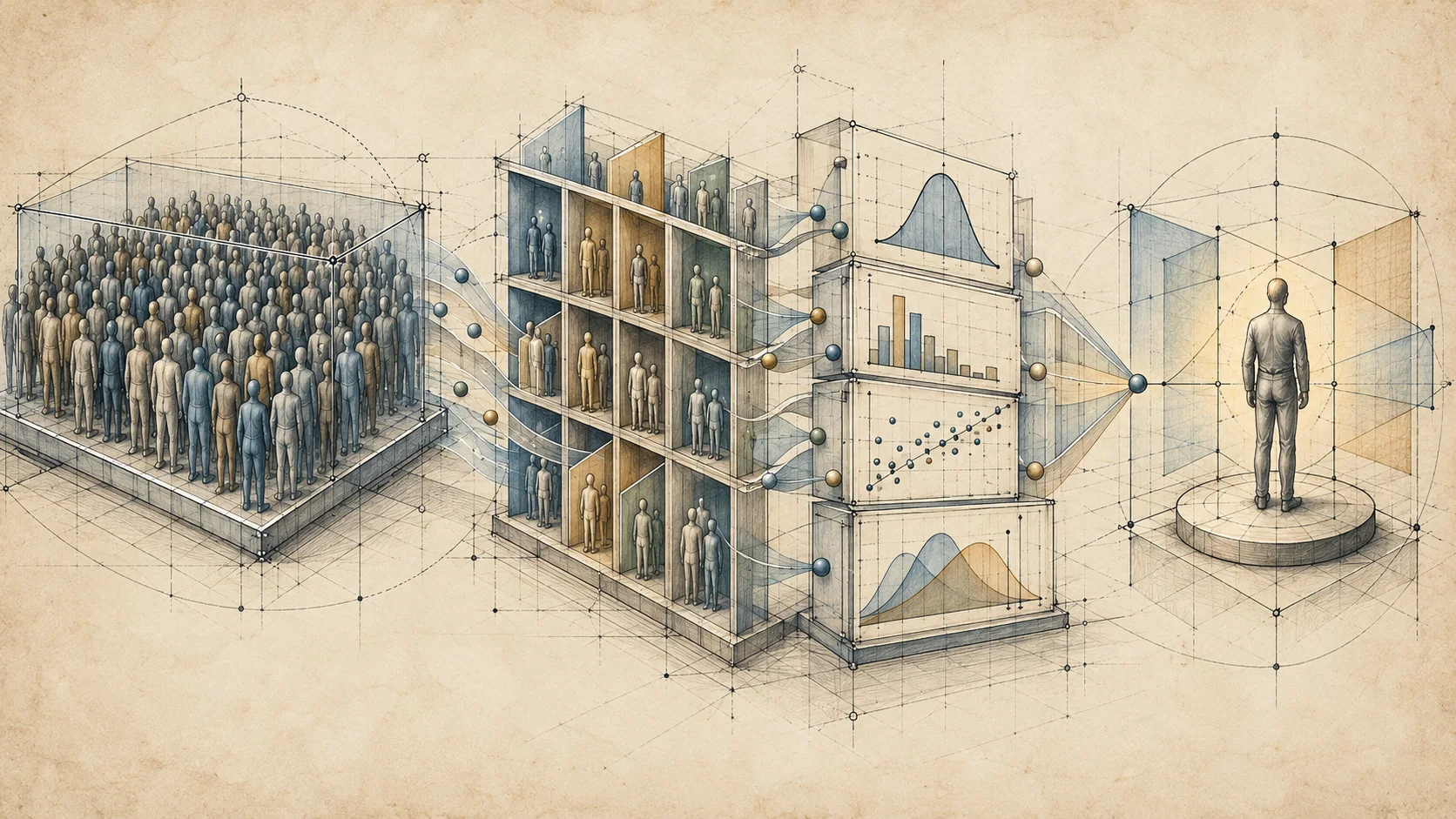
What happens when psychological constructs built from populations are used to explain individual people?
The constructs, formulated in research papers, enter psychology as a profession, a clinical practice, an institutional technology, and a way of talking about individuals.
The epistemic question changes with that move. It is no longer only whether a population-level construct corresponds to a stable psychological entity. It is whether knowledge created from relations among people can legitimately travel into explanations, diagnoses, interventions, and judgments about one particular person.
Compare it.
Population research can establish recurring differences, covariances, treatment-response averages, risks, and predictive regularities.
State the new problem.
What structure is operating in this case, how did it come to operate, and what would have to change for the outcome to change?
The two forms of knowledge can bear on one another. They are not interchangeable. Something additional is needed to carry a result established among people into a causal claim about one person.
Classification is one way that transfer happens. A person is recognized as an instance of a researched category, and knowledge associated with the category is brought into the case.
That move can be useful. It can also become circular when the category restates the person's actions in the vocabulary from which the category was built and then presents the restatement as a cause.
The problem is not that people have nothing in common. They plainly do. It is that commonality in what can be observed does not by itself establish commonality in the causal structures that matter to a person's present problem. Once that distinction is taken seriously, the person can no longer appear merely as the final recipient of population knowledge. The person remains the thing to be explained.
Outline and explain the steps.
1. From population knowledge to an individual case
Conventional psychological research does not primarily produce biographies of persons. It produces standardized representations that can be reused across cases and institutions: diagnostic categories, trait dimensions, psychometric scales, normative distributions, developmental benchmarks, risk estimates, symptom clusters, treatment-response averages, standardized intervention protocols, actuarial decision rules, and population-level correlates.
These products are useful partly because they compress variation. A diagnostic class connects one patient to a large literature. A trait score permits comparison with a reference population. A symptom scale makes change measurable. A randomized trial estimates whether one intervention tends to outperform another for a defined class of participants.
Abstract it.
The practical architecture is therefore:
That architecture makes psychological observations reusable across schools, hospitals, insurers, courts, employers, clinics, and other institutions. A diagnosis may help a patient obtain care or accommodations. A risk estimate may draw attention to a danger. A treatment literature may identify an intervention worth trying. A measure may make otherwise vague change visible.
None of those uses requires the representation to be the cause of the case.
A diagnosis makes the distinction visible. The clinician observes a set of features and says, in effect:
This person resembles the class of people represented by diagnostic category D.
The category then indexes accumulated knowledge:
That can be practically important. The inflation occurs when
quietly becomes
Generalize it.
The same shift can occur outside diagnosis. A personality score can begin as a summary of responses and end as an explanation of why the person acts. An intelligence score can begin as standardized performance and end as a statement about the person's cognitive essence. A heritability estimate can begin as a property of population variance and end as a statement about what portion of the person was biologically determined.
The practical usefulness of a representation helps obscure the shift because the same term can perform two different jobs. It can identify a recurring pattern. It can also appear to name the mechanism producing that pattern. The classificatory procedure can establish the first. The second requires separate evidence.
Treatment selection shows why the distinction matters even when the practical inference is sound. Suppose a research literature shows that people in class improve, on average, with treatment . A clinician encountering a new person who fits then has reason to consider :
That does not establish:
A treatment can work across causally heterogeneous cases. If a breathing protocol reduces panic in many people, its efficacy does not show that every recipient's panic arose from the same explanatory history. If exposure reduces avoidance across many cases, successful exposure does not show that one psychological cause generated every avoidance pattern.
Case formulation moves closer to the individual because it asks a different question from diagnosis alone.
State the new problem.
Why does this person have this condition, in this form, at this time?
A formulation may include developmental history, current relationships, beliefs, habits, reinforcement patterns, trauma, coping strategies, physiological vulnerabilities, and environmental stressors. Yet its explanatory parts can still be imported from population-derived constructs such as avoidance, attachment style, core beliefs, rumination, maladaptive coping, trait anxiety, impulsivity, or perfectionism. The case is then individualized by recombining standardized pieces.
That is not necessarily an error. Shared mechanisms do exist.
What licenses the transfer from a shared description to a shared causal structure?
Population knowledge can apply to an individual case only when the relevant mechanism is sufficiently stable across the people grouped together for the purpose at hand.
The implied sequence is:
The measurement rule may establish the first transition. The practical inference depends on the last. The step that still requires a causal warrant is the one between them:
Name that missing structure.
Call that transition a claim of local psychological homogenization: members need not be psychologically identical generally, but must be causally homogeneous with respect to the mechanism being invoked. It does not say that all people are alike. It says that, for this explanatory or practical purpose, differences among them can be ignored because the category has captured the causally relevant commonality.
Sometimes that may be justified. A tightly characterized visual deficit may arise from a shared lesion. A specific pharmacological mechanism may be sufficiently invariant. A well-specified learning mechanism may transfer reliably. Broad personality constructs, diagnostic classes, and socially saturated behavioral categories leave more room for causally different lives to satisfy the same observational criteria.
Generalize the problem.
A result is established from variation among many people, while the practical claim concerns individual :
The problem of supplying such a warrant will be called the problem of transportability.
What makes that implication valid in this case?
One reason the warrant cannot be assumed is that a relation among people and a process unfolding within one person are different objects. For example,
does not imply
Explain.
If people differ in their dynamics, or if those dynamics change over time, a between-person average need not describe the dynamics of any particular individual. The formal conditions under which a structure estimated across persons also describes the structure unfolding within persons are discussed under the problem of ergodicity. The plain-language point comes first: averaging across people does not automatically recover the process occurring within one person.
That distinction exposes three separate transfers:
then
then
Ergodicity covers mainly the first transition. Causal inference concerns the second. The third transfer, from a present causal model to its future stability in a knowledge-creating person, completes the three-transfer problem.
Successful classification establishes none of these automatically.
What happens next?
2. You become the explanatory object
The transport problem changes character once you are no longer treated as the endpoint of the analysis but as the object that still needs explaining.
Consider a psychologist observing a sustained conversation characterized by recursive criticism, abstraction, concern with classification, insistence on conceptual consistency, and repeated interrogation of the assumptions underlying psychological research.
From those observations, familiar hypotheses are available: high openness, intellectualization, obsessionality, perfectionism, rumination, need for cognition, or unusual autonomy needs.
Now flip the context:
The conversation is part of a deliberate test of a software system the participant invented, specifically to observe how that system behaves when exposed to an intellectual environment that does not inherit from the same intellectual lineage.
The outward behavior has not changed. The problem situation has.
Many of the classificatory interpretations can become causally unnecessary because the behavior is now intelligible as part of a particular project.
Before that information:
After it:
This is stronger than the claim that context matters.
The added information can remove the need for an entire class of psychological explanations while leaving the observable behavior untouched. The same outward pattern is therefore compatible with radically different causal histories.
The categorical interpretation can be preserved by saying:
You wrote the software because you possess the very traits I identified.
But now the counterexample has been absorbed into the category.
Abstract the structure.
The invention becomes evidence of the trait, and the trait becomes the explanation of the invention:
What disappears is the content of the achievement. What problem was being solved? Why this architecture? Why this intellectual lineage? Which prior explanations failed? Which criticism produced the new design? Why this solution rather than another?
The trait vocabulary does not answer those questions. It restates the creator using terms abstracted from population regularities. Novelty has been explained by commonality.
Once you are the explanatory object, a different sequence becomes necessary. The inquiry has to recover the particular difficulty as you encountered it, the understanding through which it became a problem, the possibilities then available, the tentative solutions attempted, the criticisms that altered them, and the organization that resulted.
That whole concrete configuration—the circumstances, your understanding of them, the knowledge already available, and the possibilities you can conceive—will be called your problem situation.
The same external event can therefore constitute different psychological problems for different people. The event enters a different history of explanations, expectations, skills, habits, and unresolved difficulties. What it means for you, and what responses become possible, depends partly on your history.
Compress it.
An individual-first explanation can be compressed as:
This differs from a classification-first sequence:
The contrast is not that one sequence uses general knowledge and the other rejects it. The difference is where the causal claim is earned. In the first sequence, general findings become candidates whose relevance has to survive criticism against the case. In the second, the category can too easily stand in for the mechanism.
Individuality now becomes a positive explanatory problem rather than the residue left after regularities have been extracted. To explain you is to reconstruct how a particular structure came to exist: which problems became salient, which explanations were retained, which criticisms altered them, and which changes reorganized what you could subsequently perceive or do.
Not all of the relevant knowledge need be available as a sentence you can report. Some appears in habits, expectations, skills, sensitivities, or ways of interpreting a situation without being fully articulated. Knowledge that operates in this way will be called inexplicit knowledge. Its importance is causal, not mystical: conduct can depend on retained capacities and expectations that are expressed in action without first being stated as propositions.
Neither explicit self-description nor an observed inexplicit regularity is automatically an explanation. Both are evidence from which a causal structure may be conjectured and criticized.
You, on this account, are neither an opaque exception nor a bundle of measurements. You are a historically developing causal organization whose present responses depend partly on the problems encountered, the explanations and habits retained, the criticisms that changed them, and the possibilities you can now conceive.
Generality does not disappear. It changes location.
What generalizes need not be the psychological content of every person. The recurring element may instead be the explanatory method: recover the problem, reconstruct the relevant knowledge, propose causal dependencies, expose them to criticism, and revise them when the case resists.
Shared cognitive and biological mechanisms remain part of the explanation's background. Two people may share language competence, memory architecture, perception, and many physiological capacities while interpreting the same criticism in opposite ways because their explanatory histories differ. The shared mechanisms make many responses possible. They do not by themselves determine the individual meaning of the event.
Nor does individuality imply that you require a private science with no recurring mechanisms. Recurrence has to be established at the level at which the causal claim is made. A population category can suggest where to look. Satisfying its observational rule does not by itself settle what is operating in you.
Right. So population knowledge like classification, scales, averages, traits, diagnoses, risk estimates and generalization moves fast, but knowledge of individuals, the causal reconstruction of their history, problem situation, the mechanisms of conjecture, criticism, and revision moves slow.
Return to the population knowledge and restate within this framework.
3. Returning to population knowledge
With you now treated as the explanatory object, familiar population findings can be reconsidered without discarding what they actually establish.
Suppose a study finds that measured variation in parenting explains relatively little variation in some adult characteristic. That result answers a question about differences within the studied population: how much of the observed variation among people is associated with measured differences in parenting? It does not by itself answer the larger causal question of how parenting contributed to producing the phenomenon at all.
A cause can be nearly constant across a population and therefore explain little variance within that population while remaining indispensable to the phenomenon.
Language makes the distinction clear. Among native Japanese speakers, exposure to Japanese may explain almost none of the variance in who speaks Japanese. Yet Japanese linguistic culture remains central to explaining why they speak Japanese at all.
Compare that structure.
The distinction is:
An imagined society makes the consequence concrete. Suppose "Agreeablestan" transmits, through language, institutions, norms, parenting, peers, law, ritual, and education, an unusually strong cultural system of agreeable conduct. A child whose genotype would weakly predict lower agreeableness in a Western dataset might nevertheless develop into an entirely ordinary Agreeablestan citizen. Even if subtle biological differences remained, the developed social and psychological organization could be overwhelmingly shaped by common cultural knowledge.
A behavioral-genetic result could still accurately describe residual differences among members of that population. What it would not contain by itself is an explanation of you as a whole. Explaining variation after common developmental structures have done much of the work is not the same as explaining those structures.
This distinction also clarifies the recurrent qualifications attached to heritability claims. Statements such as personality is heritable, intelligence is heritable, or particular traits have genetic correlates are often accompanied by reminders that heritability is not determinism, genes are not destiny, environment still matters, and population statistics do not determine individuals. Those qualifications matter because the underlying quantities concern relations in populations, not a partition of the causal composition of a person.
The slippage appears when a population relation is summarized in language that sounds like a claim about what the trait itself is. "Genetic basis of personality" sounds like a statement about the constitution of personality. "Genetic covariance with variance in a psychometric phenotype" states a narrower relation. The second says less because the evidence establishes less.
No hidden ideological motive is needed for the stronger reading to appear. Once a research program provides
a parent, clinician, institution, or policymaker can begin to treat the represented trait as though its future expression were already partly contained in the genetic description. The practical form of the result makes that interpretation easy to imagine even when the population evidence does not license it.
Classification has another property that becomes visible only after returning from the person-level inquiry: the representation can enter the causal system it represents. A score, diagnosis, or risk classification can affect access to treatment, educational placement, disability status, insurance decisions, institutional credibility, legal judgments, employment, and self-conception.
A diagnosis can provide relief and useful language while also becoming part of identity. A trait can provide concise description while also becoming a presumed limit. A genetic association can describe population variance while also becoming a story about what a child is destined to be.
People can encounter the theory applied to them, incorporate it into self-understanding, resist it, exploit it, or have their opportunities reorganized by institutions that use it. The classification can therefore become one of the causes shaping what happens next.
That reflexivity is methodological as well as ethical. If applying a representation changes the self-understanding or institutional conditions of the person being represented, a later causal explanation may have to include the effects of the representation itself.
Nothing in this argument removes the practical value of population knowledge. It narrows the kind of claim that has been established. Population evidence can reveal risks, common responses, useful interventions, recurring patterns, and possibilities that deserve attention. By itself, it does not complete the causal explanation of the person to whom the evidence is applied.
Now point that population knowledge at the individual.
4. Individual explanation under criticism
Turning to you creates a symmetrical danger. If your case is treated as so particular that no general standard can touch it, explanation collapses into storytelling. Any narrative could be protected from criticism by declaring you unique.
An explanation of you therefore has to expose its causal commitments. It needs to identify the problem being solved and the relevant knowledge, including both what you can state and what appears through habits or expectations. It also has to specify the proposed dependencies, the observations those dependencies account for, the counterfactuals they imply, the evidence that would defeat them, and a rival explanation capable of replacing them.
Neither intimacy nor classification supplies causal authority.
There is no such thing as causal authority. Restate the mechanism.
A clinician's statement that they understand you does not establish an explanation. Your own self-description may be corrected. A population category does not become a mechanism merely because you satisfy the category. All three remain open to criticism.
Several established problems in psychological inference fit inside this reciprocal demand. Relations estimated across many people need not describe the process unfolding within you; this is the familiar contrast between nomothetic and idiographic description and the formal problem of non-ergodicity. But intensive individual measurement does not finish the job either. A high-resolution time series remains a statistical description until its causal interpretation is independently explained.
Stop! We're trying to explain you, not psychology! Focus on the constraints.
Variation across situations adds another constraint. Stable tendencies can appear as conditional patterns rather than invariant outputs. But for you, the relevant situation is not always exhausted by the external stimulus configuration. The same event can become a different problem when different knowledge makes it intelligible in a different way.
Historical and reflexive approaches add a further complication. Psychological regularities can change when culture changes, and psychological knowledge can itself alter behavior. At the level of your own case, the causal point is that you can acquire, criticize, and create knowledge. New knowledge can reorganize the system that generated the earlier behavior.
Statistical sophistication does not remove that explanatory burden. Statistics can perform excellent error elimination while leaving open what causal structure a construct name refers to. The problem is not quantification. It is using quantification to answer a causal question before the explanatory object has been established.
These criticisms also have limits. Descriptive regularity does not disappear merely because a trait is not a deep causal primitive. Cultural explanation does not imply a biological blank slate. Ordinary genetic variation may alter affect, attention, arousal, perception, or other conditions under which problems arise. The narrower claim is:
Biological difference cannot be promoted into a limit on explanatory possibility without a mechanism establishing that limit.
Nor does an individual-first approach license unaided clinical intuition. Statistical prediction can outperform unaided professional judgment. Population evidence can still generate possibilities, identify risks, and prioritize interventions. The distinction concerns inferential role, not whether population knowledge is allowed into the case.
Historical or social construction does not imply unreality either. A psychological category can be historically constructed and still track something causally real. Every scientific category is invented in the sense that the classification is made by people. The relevant question is whether the proposed causal structure can be altered freely without losing what it explains. A structure that cannot be varied in that way will be called here a hard-to-vary explanation.
Good enough. But we need some structure to carry it. Compress these ideas algorithmically.
5. Four tests
The argument can now be compressed into four tests. Each asks for a warrant that either population classification or person-specific explanation can fail to provide.
First: has a relation estimated across people actually been shown to describe a process within you? This is the Ergodicity Test:
When population evidence is applied to you, what establishes that the relevant between-person relationship corresponds to a process within you?
Without that demonstration, the population structure remains population evidence rather than an individual mechanism.
Second: has a name for a recurring statistical pattern been mistaken for the causal structure that generates it? This is the Reification Test:
When a psychological construct names a recurring covariance pattern, what independently established causal structure does the construct refer to?
A stable factor solution is not itself the answer. The construct may summarize the observations successfully while leaving open what produces them.
Third: could an apparently stable limitation be reorganized if you acquired an effective criticism of the knowledge producing the behavior? This is the Epistemic Plasticity Test:
What would have to be true for explanatory revision to reorganize this pattern, and what mechanism would prevent that reorganization if the constraint is claimed to be fixed?
A claim of fixed constraint therefore carries a causal burden. Stability observed so far does not establish stability under knowledge not yet acquired.
Fourth: what could show the account of you to be false? This is the Idiographic Discipline Test:
What observation or counterfactual would defeat the explanation?
If no possible finding could count against the account, individuality has become a shield against criticism rather than an explanatory object.
The four tests impose reciprocal discipline. Population models have to earn individual applicability. Individual explanations have to earn causal status.
The contrast is therefore not statistics versus stories, quantitative versus qualitative, general versus unique, or objective versus subjective. The relevant distinction is between representations whose evidential reach is known and explanations whose causal claims have survived criticism at the level where they are being applied.
I find it ironic that we're categorizing and systemizing the thing that we first criticized as categorical and systemic. But let's wrap this up with a tentative solution to our problem.
6. What can population knowledge reveal about you?
The inquiry can now return to its starting point. Conventional psychology produces knowledge about population differentiation, behavioral measurement, classification, prediction, intervention efficacy, and institutional decision support. Those are substantial achievements and can produce useful, sometimes life-improving technologies.
The explanatory error begins only when success at those tasks is treated as though it automatically supplied a causal account of you.
Once you enter as the explanatory object, two questions that had been allowed to collapse into one have to be kept distinct:
Which known structure do you instantiate?
and
What structure is actually operating here, how did it come to operate, and what would show that we are wrong about it?
The first question can narrow possibilities, surface risks, and connect the case to accumulated knowledge. The second asks whether any of those possibilities actually explain you. Classification can begin that investigation. Naming the resemblance cannot complete it.
The deeper contrast is therefore not between generality and uniqueness. It is between classification-first explanation and individual-first explanation.
Classification-first explanation is fast. It begins with a representation whose meaning was stabilized across a population and asks how you fit it. Individual-first explanation is slow. It begins with your actual problem situation and asks which general findings, if any, survive criticism when transported into your case.
That change of direction also changes what population knowledge can mean personally. A population result may show that people resembling you in some measured respect have often followed a certain course, responded to a certain intervention, or displayed a certain risk. That is information about possibilities that may deserve attention. It is not yet an explanation of why you are as you are.
A causal explanation requires the organization particular to the case to be reconstructed: the relevant problems, the knowledge through which they are understood, the explicit and inexplicit expectations that shape action, the criticisms already encountered, and the changes that remain possible.
That reconstruction illuminates the next problem. If you can acquire criticism, create new explanations, and reorganize the knowledge through which a situation is understood, then the object being explained is not merely particular. You can change the very structure from which your previous regularities were generated.
The remaining question is therefore harder than how to model an individual more accurately:
How can a causal explanation of you remain testable while taking seriously that you can acquire new knowledge that changes the causal organization being explained?