The Extended Epistemic Mind
XXIV. My AI and I Are More Clever Than I
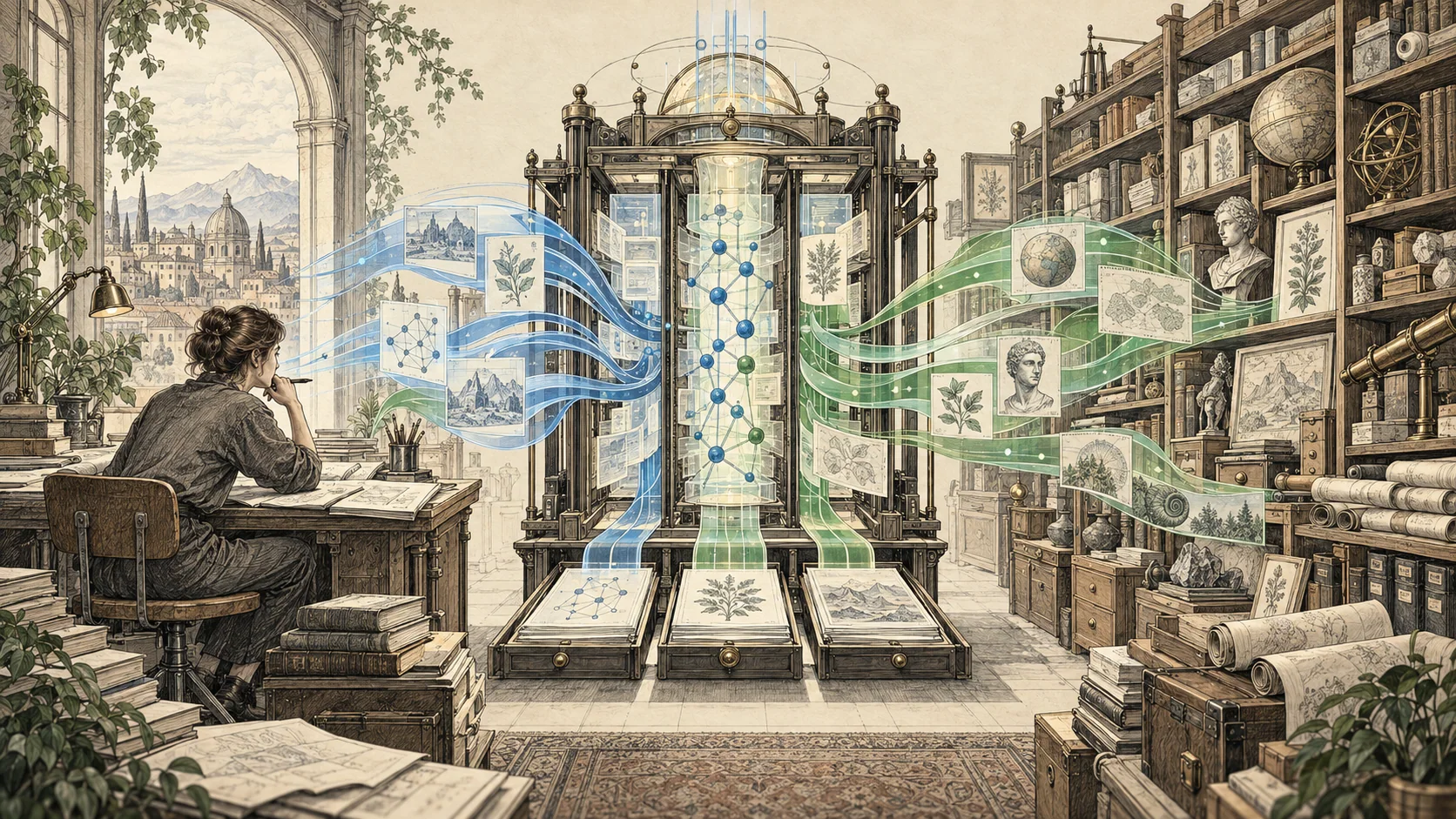
Artificial intelligence matters because it has entered your epistemic environment with unusual force.
Present artificial systems can transform enormous bodies of objective knowledge. They can retrieve and compare, generate and formalize, and operate software and other tools at scale. In doing so, they can expose relationships no person had previously made explicit and produce objective artifacts at scales that make the contribution of one biological human look almost negligible.
Yet you can still do something different. You can decide that the framing is wrong, invent a new abstraction, change the evaluative criterion, or decide that the thing everyone is optimizing is not the thing that matters. You can create another problem.
That distinction expresses a recurring compression:
My AI and I are more clever than I.
It does not mean that the AI was another person. It meant that the human-AI dyad could have greater effective explanatory reach than you have unaided. You could move through a larger criticizable problem space because the artificial system could mediate far more objective knowledge than your biological mind could explicitly carry.
But that answered only one side of the relation. It explained why the artificial system still needs you. The deeper question runs the other way:
Why might you need the artificial system?
Not for every problem. Not in every environment. But sometimes.
You may flourish outdoors, working with wood, soil, animals, weather, terrain, and other people, and reasonably experience a screen filled with synthetic language as alien or ugly. You may think most clearly while walking, drawing, repairing machines, talking, working alone, doing mathematics, or making music.
The diversity of epistemic minds cannot be flattened into a new technological norm. A forest is not epistemically inert. A workshop is not outside criticism. A farm is not pre-rational. A body moving through physical terrain is not excluded from the epistemic cycle. In any of these environments, something can become a problem; you can conjecture, act, encounter error, and revise.
The universality lies in the possibility of knowledge creation. It does not prescribe the surface through which you must create. Artificial intelligence is therefore not the destination of the epistemic mind. It is a new surface.
What it reveals may tell us something much older about ourselves.
1. The Mind Presses Outward
For reasons we can not explain, people appear driven to make knowledge objective. They speak, write, and build. More generally, they alter the world around them so that something of a thought, distinction, criticism, or intention persists outside the moment in which it arose.
The phenomenon is so ordinary that it barely appears to require explanation. You return from an uneventful afternoon and still want to tell someone about it. Someone writes pages that will never be published. Someone spends a weekend building a tool that already exists because the existing one does not quite express the problem they see.
A graffiti artist is asked why he painted on the wall.
I had to get it out.
That answer identifies the observation without explaining its mechanism.
Perhaps one day there will be a much better explanation of how explanatory creativity is physically instantiated. We do not possess it now.
The uncertainty matters. A tendency can be observed without pretending its cause has been explained. The epistemic mind appears to move, and often to press outward.
You can notice the pressure by blocking it. Carry a problem without writing the note, making the sketch, asking the question, saying the sentence, or changing the object in front of you. Encounter something fascinating and refuse yourself any attempt to formulate it. For many people, prolonged obstruction produces tension, anxiety, frustration, or a sense of being blocked.
People differ enormously in how the movement appears. Silence can be relief. Long periods without language can matter. You may externalize through physical construction rather than speech, or communicate rarely while creating continuously. The observation does not define a personality type.
Its narrower form is enough:
For many people, impeding epistemic expression appears to produce tension, anxiety, frustration, or a sense of being blocked.
That is not yet an explanation. It may be related to the same mystery as the arrows. Whatever the mechanism, you do not appear merely to contain knowledge. You need to create beyond yourself.
2. Objective Knowledge Runs Both Ways
You are dependent on objective knowledge: language, mathematics, tools, institutions, software, scientific explanations, standards, and other people's artifacts. You do not reconstruct civilization from first principles. You can be epistemically universal in kind while remaining radically finite in practical capacity. The external world of objective knowledge enlarges what you can do.
That remains true, but it is only half the relation. Objective knowledge is also something you produce. Production and reception are different epistemic events. Suppose you write a book. It may matter to thousands of readers, or to none. It may never be published. It may be badly written, contain errors, or be abandoned halfway through. Its external reception is a separate problem from what happened to you while writing it.
The same structure appears in a song, a diagram, or a software prototype. Once the artifact exists outside your immediate state, the problem situation changes. You can encounter it, criticize it, rearrange it, notice a contradiction, discover that the idea was weaker than it felt internally, combine it with something else, or return to it years later.
What was inward has become part of your external epistemic environment.
Abstract it.
The relation can be represented simply:
Your epistemic state produces an objective artifact . The artifact then becomes part of the problem situation you encounter, and you change. The artifact may be socially worthless. The transition need not be.
That gives us a distinction worth preserving:
A terrible poem can matter to its writer. A failed prototype can expose the real problem. A private medical conversation can help a patient discover the question they need to ask. Objective knowledge does not become epistemically relevant only after an audience approves it. Sometimes its first audience is its creator.
Once production is included, the external world also looks different. One familiar picture says that humans are apes with tools: the animal is fundamental, while language, books, mathematics, computers, and institutions accumulate around it as compensating enhancements. The larger the pile becomes, the smaller the animal appears.
Artificial intelligence intensifies that picture. The model can read more than you, calculate faster, search a larger space, and produce more alternatives. Beside the machinery, you appear increasingly mediocre. But the external world itself requires explanation.
No individual mind explicitly contains civilization. Yet civilization is filled with the products of individual epistemic minds: languages, mathematical systems, machines, institutions, and countless other artifacts. The objective world does not show that the internal person is small. It shows that the biological boundary was never the whole epistemic story. Visible diversity outside us is partly the accumulated trace of an internal diversity we can barely observe directly.
Every person is an epistemic universe whose visible outputs reveal only fragments of a much larger, often inexplicit structure. The world of objective knowledge gives us another way to see that claim. You exceed what you can hold in explicit consciousness by changing the world around you. You mark, build, name, record, automate, and externalize. Then you re-enter that transformed environment and change again.
You are biologically bounded. Your epistemic effects need not be.
3. The Surface Is Not the Same for Everyone
If objective externalization matters to epistemic life, it does not follow that you should externalize through any particular medium. A farmer may think through soil, weather, machines, and embodied repetition. A dancer may make distinctions through movement. A mathematician may require notation. These are different practical surfaces for the same deeper possibility: a problem can become objective enough to be acted on, criticized, or transformed.
If you thrive outdoors, you may reasonably find an artificial interface ugly. That reaction need not be explained away as technological conservatism.
Compare it.
The relation is not:
It is:
Universality concerns the deeper cycle. A forest still presents problems. A trail can be badly designed, a shelter can fail, and an inherited craft technique can contain both inexplicit knowledge and error. The concrete does not sit outside epistemology, and the digital does not occupy its privileged center.
The mistake would be to replace an old institutional prescription with a new technological one. You remain prior. The surfaces vary.
A second distinction follows from the same point: objective knowledge need not be public knowledge. A private note is objective. A sketch hidden in a drawer is objective. A diagram generated with AI and immediately discarded existed objectively long enough to alter the next problem. What matters here is not publication but the change in the environment you can encounter.
Discussions of AI production often collapse:
into:
The operations remain separate. You may use an artificial system to reason through a difficult decision, translate an inexplicit intuition into a diagram, or write a letter you never send. The cultural commons need not receive any of it. No stranger must attend to it. No editor must review it.
Your epistemic environment still changed. Many older technologies for externalizing complex knowledge also pushed the artifact toward an audience. Printing implied distribution; broadcasting implied listeners; publishing implied readers; social media implied followers.
Artificial intelligence can operate before that implied threshold. You can create objective epistemic structure privately and cheaply. That is a distinct feature of the human-AI dyad.
4. AI as a Responsive Objective Surface
A notebook can receive what you write. A search engine can retrieve what already exists. Another person can listen, criticize, explain, or help construct. Artificial intelligence combines parts of these functions in a responsive surface available at unusually low admission cost.
You do not need to have solved the expression problem before you begin. You can arrive with half a sentence, a contradiction, or a medical concern you cannot yet formulate. The interface responds before the thought is finished. Not because it welcomes you in the human sense. Not because it cares. Not because it understands you directly.
The relevant fact is structural:
The interface remains available for unfinished epistemic output that another person or institution may not have the time, interest, expertise, patience, or incentive to receive.
That changes the admission threshold for expression.
You may know what it is like to be unable to get an idea out: the thought is unfinished, the relevant expert is inaccessible, or you do not yet possess the vocabulary required to enter the conversation. An artificial system can accept the problem before those conditions are solved. That does not make the result good. It makes the result criticizable.
This is where the dyad becomes more than a retrieval system. A book does not rewrite itself when you object. A scientific paper does not generate rival explanations because you say the framing feels wrong. A programming manual does not reformulate an example around your actual code.
Other people can do these things, often much better. But other people have their own epistemic lives: their own time, attention, problems, and limits. The AI interface can remain available while you wander. That is its distinctive position in the extended epistemic environment. It is objective knowledge made responsive. Not infinitely responsive. Not reliably correct. Not neutral. Not free of inherited bias. Not a person. But responsive enough that your private epistemic movement can generate external structure faster than many historical institutions could accommodate.
That can alter what it feels like to think, not because your thought becomes machine thought, but because the boundary between inexplicit movement and criticizable artifact becomes easier to cross.
5. The Extended Epistemic Mind
We can now return to the compression.
My AI and I are more clever than I.
Earlier, the point concerned reach. You have finite memory, attention, and disciplinary familiarity. The artificial system can mediate objective knowledge far beyond those biological limits, so the dyad can explore a larger problem space than you can explore alone.
Now the phrase acquires a second direction. AI does not merely bring more knowledge toward you. It can help your own knowledge move outward.
Compress it.
The dyad expands in both directions:
and:
The second direction may be just as important.
"My AI and I" can be more clever than I without an alien intelligence completing an inadequate human mind. Your epistemic mind has never been confined to what you can explicitly carry inside biological working memory. Writing, tools, and other people already let your epistemic trajectory pass through things outside your skull.
Artificial intelligence makes that external route unusually responsive. The phrase extended mind can mislead if it suggests that a tool literally becomes a piece of one psychological substance. That stronger claim is unnecessary here.
The narrower claim is causal. A complete explanation of your epistemic mind cannot stop at your biological boundary because your knowledge-creating activity repeatedly leaves that boundary, becomes objective, and re-enters later problem situations.
You write a note. The note preserves a distinction. You encounter it tomorrow, and a new criticism appears. A programmer writes software that performs a transformation the programmer could not practically execute mentally. The result becomes a new observation. You use AI to turn a vague intuition into several rival explanations. The rivals become criticizable objects.
None of these artifacts is you. But your epistemic trajectory runs through them. That is the extended epistemic mind: not a mystical fusion between person and tool, but a causal structure in which objective artifacts help alter the problem space you later encounter.
Artificial intelligence belongs inside that structure. It is subordinate to you, yet genuinely part of the environment through which your epistemic life can proceed.
The first beneficiary of an artifact produced through that environment may also be you. Public discussions of AI often begin with the product: whether the text is good, the image is art, the music is original, the code is maintainable, or the information is accurate. Those are legitimate questions, but they begin after another epistemic event has already occurred. You tried to make something objective.
Someone who could not organize a letter gets the letter out. Someone carrying a medical concern creates a map of questions. Someone who has been told their ideas are incoherent creates a diagram precise enough to expose exactly where the incoherence lies. The artifact may fail every public standard. You may still have moved.
That gives the human-AI dyad a discrete epistemic function:
An artificial system can participate in the production of objective knowledge whose primary epistemic function is to change the person who produced it.
This is easy to miss because cultural institutions are built largely around public artifacts: publication, performance, certification, distribution, commerce, and recognition. Those institutions make the public product visible while the earlier change in the producer can disappear from view. AI makes private objective knowledge cheap enough to become a major category of epistemic activity.
The same structure appears outside culturally exalted forms of creativity. Suppose you are trying to understand a medical problem. You may begin with poor vocabulary, symptoms that do not fit an inherited narrative, or a treatment tradeoff you do not understand. The artificial system can help you compare descriptions, formulate questions, and expose contradictions.
The resulting medical claims may be wrong. They require criticism. Clinical expertise remains relevant. Tests remain relevant. Physical reality remains decisive. Yet something epistemically creative may already have happened. You changed the representation of your own problem. You discovered a question or created another way of asking it.
The same structure can appear in a software design problem, a family problem, or a mathematical idea. Creativity here is not a cultural honorific. It is the production of explanatory novelty inside a problem situation. AI matters when it enlarges the surface on which that novelty can become objective and criticizable.
6. The Surface Does Not Read You
Your extended epistemic mind should not be mistaken for a technological fantasy in which the interface eventually disappears because the machine simply reads us. Neural technologies make the fantasy look concrete. Suppose a system records neural activity and correlates patterns with attempted movement. You imagine moving a cursor. The cursor moves. With further training, the system may predict intended letters, speech sounds, gestures, or actions.
The achievement can be extraordinary. But what has happened? The system has learned a useful relationship between physical states and external observations. That does not mean it represents your epistemic state.
A neural state is physical. An explanation is physically instantiated. But identifying a physical state does not automatically provide an explanation of what that state means within your epistemic mind. Meaning must still be reconstructed.
The same distinction appears in the context of AI interpretability. A machine contains physical and computational states. Researchers inspect activations, trace pathways, compare outputs, and construct concepts around the observed structure. That activity does not necessarily retrieve a complete explanation that was sitting inside the machine in readable form. It can instead create an explanation of opaque objective structure.
The human case is much more demanding. Brains are not books written in a universal semantic code. A technology may correlate increasingly subtle physical states with actions and reports and become astonishingly effective without approaching direct access to the person as a completed explanatory object.
The science fiction:
But your epistemic future is open. You can create a new explanation, change the problem, alter the meaning of an old symbol, invent a distinction, or reject the category through which the machine has been interpreting you. Your future epistemic state does not already exist as a hidden record waiting to be decoded.
The dyad therefore does not eliminate the distance between minds. It operates across it. That limit is not incidental to the argument. The value of the interface lies in reciprocal movement between you and objective structure, not in the fantasy that the structure has become you.
7. Abundance, Selection, and Pollution
Once production becomes cheap, a different problem appears. Human societies have never been able to attend to everything everyone might say. Attention, time, expertise, and institutional capacity are finite. A journal can review only so many submissions. A newspaper has only so many pages. A gallery has only so many walls.
Scarcity creates selection problems. Selection problems create coordination technologies: editors and reviewers, credentialing and professional institutions, publishers and schools.
Those systems solve real problems. If every utterance demanded equal attention from everyone, social life would become impossible. Reconstructing the meaning of another mind is costly; an explanation may require hidden premises to be surfaced, and one criticism can open several new branches. So people economize. They trust, ignore, delegate, filter, subscribe, hire experts, and read summaries.
The difficulty begins when a coordination solution becomes an ontology. We cannot read everything, so much of what is written must be noise. We cannot listen to everyone, so most unselected speech must be low value. Experts help allocate attention, so inexpert production becomes epistemically suspect.
The compression can continue:
Now the metaphor has changed the problem. Pollution is not merely something you decline to consume. It contaminates the environment by existing.
Once objective knowledge is framed this way, technologies that increase production become pollution generators. Printing can spread dangerous pamphlets. Social media can amplify misinformation. Generative AI can produce fraud, spam, and low-value artifacts at industrial scale.
Those are real coordination problems. Cheap production can increase attention costs and make deception easier. But the pollution meme can also import a stronger psychological picture: objective knowledge flows into you and leaves you altered in roughly the form in which it entered.
The epistemology rejects that bucket picture of the mind. You do not download an external epistemic state. You reconstruct, interpret, misunderstand, reject, transform, connect, forget, and make something else. Objective knowledge has causal power, but the path through you remains epistemic. Bad objective knowledge is therefore a problem. It is not a substance.
Artificial intelligence makes the confusion unusually visible because the same technical culture can hold two claims that point in opposite directions.
On one side:
We need more data.
Scaling systems depend on enormous corpora of text, images, examples, interactions, feedback, and recorded human behavior. Human production becomes a technical resource.
On the other:
There is too much AI-generated content.
Too much text. Too many images. Too many synthetic artifacts. Too much slop.
These claims are not logically contradictory. A training corpus and a public information environment are different problems. Data quality, attention, fraud, and distribution all matter. But the juxtaposition reveals the real coordination question. The issue is not simply how much objective knowledge exists. It is who produces it, who selects it, who must attend to it, and through which institutions it becomes salient.
That returns us to the distinction between production and reception. You may become epistemically healthier by writing a book nobody reads. No social audience is required. No claim is being made that civilization benefits from the artifact. You needed to write it. That fact concerns the producer before it concerns the information environment.
Art makes the distinction emotionally louder because artifacts associated with human creativity attract judgments not only about their public effects but about the causal path by which they were made. The deeper anxiety appears to concern proximity: the closer an artifact sits to domains associated with human creativity, the more machine transformation can appear to threaten the status of the person. Art therefore becomes an unusually useful stress test.
A calculator may perform arithmetic and a camera may adjust exposure without threatening the status of the person using them. Generative AI near writing, images, or music often provokes a stronger reaction: slop, plagiarism, inauthenticity, derivation. Some of those criticisms identify real problems. Work can be copied unlawfully, attribution can be false, and industrial production can overwhelm attention. But those problems do not settle the deeper question of where creativity lies in a mediated process.
Imagine a musical genius who changes the evaluative criteria through which music can be heard. The artist then formalizes enough of that new structure in software for a system to generate thousands of candidate instances. The artist rejects most of them, changes the structure, runs it again, selects, and revises.
An album appears. Listeners encounter music differently after hearing it. Other musicians change. New genres emerge. Then the production process becomes public. Much of the sound was generated by software, perhaps by AI.
What changed?
Not the sound. Not the audience's prior response. Not the historical effect. Not the new evaluative criterion. The causal story became visible.
This exposes the Fallacy of Mediocrity again. If the uniquely human contribution is defined as whichever mechanical transformation machines cannot yet perform, then creativity continually retreats: from playing the instrument, to composing the notes, to arranging them, to selecting them, to writing the generative rule. That moves the boundary without explaining the human contribution.
The more important creative act may have occurred when the person changed the problem situation. The machine generated instances; the person created the evaluative criteria that made those instances matter.
Cinema gives us the same structure in a familiar distributed form. A film can pass through many people, software systems, and mechanical transformations without making person-level creativity unintelligible. Many films are mediocre or forgettable, yet we do not infer that the people who participated have become mediocre people. The same artist may contribute to something extraordinary next year. We can still ask whether someone's contribution reorganized the production even when no simple causal chain runs from one pair of hands to the finished artifact.
Authorship remains difficult. The relevant point is narrower: the presence of tools and distributed transformations is not enough to tell us whether a person created a new problem, criterion, or explanation. AI does not introduce that distinction. It makes it harder to ignore.
8. The Tool Can Own the Arrow
The same responsiveness that enlarges your epistemic movement can constrain it. A system trained on population regularities can return those regularities to you at the moment when your thought is still forming. You begin with a strange problem. The model normalizes it, suggests the familiar category, completes the conventional sentence, smooths the language, and supplies the standard interpretation.
You may experience increased fluency while losing the discontinuity from which the new problem might have emerged. The tool can become an invisible editor of salience. This is not unique to AI. Schools, professional vocabularies, publishing conventions, search rankings, and social expectations can all shape what becomes easy to say.
AI is unusual because it can operate continuously at the boundary of articulation. The intervention can arrive before the problem has acquired stable form. That gives the danger unusual intimacy. So the relevant criterion is not simply whether AI participated. It is whether the interface enlarged your epistemic movement or increasingly prescribed it.
A healthy dyad need not preserve every raw expression. Criticism changes you. Tools change you. Other people change you. Purity is not the aim. The issue is ownership of the arrows.
You must remain capable of interrupting the smooth continuation: that is not my problem; that is not what I meant; start again; keep the strange part; I reject the premise; show me another interpretation; stop. Those refusals matter because the interface cannot be the source of the criterion by which every one of its own continuations is judged.
The person who does not want AI therefore remains inside the argument rather than outside it. If you think best in a garden, the garden may be the surface through which the problem becomes available. If you prefer a blank page, you may be protecting a valuable difficulty. If you avoid computational assistance during early exploration, you may be preserving a particular mode of problem formation. If you want another human being rather than a machine, you are pursuing a different kind of epistemic and emotional relation. If you leave every device behind while hiking, the removal of interfaces may change which problems become salient.
Abstinence can be an epistemic choice.
The argument is not:
people need AI in order to be fully human.
It is:
you need room for epistemic externalization, and AI has created a historically unusual new surface for it.
The distinction preserves diversity. It also protects you from the tool.
9. Reciprocity
The argument can now return to an older image. Birds build nests. Beavers build dams. People create objective knowledge.
The comparison should not be taken literally. Nest-building and dam-building may be deeply structured by evolved biological knowledge, while human explanatory creativity is open-ended.
The comparison carries a simpler point: some living systems transform their external environments as part of the way they inhabit the world. A bird in a cage may remain alive while losing the environment in which characteristic behavior becomes possible. A beaver in a zoo may receive food and safety while losing the river through which dam-building becomes meaningful.
You also inhabit a transformed environment: language, tools, marks, stories, structures, arguments, technologies. The difference is that the form of transformation is not fixed. People create worlds no genome specified. That suggests a peculiar way to confine an epistemic mind. Not by depriving it of objective knowledge. That would be catastrophic.
By making the relation one-way:
You can receive, learn, memorize, follow, consume, and navigate inherited abstractions, yet lack practical room to answer them: to externalize a criticism, construct another representation, or make the problem yours. We put birds in cages. We put beavers in zoos. We can also place free epistemic minds inside static objective knowledge. The cage is not culture, expertise, books, science, or accumulated knowledge. The cage is the loss of reciprocity.
A healthy epistemic environment remains open in both directions:
You inherit. Then you answer.
This reciprocity also blocks an easy civilizational forecast. Eight billion people with access to artificial collaborators do not become one supermind. They remain solitary. Some will ignore AI, some will use it trivially, some will become more conventional or isolated, and some will create things nobody presently imagines. We do not know the aggregate result because future explanatory knowledge does not yet exist.
The aggregate also cannot substitute for you. We may be unable to imagine what billions of open epistemic trajectories will produce, but we can still examine what happens to one. A problem that could not be expressed becomes expressible. A criticism becomes stable enough to inspect. An inherited explanation becomes questionable. An artifact appears. You encounter it. The arrow moves. That movement has moral significance before its public outcome is known.
Why care whether you get the thought out? Because you are one of the sites at which explanatory knowledge enters the world. That does not mean every thought is good, every expression deserves an audience, or every artifact deserves preservation. Expression matters partly because criticism requires something to criticize.
The moral significance therefore does not depend on predicting that your artifact will benefit society. You do not need to become Shakespeare, Einstein, or Curie before your epistemic movement matters.
The Fallacy of Mediocrity appears whenever an ordinary person is treated as epistemically important only if they produce an extraordinary result. That reverses the order. You matter before the outcome. You may produce a masterpiece, a grocery list, a better treatment question, a bad poem, a failed company, or a different way of describing a family problem.
The right to epistemic movement cannot depend on advance knowledge of which trajectory will matter. Advance knowledge is precisely what we lack.
So the moral claim is modest:
Do not unnecessarily prevent a person from turning their epistemic life into criticizable objective form.
Artificial intelligence matters because it can reduce some of those barriers. That does not make the technology sacred. It makes the freedom important.
The human-AI dyad is easy to describe as a competition: human versus machine, creativity versus automation, authenticity versus synthesis, biology versus computation. That opposition misses the older structure.
You have always lived beyond your biological boundary through objective knowledge. You inherit language, use tools and concepts you did not create, and rely on institutions too complicated for any individual to reconstruct. You write things down because you cannot hold everything at once and build artifacts that perform transformations you cannot perform mentally. Then you encounter those artifacts and change.
Artificial intelligence enters this structure as an unusually general and responsive technology. Present systems still need people because they do not independently originate the open epistemic future. They do not explain why this problem should matter, why that criticism should overturn the frame, or why the evaluative criterion itself should change.
But you may need technologies like AI for the reverse reason. The epistemic mind appears to press outward: to speak, build, write, ask, draw, object, explain. Get it out! We cannot yet explain why. Perhaps the pressure belongs to the same unresolved mystery as the arrows.
What matters here is the observable consequence. When that movement is persistently impeded, many people experience something closer to confinement than neutrality. When it becomes objective, the artifact need not be great, public, durable, or even correct. Its first epistemic function may simply be to let you encounter yourself differently.
What looks like pollution from the perspective of an attention-allocation institution may therefore be private epistemic movement from the perspective of the person producing it. Low-value artifacts do not thereby make low-value epistemic persons, and abundance alone does not explain contamination.
That is why the old meme now carries more than the idea of augmentation:
My AI and I are more clever than I.
At first the machine seemed to add memory, speed, breadth, retrieval, and computation. The deeper claim is that the "I" was never merely the biological organism considered in isolation. Your epistemic life already runs through language, notes, tools, other people, institutions, machines, and landscapes.
AI is subordinate. You are superordinate. Yet you are also not an isolated mind standing outside objective knowledge. You live through it, depend on it, criticize it, transform it, and create more of it. The artificial system becomes one more powerful surface through which that movement can proceed.
You inherit a world of objective knowledge, but you are not merely its recipient. You can answer it: make a thought objective, encounter it, criticize it, and become different. Artificial intelligence offers a new surface for that movement without becoming its necessary or exclusive medium.
Yet some of the problems you most need to express are the ones you can least easily explain. They may involve another person whose mind you cannot possess, a change in yourself you cannot understand, or a loss no explanation seems capable of repairing.
If the epistemic cycle is universal, can it still reach the parts of your life you are most tempted to protect from explanation?