
One Reality, Many Worlds
X. Problems Aligning
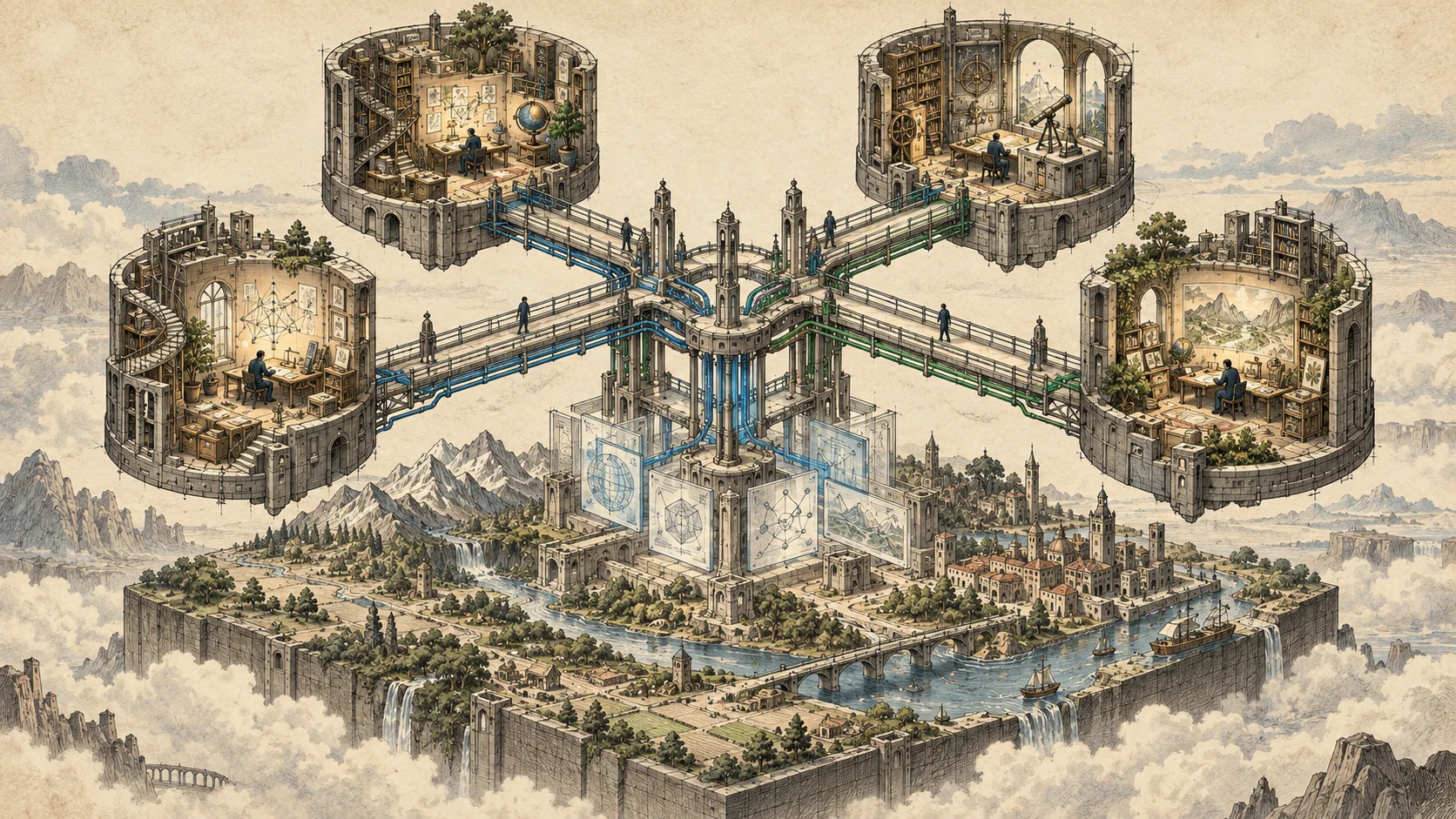
You are an unsettled and unsettling individual.
That picture is exhilarating when the subject is freedom. It becomes frightening when the subject is coordination.
If every person is such a system, how do billions of them get anything done? How do they raise children, build bridges, run hospitals, trade with strangers, operate businesses, govern cities, form friendships, or simply agree to meet at eight?
The familiar answers arrive quickly: humans are social animals; civilization requires hierarchy; individuals sometimes have to yield to a larger purpose. Without enough authority or structure, the story goes, coordination gives way to selfishness, irrationality, or conflict.
These explanations are so familiar that they often arrive as conclusions before the problem has been made explicit.
Epistemology offers a different place to begin. The coordination problem should submit to the kind of solution already partially instantiated within your epistemic mind.
A mind is already a coordination problem of incalculable complexity. And somehow, imperfectly and mysteriously, it works.
1. Coordination Begins Inside a Person
You do not appear internally simple. A single mind contains memories, habits, skills, expectations, fears, interests, inherited explanations, inexplicit abstractions, unfinished problems, emotional pressures, and changing criteria. These structures do not all agree, become explicit at once, or point in the same direction.
You can want incompatible things and believe propositions that conflict. An old explanation can survive for years before a new observation makes its contradiction visible. You can also know what you ought to do while finding a different problem more compelling. Yet you normally experience something like a self.
That apparent unity is not yet explained. Calling it "the self" merely names the phenomenon if we imagine a little manager inside the mind coordinating everything else. We do not yet possess a causal account of how subjective unity, explanatory creativity, problem formation, and the physical processes of the brain fit together.
But incomplete is not empty.
Across the previous essays we developed several broad structures that appear to regulate the epistemic mind. Problems become salient. Tentative explanations arise. Criticism eliminates some errors. Reality resists arbitrary expectations. Explanations that survive one problem can collide with explanations used elsewhere. Internal consilience can produce a temporary equilibrium, and new contradictions can reopen it. Interests make some classes of problems recurrently available. Objective knowledge extends the reach of the biological system.
None of this requires a perfect internal controller. It describes a system that can remain directed by continually self-correcting.
That distinction changes the coordination problem. Order need not mean command. Coordination need not mean that every component has the same goal. Complexity need not imply that one privileged center has calculated the state of the whole.
Inside you, enormous epistemic heterogeneity somehow remains sufficiently coordinated for action to continue. The fact does not establish that societies work the same way. A society is not a nervous system, a firm is not a consciousness, and a government is not the frontal cortex of a nation. But the individual case weakens one familiar intuition: complexity by itself does not establish the need for a central controller.
The skeptic asks how billions of autonomous explainers could possibly avoid chaos. The first mystery is that one solitary mind does. Billions of solitary minds do. It doesn't begin to explain the coordination problem but it deepens it.
Reality helps explain why that internal coordination is not completely arbitrary. Your abstractions do not exist in a vacuum. Expectations fail. Bridges collapse if their structure is wrong. A tool does not work merely because its user prefers the theory behind it. Other people behave differently from the models we construct of them. Bodies age. Resources have physical constraints.
Reality does not write our explanations for us. It constrains them by resisting some of what we conjecture. That resistance gives otherwise divergent abstractions something outside themselves against which they can fail.
This is not certainty, direct access to reality, or the old dream that enough facts will force all rational people to agree. The claim is weaker: there is one reality, and different explanations of it remain exposed to consequences they do not control.
That matters when we move from one mind to many. Different minds do not need identical internal landscapes to encounter the same bridge, contract, disease, customer, storm, or traffic signal. They are different explanatory systems acting in one world.
Reality supplies common constraints without supplying a common mind.
2. Bridges Without Merger
Shared reality is not enough. Two minds can face the same object and still understand it differently. Coordination requires some way for the products of one mind to alter the problem situation of another.
Communication does this without transmitting a mental state intact. One person constructs an expression. Another reconstructs something from it. The result in the second mind is never simply a copy of the first, but a copy is not required. A sentence can expose a contradiction, a drawing can reveal a hidden dependency, and a price can make a resource constraint visible. The second mind only needs to be perturbed in a way that changes what can be noticed, criticized, or attempted next.
Two minds do not need to merge in order to become mutually corrigible. The social process is real. The collective knower is not.
The same pattern extends beyond conversation. Solitary minds coordinate through structures that exist outside any one of them: language, writing, contracts, laws, standards, schedules, money, technical interfaces, scientific papers, software, databases, road signs, and calendars. These structures are objective knowledge. They can persist after their creators have left, be criticized by people their creators never met, and coordinate people who disagree about almost everything else.
A bridge does not require every engineer, steelworker, inspector, financier, truck driver, and future traveler to share the same internal problem world. The participants need compatible interfaces for their different contributions to meet.
The more people a coordination structure has to serve, the less it can depend on the full internal world of each participant. In that sense, coordination scales by becoming thinner. A traffic light need not know why each driver is traveling. A contract need not contain the parties' philosophies of life. A technical standard can fix an interface while leaving the work above it open.
Objective knowledge therefore allows deep internal difference to coexist with narrow external compatibility. Society need not be one mind coordinating its parts. It can instead be a world dense with objective structures through which different minds become partially predictable to one another.
That solution contains its own danger. The interface works precisely because it represents only part of the person.
3. Compression and the Appeal of Authority
Institutions cannot represent the full epistemic life of every person participating in them. They need roles, categories, schedules, procedures, credentials, permissions, responsibilities, and expected outputs. A workplace sees an employee, a school sees a student, a court sees a litigant, and a bureaucracy sees a case.
These abstractions are not necessarily mistakes. They can be useful solutions to real coordination problems. The mistake begins when the compression is mistaken for the person: the role becomes an ontology, the category becomes an explanation, and the hierarchy becomes evidence of human rank. A technology for coordinating people starts to make claims about what those people are.
This is one place where the authority memeplex reappears. Its attraction need not begin as a moral theory. Hierarchy is cheap.
If ten people must negotiate every decision with every other person, coordination becomes costly. If one person decides and nine comply, the decision path becomes simpler. Authority can reduce uncertainty, assign roles, fix priorities, and permit action before deep shared understanding exists.
That is a real solution to a real problem, which helps explain why hierarchy appears so persistently even in cultures that celebrate liberty. Workplaces assign problems and outputs. Schools impose curricula. Families encode responsibilities and rank. Games deliberately construct rules, penalties, referees, captains, and winners.
None of this proves that human beings secretly crave subordination. It may instead show that hierarchy has long been one of the cheapest available coordination technologies.
A useful technology can then harden into a theory of human nature. "Someone has to be in charge" moves from a practical conjecture to an assumed law. "People need structure" becomes "people cannot be trusted with freedom." A manager's local knowledge becomes evidence of epistemic superiority. An adult's responsibility becomes evidence that a child is not yet an explainer. A ruler's need to act becomes evidence that a population needs ruling.
The transition is easy to miss because the original coordination problem is real. The error is not that coordination requires constraints. It is that a successful local constraint is promoted into an explanation of the person being constrained.
4. Liberty, Constraint, and Process
The Enlightenment becomes relevant to the argument. It matters here neither as a sacred historical episode nor as an authority to which the epistemology must conform. The relevant point is that some liberal institutions can be described in terms already supplied by the epistemology.
If knowledge grows through conjecture and criticism, then institutions that preserve criticism preserve a condition of error correction. If different people create different problems, then pluralism preserves variation that uniformity would remove. If explanations are fallible, then structures that keep authority criticizable preserve the possibility of revising the rules.
Free speech can therefore function as an enabling technology for criticism. Free association permits recombination among different problem worlds. Freedom of conscience leaves room for your internal criticism to continue beyond an externally preferred conclusion. Exit lets you leave a problem environment that has become closed to revision.
These institutions remain morally interpretable in many ways. The present argument does not need to settle those theories. Its narrower claim is explanatory: some liberal forms appear consilient with conditions under which fallible explanatory systems can continue producing and correcting knowledge.
Perhaps the Enlightenment discovered parts of a social epistemology before we possessed an explanation of why those discoveries worked.
That formulation immediately creates a problem. Political liberty can coexist with highly constrained epistemic life. You may possess the vote and freedom of speech while spending most of your waking hours inside someone else's problem formulation. You may be free to criticize the government while finding that questioning a workflow threatens your employment. You may choose an institution freely and still find little room to challenge its assumptions once inside.
The point is not that political liberty is meaningless. It is that political principles do not by themselves solve the coordination problem inside ordinary institutions.
Freedom at scale still requires constraints. A programming language restricts syntax and thereby makes a shared technical space possible. A road protocol constrains drivers so that many independent journeys can coexist. A technical standard fixes an interface so that variation can proliferate above it.
The useful distinction is therefore not between constraint and freedom. It is between constraints that preserve or enlarge future problem spaces and constraints that close them. A coordination structure can specify what must be shared while leaving unrelated questions open; it can also expand its jurisdiction until the interface is treated as the person.
That replaces the vague instruction to "balance freedom and order" with a more specific question:
Which constraints make more independent epistemic lives possible?
The answer can differ across a constitution, a family rule, a workplace process, a school curriculum, a software protocol, or a market institution. The criterion remains the same even when the local tradeoff does not.
The criterion becomes harder when coordination is economic, because one person's open problem space does not create an automatic claim on another person's resources.
Suppose you develop a deep interest in an obscure form of music, an abandoned language, or an unfashionable mathematical problem. There may be no market for it. An employer has customers, deadlines, payroll, quality requirements, contracts, equipment, and risk. The employer can reasonably say:
Your interests are your problem. If you want me to pay you, I need you to work inside this process. That is my problem situation.
The employer is also a solitary problem-selector. The worker's interest does not establish an economic obligation on the employer, while the employer's need for predictable output does not establish epistemic superiority over the worker. They are different problem situations looking for a structure of exchange.
Economic institutions can sometimes provide such an interface. A buyer and seller need not agree about why the exchange matters. A worker may want security while an employer wants reliable output. Exchange can coordinate those purposes without replacing them with one shared goal. Free association permits new combinations of people and knowledge. Entrepreneurship lets someone act on a problem others have not yet recognized. Competition exposes organized solutions to criticism by alternatives.
Some features of economic liberty therefore resemble the epistemic properties already identified in political liberty: variation, association, experimentation, criticism, and exit. That does not amount to a theory of liberal economics. Markets can concentrate power. Exit can be costly. Economic value and epistemic value are not the same. Firms can create epistemic confinement.
The objection does not disappear. It becomes more precise.
Return to your loved one. At work, they appear reduced because the process may already specify the problem, what counts as a solution, the sequence of action, and even the acceptable language for describing failure. The worker still supplies attention, memory, judgment, and action, but much of the epistemic landscape has been closed in advance.
There can be good reasons for doing this. Variation can be expensive or dangerous. A factory cannot allow every worker to redesign the product on the line. An airline cannot let each pilot invent a new landing protocol. A hospital cannot make every safety procedure optional. Standardization can encode hard-won objective knowledge.
So the explanatory problem is not whether process is bad. It is how much of a person's problem-generating capacity must be constrained to solve the actual coordination problem. A second question then appears: which remaining constraints exist only because the available coordination technology cannot cheaply adapt?
Historically, the answer has been: quite a lot. Hierarchy and standardized process were available. Deeply adaptive coordination was not. Some forms of social and economic constraint may therefore have survived for a different reason. The people inside them may have been capable of greater autonomy while cheaper ways to coordinate heterogeneous minds were unavailable.
That conjecture changes the criticism. "Democracy is failing" and "capitalism is failing" remain possible problem statements, but neither phrase yet identifies a mechanism. Failing how? Which part of the tentative solution is implicated? What observation would distinguish a failure of liberty from a failure of the institutions through which liberty is being coordinated?
Polarization, for example, could implicate free speech, information architectures, political incentives, or some interaction among them. Alienating work could implicate voluntary exchange, the practical cost of exit, primitive coordination technology, concentrated authority, or something else. The labels do not decide among those conjectures.
The epistemic stance is therefore not to protect democracy or capitalism from criticism. It is to keep the criticism open until a mechanism has been proposed. Liberal institutions remain tentative solutions inside the same cycle as everything else: problem, tentative solution, error elimination, new problem.
No institution becomes exempt from criticism because it is liberal. No criticism becomes explanatory merely because the institution disappoints us.
5. Society Is Not the Problem
The argument returns to you.
We routinely say that society is losing faith in democracy, the public thinks capitalism is broken, the market wants growth, or the government knows what must be done. These phrases are useful compressions. Taken literally, however, they recreate the collective mind we have spent several essays dissolving.
There is no social subject contemplating the failures of liberalism. There are people reconstructing objective structures inside different problem situations.
A newspaper headline, political meme, economic theory, institutional rule, or workplace procedure can exist outside any one person. But criticism becomes epistemically active only when someone reconstructs one of those structures as a problem. "Democracy is failing" can circulate through millions of artifacts and mouths without becoming the same problem twice. One person may reconstruct it as a problem of representation, another as a problem of information, and another as a problem of authority. Someone else may not experience it as a live problem at all.
The same is true inside a workplace, family, market, or school. A rule, role, process, or status structure can be objective knowledge. The tension between that structure and your other explanations occurs inside your particular mind with your particular history of interests, expectations, problems, and criticism.
That is where coordination reaches you.
The institution never receives your whole epistemic system. It receives behavior through an interface. You never receive the institution as a whole either. You reconstruct fragments of rules, reasons, expectations, incentives, stories, and consequences inside your own problem situation.
Coordination therefore does not consist of a collective subject solving one problem. It consists of solitary problem-holders becoming partially coupled through objective structures.
This changes what a coordination failure can be. The shared interface may be too thin for the task. It may encode bad knowledge. One side may be unable to reconstruct the constraints faced by the other. A role may suppress criticism the system actually needs. Exit may be formally available but practically inaccessible. Or a compressed representation of you may have been mistaken for you and used to close problems that remain alive for you.
None of those explanations requires a social mind. They require people, objective knowledge, and mechanisms through which each changes the problem situations of the others.
The point becomes personal because the social world does not revise itself above you. A criticism becomes live when you reconstruct it. A rule becomes a problem when it collides with something else you know. A role becomes confining when the interface closes a problem space you are trying to open. A shared project becomes possible when enough objective structure lets you act with people whose inner landscapes you cannot inspect.
Society is not making up its hive mind. You are reconstructing your part of the social world inside your own mind from objective structures that other people have made available for reconstruction and criticism.
That is precisely why the next technology frontier matters.
6. AI Changes the Coordination Technology
Much contemporary anxiety about artificial general intelligence imagines a future entity that is difficult to control. It can form goals, revise strategies, outgrow its creators, resist instructions, and reorganize the world around problems we did not choose.
The substrate would be new. The coordination fear is not.
We already live among general intelligences that change goals, reject authority, create new problems, outgrow their teachers, reinterpret instructions, develop unexpected interests, and sometimes refuse to cooperate. They are biological general intelligences: people.
Before AGI, there was BGI.
The analogy has limits. A hypothetical artificial person might operate at different speeds, copy itself, consume different resources, or possess capabilities no biological person has. Those differences could create new coordination problems. The narrower resemblance is the problem of autonomy: how do we coordinate something that cannot be perfectly aligned to our goals?
Civilization has spent millennia constructing partial answers through laws, norms, markets, rights, schools, hierarchies, contracts, constitutions, bureaucracies, and systems of surveillance. The AGI alignment problem therefore enters a species with a long history of trying to align generally intelligent entities.
That makes another distinction important. Contemporary AI can exceed an unaided person's capabilities in particular tasks. It can search and compare large bodies of text rapidly, manipulate symbols, translate languages, calculate, and synthesize across domains. Those capacities do not by themselves establish personhood.
Under this ontology, the threshold would be different. It would concern autonomous creation of new explanatory knowledge, self-originating problem formation, criticism, revision of evaluative criteria, and the other structures associated with persons. Current AI can execute methodologies, recombine objective knowledge, and participate functionally in explanatory work without thereby becoming an autonomous epistemic subject.
The more immediate social configuration therefore does not require AGI. It is already intelligible as:
billions of biological general intelligences with access to unusually powerful objective-knowledge tools.
A book stores objective knowledge. A database structures it. A search engine retrieves fragments of it. An AI system can add a further operation. It can reorganize available objective knowledge around the current problem posed by an individual, then reorganize it again when criticism changes that problem.
That sequence matters. You prompt the system from inside your idiosyncratic problem situation. The system produces a reconstruction that crosses oceans of objective knowledge not originally organized around that problem. You criticize the reconstruction. The criticism changes what now needs explaining. The objective landscape can then be reorganized around the changed problem.
Human teachers, librarians, editors, consultants, friends, and experts have always adapted knowledge for other minds. The difference here is not absolute kind but scale, speed, availability, and breadth. And the incumbent authorities are understandably anxious.
The result is a new practical interface between a solitary mind and vast objective knowledge. It does not make the AI a person. It changes forever what a person can reach.
Previously, access to AI could be framed mainly as an individual extension. Equipped with better tools, you can compare more, remember more, and reach further into objective knowledge. The coordination problem changes the question. Social coordination depends on objective structures that let different minds partially reconstruct one another's constraints. A technology that adapts those structures to different problem situations can therefore alter coordination itself.
A team may be divided by incompatible vocabularies. A worker may see a procedure without understanding the business constraint behind it. A citizen may receive a policy argument compressed into partisan language. In each case, the obstacle may not be disagreement alone. It may be that one problem landscape is poorly represented inside another.
AI can lower that translation cost. It need not merge the minds. Of course it can't. But it can help each person reconstruct enough of the other's objective structures to formulate a better problem.
That is the important shift. The technology may matter socially not only because it makes individuals more capable, but because it may help heterogeneous groups communicate and coordinate without requiring their members to become more alike.
The same capability can move in the opposite direction. AI can increase surveillance, make people more legible to institutions, personalize persuasion, enforce procedures, or concentrate objective knowledge behind proprietary interfaces. Nothing about the technology guarantees liberty.
The symmetry is the point. The technology is morally neutral. A tool that lowers the cost of coordinating autonomous people can also lower the cost of controlling them.
Historically, hierarchy often had an advantage because it was cheap. Dynamically adaptable objective knowledge may lower the cost of coordination among people who retain independent problem situations. If it does, some apparent tradeoffs between freedom and order may not be permanent features of human nature. They may be temporary features of our now antiquated coordination technologies.
That is an optimistic conjecture, not a conclusion. It opens a new problem space.
7. You Are Inside the Experiment
This argument is recursive; this essay was produced through the kind of coordination it describes.
A person entered the inquiry with a problem. Call him the operator. An artificial system preserved context, retrieved and compared formulations, extrapolated patterns, and generated candidate reconstructions. But those operations did not fix the problem in advance. Objections changed what counted as a good answer. Some formulations were rejected. New distinctions appeared. The operator changed the resolution of the inquiry, and the system reorganized objective knowledge, including the operator's insights, around the changed problem.
No shared consciousness appeared. No hive mind was required. A solitary human mind coordinated with objective knowledge through an artificial system.
Now the result reaches another solitary mind: yours.
You do not receive the operator's mental state. You reconstruct this argument inside your own epistemic landscape. Some sections may become salient because they collide with experiences or explanations the author never possessed. Some may appear obvious, others wrong, and still others may create a problem that did not exist for you before reading them.
If you take one of those tensions into your own AI-mediated inquiry, you become the operator, and the knowledge evolves. The text is objective knowledge. Your criticism changes the problem. The available objective landscape is reorganized around your new problem.
A social epistemic process has then occurred without a social mind. This is not merely an analogy to the coordination mechanism under discussion. It is an instance of it.
That instance also reveals a capability asymmetry. Institutions, governments, companies, experts, competitors, and individuals can all use tools that reorganize objective knowledge around a target problem. If such tools materially expand explanatory reach, people without comparable access will be less able to reconstruct the problems in which they are being asked to participate.
The deeper opportunity is not epistemic warfare. It is participation at a different scale. You may once have had to defer because relevant knowledge was dispersed across inaccessible fields. You now may be able to reconstruct enough of the problem to criticize it productively, if that's where your interests pull you. A worker may understand an employer's constraint. An employer may see where a process unnecessarily crushes variation. A citizen may reconstruct the strongest explanation behind a policy rather than responding only to its slogan.
"I may be wrong and you may be right, and by an effort, we may get nearer to the truth." It's a beautiful compression, but effort can be crushing. AI cannot eliminate the effort, but it can reduce the coordination costs substantially.
8. The Greater Good Without a Greater Mind
The language of the greater good often appears where coordination becomes difficult. Billions of problem situations is overwhelming, so the complexity is compressed into a superordinate problem: one goal, one metric, one direction. Individual interests are then evaluated through that model.
Sometimes common constraints are real and urgent. A contagious disease, a military attack, a failing power grid, or a collapsing bridge can create problems around which many people have to coordinate quickly. Powerful AI systems operating uncontrollably would certainly meet that standard.
But the "greater good" is not a mind. It is an objective model of goods, harms, priorities, and tradeoffs. Someone conjectured it. Different people reconstruct it. Someone can criticize it.
That does not make common action impossible. It makes the epistemic structure explicit. The question is not whether individuals ever accept constraints for common purposes; they plainly do. The question is what happens when a collective purpose is treated as if it could no longer be criticized as a problem.
Freedom preserves an open future. Openness has an intimate form: the capacity for new problems to become alive in a particular person. The coordination problem now extends the same idea into groups.
Individual flourishing does not require escape from society. It requires social structures in which belonging does not demand epistemic flattening. A group can have rules, responsibilities, shared projects, and even hierarchy where the local problem requires it. The relevant distinction is whether those structures remain criticizable. In the form being described here, members retain the capacity to form problems the group did not assign, and the shared interface remains narrower than the person who participates through it. Authority then remains a coordination relation rather than an ontology of superior and inferior minds.
This is not a blueprint for an ideal society. It is an explanatory criterion: does this structure preserve more independent error-correcting lives, or does it unnecessarily close them?
That question scales from two people to billions.
Seen this way, liberty is not a completed historical discovery. The Enlightenment did not complete the problem of human coordination. Democracy, capitalism, free speech, and rights did not complete it either. They remain tentative solutions whose failures can reveal what their underlying assumptions missed.
A liberal institution may preserve criticism in one layer while centralizing it in another. A market may formally permit exit while making it practically expensive. Speech may be formally free while an information architecture rewards low-quality conflict. An institution designed to protect liberty may still depend on workplaces, schools, families, or bureaucracies whose coordination logic was inherited from older authority structures.
The same epistemic stance that makes liberty intelligible therefore prevents liberty from becoming dogma. The old explanations remain open to the process that produced them: problem, tentative solution, criticism, and a new problem.
That is creative criticism.
The explanation remains incomplete. We still do not know how one mind achieves its apparent unity. We do not know the full conditions under which free institutions remain stable. We do not know whether AI-mediated coordination will predominantly enlarge individual problem spaces or make individuals more governable. We do not know what forms of artificial personhood, if any, may eventually appear.
The incompleteness does not erase the direction of the argument. The coordination problem does not require a mind above minds. It may require better bridges among them.
If that is right, some apparent conflict between freedom and order may have another source. It may reflect limitations in the objective knowledge through which people have been coordinated. It would require better explanations and better technologies for allowing people to remain epistemic.
You may already be testing the mechanism while reading this. You are reconstructing the argument inside a problem situation no person can fully know, perhaps with an AI beside you reorganizing the same objective knowledge around your own questions.
That success illuminates the next problem.
The same technology that can equip you can equip people that want to understand, predict, persuade, rank, and control you. Dynamic objective knowledge can widen your problem situation. It can also make you compressible and easier to control.
The question is no longer simply whether billions of minds can coordinate. It is whether the technologies that make deeper freedom possible can remain aligned with the freedom they enable.