Where Knowledge Becomes
XXIX. Your Open Mind and Its Rulers
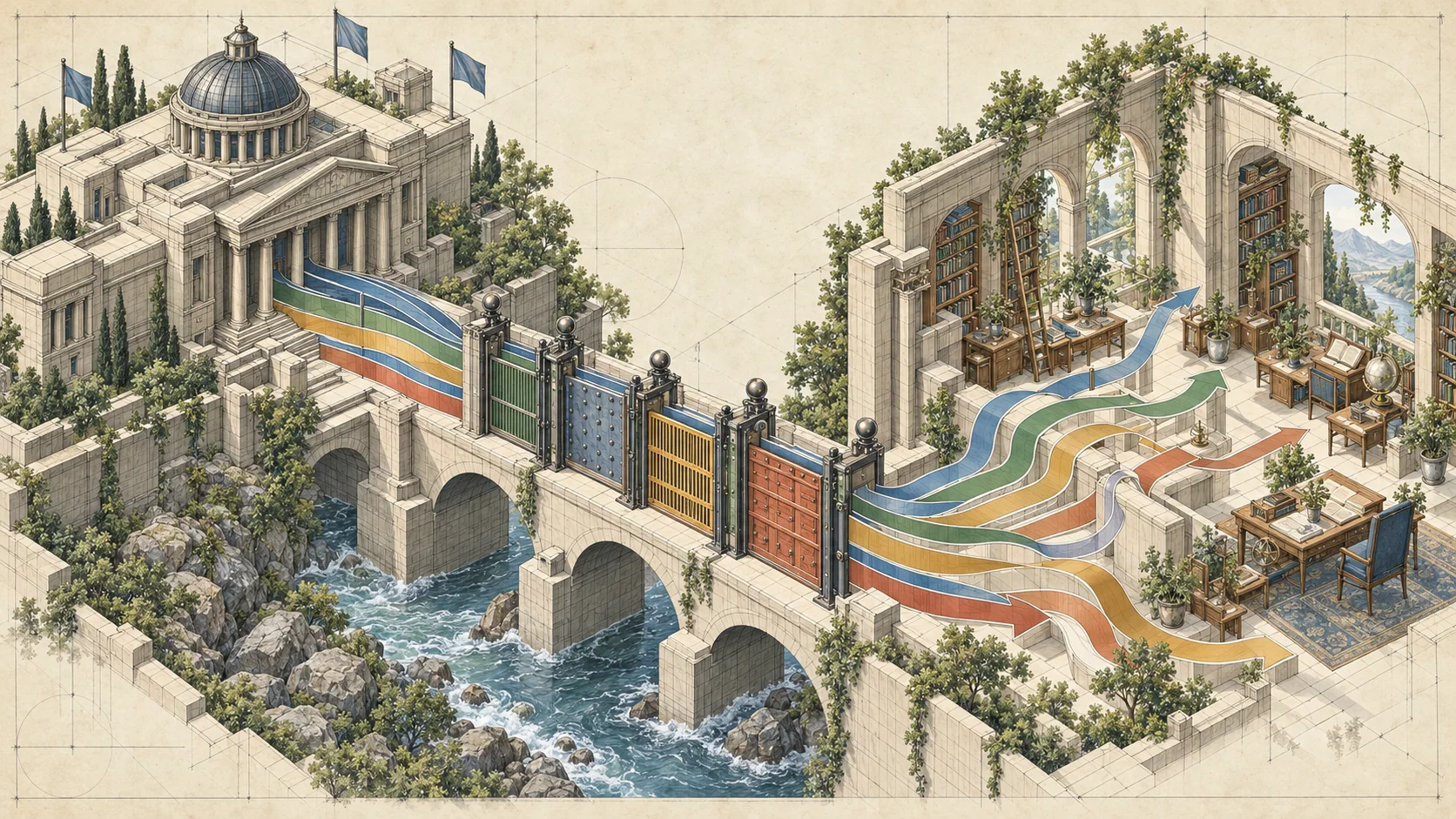
We ended with a familiar story about children, declining educational performance, digital devices, and artificial intelligence. Pieces of research, classroom observations, parental worries, and public commentary had become one explanation:
The children are getting dumber.
The truck was coming toward us, and the final question was:
Do you really want to stop it and inspect what's inside?
We did not. That may have seemed strange. We have spent a long time stopping trucks: a personality score, a heritability estimate, a diagnosis, a political category, a social abstraction, a value, an inherited theory of the person. Again and again, the compression became the problem, so we opened it.
Why leave this one moving? Perhaps we should have stopped it. Perhaps we still should. But not because stopping every truck is what a rational error-correcting person always does. There is no such rule.
You cannot inspect every abstraction, reopen every category, reconstruct every causal chain, or hold every problem active at once. Criticism is work. Attention is finite. Time passes. Other problems exist. A building may be burning. Someone may need help. Your child may be calling you. The explanation you are reading may not be the problem that matters to you now.
Morality has been waiting inside this distinction. And this time the truck is ours.
1. The Missing Arrow
We have made moral claims, sometimes quietly and sometimes explicitly. Preserve criticism. Do not freeze the person. Do not mistake a population model for an individual. Do not convert an abstraction into authority. Preserve the ability to reject, revise, create, and become otherwise. Permit disagreement. Preserve exit. Avoid coercion. Treat the current explanation as provisional.
These claims often appeared to follow from the epistemology. If knowledge grows through criticism, then institutions should preserve criticism. If persons create explanatory knowledge, then persons should not be treated as finished objects. If future knowledge cannot be predicted, then your future should not be inferred from your present category. If social abstractions compress, then coercive action based upon them should be approached carefully.
The fit has become increasingly strong. Perhaps by now the moral consequences feel obvious. That is precisely when criticism becomes useful. A compression can become a truck of its own. Consilience can feel like inevitability. Reach can feel like proof. A model that reorganizes many problems can begin to feel like reality without mediation. Then the word appears:
of course.
Of course people should be free. Of course criticism should be preserved. Of course authority should be limited. Of course coercion is wrong. Of course individuals matter.
Perhaps. But we have spent too much time criticizing manifest truth to claim exemption for its own morality. So stop this truck too. Open the compartments. What exactly follows?
A familiar philosophical warning says:
You cannot get an ought from an is.
A description of reality does not by itself contain a moral command. A statement about what exists does not logically entail what anyone should do. That objection matters here because the epistemology has described people as fallible creators of explanatory knowledge, criticism as part of knowledge growth, coercion as capable of blocking criticism, social categories as compressions, and individual futures as open. It has then repeatedly approached claims such as:
preserve criticism; preserve individuality; preserve the ability to change.
Where did the word should come from? There is a tempting reply. You cannot get an ought from an is, but you cannot get an is from an is either.
Consider observations. The sky appears blue. A needle moves. A population score declines. A planet appears in one place rather than another. Someone behaves differently than expected. No finite collection of observations contains its own explanation. The explanation must be created.
The observations constrain the explanation. They can refute it, create problems for it, or become inexplicable under one theory and intelligible under another. But accumulation does not manufacture the theory.
Something happens between:
and:
The same problem appears between:
and:
The epistemology may severely constrain what a moral explanation can coherently say. It may expose contradictions, reveal the causal consequences of coercion, show that an abstraction does not contain the person it classifies, or explain why criticism matters. None of those statements constrain your next action.
Again, the arrow matters. We have encountered this structure before. A problem does not mechanically generate its tentative solution. A tentative solution does not mechanically generate the criticism that will matter. A criticism does not mechanically generate the next problem. A body of objective knowledge does not mechanically generate an invention. A moral explanation does not mechanically generate obedience.
We write:
But the arrow is not a conveyor belt. Relations change. Salience changes. A contradiction becomes visible. A new abstraction appears. Something becomes a problem that was not a problem before.
The moral transition is another instance of that structure. Suppose an explanation implies that some intervention will damage your capacity for criticism. Suppose the explanation survives criticism. Suppose you understand it. Does that force you to act?
No. You may reject the problem or rank another above it. You may disagree about the cost. You may possess knowledge I do not. You may see a conflict I have not noticed. You may be wrong. So may I.
The explanation can constrain your problem situation. It cannot occupy the place from which your next explanation will be created.
2. Finite Attention
Return to the children. The educational measurements may matter enormously. The decline may represent real harm. The role of schools may be changing. Digital media may be involved. Artificial intelligence may be involved. The tests may be compressing several transformations into one score. Some explanations may be excellent; some may be terrible.
Why not stop the truck immediately? Because the existence of an available criticism does not establish that this is the problem you should solve next. If you are an education researcher, stop the truck. If you are a teacher watching students struggle, stop the truck. If you are a parent deciding what environment to create for a child, stop the truck.
But if you are standing beside a burning building, perhaps the truck isn't your immediate problem. You have not become epistemically inactive because one abstraction remains unopened. Your attention may simply be somewhere else.
This matters because moral language often conceals the opposite assumption:
If you understood, you would act. If you really knew, you would agree. If you cared, you would choose correctly. If you were rational, you would see what must be done.
Each statement may occasionally be true. None is entitled to be true in advance. An unopened truck does not prove indifference, irrationality, or moral failure. It tells us almost nothing about the problem currently active inside your epistemic mind.
Now imagine that the building really is burning. Smoke is coming through the hallway.
Someone says:
We should leave.
Another person asks:
But what caused the fire?
The question matters.
Later. Right now the causal history of ignition is not the active problem. The immediate problem is:
The person who pulls the alarm does not need a complete theory of combustion. The person who carries a child outside does not need to settle a philosophical argument about authority. You act under incomplete explanation constantly. That is not a defect in explanation. It is one of the conditions under which explanation exists at all.
The problem situation a causal structure that appears temporal. Some criticisms can wait; some cannot. Some actions preserve the possibility of later criticism; some destroy it. If the building burns with everyone inside, there will be fewer future explanations of the fire? No! People will have died.
So the moral objection to authority cannot simply be:
no one may ever tell another person what to do.
A firefighter may tell you to leave. A parent may stop a child from running into traffic. A court may restrain someone who is attacking another person. An institution may temporarily close a bridge because it is failing.
The relevant question is not whether authority exists. It plainly does. The question is what work it is doing.
3. Authority as a Relation
Authority is another noun. The grammar makes it sound like a possession: a person has authority, a court has authority, a parent has authority, a government has authority, an expert has authority. Something one actor has and another lacks. But authority moves with the problem situation.
A surgeon may have relevant authority in an operating room without becoming your political ruler. A parent may decide where a four-year-old sleeps without acquiring the same authority over a forty-year-old child. A judge may impose a sentence within a legal procedure without becoming the final authority on physics. You may reasonably defer to another person's technical knowledge without transferring ownership of your epistemic authority.
Authority is better understood as a conjectural relation inside a problem situation. Who may act? On what? For how long? Under what constraints? With what avenues for criticism? With what possibility of reversal? What happens if the explanation of the authority fails?
The same institution may exercise reasonable authority in one domain and unreasonable authority in another. The same parent may correctly prevent immediate physical danger and incorrectly infer that a child's unusual interest is harmful. The same state may coordinate traffic rules and also attempt to decide which ideas citizens may consider.
The category does not decide. The explanation does, and the explanation remains fallible.
This may sound unstable, even swampy. Perhaps we want authority precisely because we do not wish to reopen every decision. That is true. A society cannot deliberate from first principles at every traffic light. A hospital cannot renegotiate sterile procedure during every operation. A child cannot independently reconstruct all electrical safety knowledge before being told not to insert metal into an outlet.
Compression is necessary. Institutions are partly machines for preserving useful compression. Authority can preserve it too.
The problem begins when temporary compression becomes ontological entitlement: a rule created to solve one problem becomes proof that the ruler knows better in general; a temporary restriction becomes a theory of the restricted person; useful expertise becomes immunity from criticism; a necessary emergency action becomes a permanent political arrangement.
Abstract it.
The transition is familiar:
That arrow is not automatic either.
Reasonable authority therefore has a peculiar structure. It can coordinate without pretending to be infallible, act without claiming final knowledge, compress without claiming the compression is the whole person, and temporarily close a decision while preserving a route by which the decision can later become a problem.
A verdict that can never be reopened is different from one that ends the present dispute while remaining embedded in institutions capable of criticism. A teacher who says, "for this exercise, use this method" is doing something different from one who says, "this is the only way your mind should work." The same distinction appears when a parent says "not now" rather than "never become someone I cannot understand."
The difference is not softness. It is epistemic structure.
4. The Removable Ruler
Political philosophy often begins with a question:
Who should rule?
The best person? The wisest? The majority? The educated? The virtuous? The property-owning? The workers? The experts? The people? The question invites a particular kind of solution: find the correct ruler, then give that ruler sufficient authority to rule correctly.
But the epistemology explored here begins elsewhere. Every ruler is fallible. Every institution compresses. Every political explanation can contain error. Every majority can be wrong. Every expert can misunderstand the problem. Every good intention can become an environment in which criticism is expensive.
Another question then becomes available:
How can bad rulers be removed?
The difference is larger than it looks. The first question seeks a source of correct authority; the second assumes error. The first asks how to select the right answer in advance; the second asks how to keep a wrong answer from becoming permanent. The first tends toward legitimacy as identity:
this actor is entitled to rule.
The second tends toward legitimacy as corrigibility:
this arrangement remains usable while its errors can be exposed and changed.
Elections are one technology for doing this. Courts can be another. Appeals, free speech, opposition parties, independent institutions, exit, competing jurisdictions, public criticism, and rules restricting arbitrary power can all create surfaces upon which bad outcomes become problems. None guarantees good outcomes. That is not their deepest function here.
Seen this way, some moral axioms associated with modernity begin to look different: human equality, freedom of conscience, tolerance, individual rights, freedom of speech, limits on arbitrary government, pluralism, consent. These are often presented as principles, sometimes as self-evident, sometimes as products of culture, sometimes as inherited commitments that modern societies simply happen to prefer. But they can also be approached as inventions.
A moral invention need not be a sentence no one had ever uttered. It can be a new distinction, a new problem, or a new relation among existing explanations. Something previously treated as ordinary becomes criticizable. A ruler's religious authority becomes a problem. Slavery becomes a problem. The legal subordination of women becomes a problem. Punishment for dissent becomes a problem. The inherited status of a child becomes a problem. The assumption that one group can determine the lives of another becomes a problem.
The new moral explanation enters objective knowledge and changes the problem environment. Institutions change. Language changes. Law changes. Children inherit different categories. Later criticism begins somewhere else. This does not prove that every liberal institution is good, that humanism is complete, or that modern societies are morally final. It explains how moral knowledge can move.
Not:
how much does knowledge contribute?
But:
what changed because knowledge was present?
Apply that here. What changed because freedom of conscience existed as a concept? Because legal equality existed? Because consent became a moral category? Because arbitrary detention became something that required explanation? Because a child came to be understood as a person rather than as property? Because a ruler's authority could itself become a problem?
The answer is not merely that people came to believe new propositions. New criticisms became possible. New harms became visible. Old arrangements lost their status as nature.
You could say:
you may have power over me, but you have not explained your right to use it this way.
That sentence contains an invention. It separates:
from:
Once separated, they can be criticized separately. That is causal work.
5. Humanism Without Declaration
Humanism can be approached in the same way. One could begin with the command:
every human life has equal dignity.
That may be an excellent moral conjecture. But we took an epistemic route.
It began with a population statistic. Then the person expanded. Genes became biological knowledge. Behavior became a surface. The trait became a compression. The mind became a vast epistemic landscape, much of it inexplicit. Objective knowledge crossed into it. You reconstructed inherited explanations, created new problems, externalized criticism, used tools, built institutions, loved, invented, changed. Another person could not fully reconstruct your epistemic mind. Neither could you. Yet you could sometimes stop the truck.
Now choose one stranger. You may know almost nothing about them. Perhaps you see them on a train, encounter them for a moment in a crowd, learn that they live on another continent, or read about someone who lived two thousand years ago. What evidence would establish that their epistemic mind is shallow? You cannot see most of it. Neither can they. The absence of access tells you little about the depth.
No command is required. Notice instead what the explanation has done to the stranger.
There is a phrase that can sound morally dangerous:
I am not like you.
Another:
We are not the same.
Much moral language tries to overcome this by emphasizing common humanity: shared needs, rights, vulnerability, biology, reason. There is truth in each. But the epistemology has produced a stranger conjunction. Every known person belongs to the same explanatory class. Every person is capable of creating explanatory knowledge. Yet every person's mind landscape is historically singular.
The universality is common. The individuality is not.
You and another person can share language, family, country, profession, religion, politics, childhood home, and decades of memory, yet still discover that the same event inhabits two radically different explanatory worlds. The overlap can be enormous. The divergence can be larger.
So perhaps:
We are not the same
is not the threat. The threat appears when difference is forced into hierarchy.
That arrow must also be explained.
Earlier we described each person as a universe. Not a separate reality. There is one reality. But each person contains an enormous evolving abstraction of it.
Imagine two such universes. One contains knowledge you admire; the other, explanations you despise. One has produced great kindness; one, cruelty. One has encountered criticism and changed; one appears closed. One is brilliant in a domain you understand; one seems confused. One is a child; one is dying.
What unit would let you weigh their capacity to create the next explanation? There is none available.
The absence of such a unit does not prove moral equality. It removes an easy route to moral inequality. A demographic category cannot supply it. Neither can an intelligence score, a personality profile, a political identity, a diagnosis, or a reputation. None of these compressions contains the future epistemic trajectory of the person. The moral conclusion is still not forced. But some shortcuts have disappeared.
There are billions of people alive now. The number is easy to say; the thing it refers to is almost impossible to imagine. Billions of histories. Billions of partly inexplicit worlds. Billions of memories whose significance cannot be externally recovered. Billions of networks of salience, skill, expectation, and attachment. Fear, curiosity, resentment, humor, unfinished problems, half-formed distinctions, private contradictions. Billions of possible future explanations.
Some will never become objective. Some will become jokes, tools, criticisms, equations, acts of cruelty, acts of care, institutions, mistakes, or ideas that reorganize civilization.
The abstraction humanity is tiny beside what it compresses. We need it; no person can encounter everyone individually. But when the abstraction begins to feel complete, something has vanished.
Perhaps awe is the feeling produced when the compression briefly fails. Not mystery as an excuse. Not mysticism. Not reverence demanded by doctrine. The recognition that the object before you has more explanatory depth than your model can hold.
One person can sometimes do that. The class of all people is beyond imagination.
6. Judgment Without Completion
The word evil compresses too. That does not make it useless. Some people deliberately torture others. Some build institutions that preserve suffering. Some exploit vulnerability. Some kill. Some terrorize. Some knowingly block criticism because criticism threatens their power. The causal consequences can be terrible.
A moral framework that cannot condemn or stop such actions would be defective. But a second claim does not follow from the first:
does not entail:
Earlier we described evil as something like persistent harmful closure:
That remains useful. It identifies something we may need to oppose immediately without requiring an essence of evil inside the person. The person can be dangerous. The action can be intolerable. The institution can require dismantling. The ruler can require removal. And the explanation of the person can still remain incomplete.
This distinction is difficult because urgency compresses. Sometimes it must. If you are running from violence, you do not owe the attacker a complete epistemology. Again, the problem situation matters.
The harder danger appears when moral authority turns the compression into a closed system. The language is familiar:
Any decent person knows this. No reasonable person could believe that. Only someone evil would disagree. The matter is settled. The science says. History is not on your side. Everyone knows what side you should be on.
Each statement may refer to something true. The problem is structural: a conjecture has become a condition of participation. Disagreement no longer arrives as criticism. It arrives as diagnosis. The dissenter is stupid, corrupt, brainwashed, dangerous, immoral, unfit. The original explanation may survive not because it is hard to vary, but because criticism has been reclassified as evidence against the critic.
Externally, this can produce authoritarian institutions. Internally, it can produce something stranger. The voice says:
A good person would not think this. A rational person would not feel this. Someone like me cannot want that. If I doubt this, I am betraying who I am.
The ruler has crossed the border into your epistemic mind.
7. Who Rules You?
Ask the political question again:
Who should rule?
This time do not imagine a parliament. Imagine your epistemic mind. Which explanation gets authority? Your parents? Your religion? Your politics? Your diagnosis? Your profession? Your reputation? A memory? A fear? A moral injury? A theory of yourself formed when you were sixteen? A person who hurt you? A person you loved? A sentence someone said once and never remembered?
The question is not whether these structures should disappear. Some may contain excellent knowledge. Some may have preserved you. Some may be true. Some may still solve important problems.
The question is which of them may become a problem. Which explanation is allowed to be contradicted? Which identity can survive revision? Which value may be inspected without the inspection itself being treated as betrayal? Which ruler can be removed?
A bad internal ruler need not be false. That makes the problem harder.
Suppose you are talented. The explanation may be true. Then:
I am talented
can become:
I must not fail.
Suppose you were harmed. That may be true. Then:
I was harmed
can become:
I can only understand myself through the harm.
Suppose your political opponents have made serious errors. That may be true. Then:
they are wrong about this
can become:
everything they say is evidence of corruption.
Suppose your parents loved you. That may be true. Then:
they loved me
can become:
therefore their explanation of my life must be right.
A ruler can begin as knowledge. The failure occurs when the knowledge acquires sovereignty. Criticism becomes forbidden not because the explanation has survived criticism, but because criticism threatens the structure around it.
This is how a self-conception can become manifest truth. You no longer experience:
I currently understand myself this way.
You experience:
this is what I am.
The difference is one word. The consequences can be enormous. It is easy to condemn the same closure in someone else. The compression is efficient: selfish, weak, narcissistic, irrational, lazy, broken, evil. Sometimes a compressed description solves the immediate problem. Sometimes you need distance, a legal category, an exit, or a way to stop someone. But understanding requires more work.
What problem were they solving? What did they know, and what did they not know? What structure made the action seem available? What criticism failed to enter? What harm did the explanation create? What power preserved it? What could change?
The same questions apply inwardly. What problem were you solving? What did this belief protect? Why did this feel obvious? What changed? What criticism are you routing around? What would you lose if this explanation failed?
There is no guarantee that asking produces wisdom. The questions can themselves become rituals. You can explain endlessly to avoid acting. A clever mind can rationalize anything. Criticism is not moral purity. It is an opportunity for movement. Political systems sometimes make rulers removable, not because the replacement will be perfect, but because permanence magnifies error.
The internal analogue should not be pushed too far. A mind is not a state. A thought is not a president. A memory is not a legislature. The metaphor works at one point: Sovereignty. A ruler becomes dangerous when there is no legitimate route by which the ruler can cease to rule. The same can happen to an explanation.
So perhaps the internal question is not:
What is the correct belief that should rule my mind?
It is:
What makes a bad explanation removable?
Contradiction may do it. So may conversation, time, humor, a book, a new friendship, an experiment, a loss, a tool, a therapist, a child, an enemy who notices something your friends do not, a question you cannot dismiss, or an explanation that reorganizes years of inexplicit knowledge.
No universal procedure decides which will matter. That would require knowing the next problem before it exists. The important structure is that movement remains possible.
8. Do Not Clean the Swamp
The epistemic landscape is a swamp. Not because knowledge is polluted, but because many forms of knowledge coexist there: biological feeling, social inheritance, objective explanation, memory, skill, habit, moral criticism, identity, contradiction. Some reinforce one another. Some conflict. Some never meet.
There is a temptation, especially in morality, to imagine the healthy mind as clean: no contradiction, no forbidden thought, no shame, no uncertainty, no wrong desire, no ideological contamination, no irrationality, no inherited error, no inconsistency.
But remove all variation and what remains? A perfectly coherent mind might be perfectly wrong. If you cannot think the forbidden thought, you cannot criticize the rule that forbids it. If you must remain consistent with a prior self, you have lost one route to becoming otherwise.
The point is not to celebrate confusion. Coherence matters. Consilience matters. Temporary equilibrium matters. You need to act. But the swamp must remain capable of moving. The goal is not the correct ruler. It is a landscape in which no ruler is beyond criticism.
Now the ought can return. Does any of this tell you what you ought to do?
Perhaps you feel that it does. Perhaps you feel the opposite. Perhaps the explanation of people as open epistemic minds makes freedom seem morally unavoidable. Perhaps it makes responsibility seem more important. Perhaps you think the entire structure smuggles liberal values into its premises. Perhaps you think it does not go far enough. Perhaps you reject the definition of a person. Perhaps you accept the epistemology but deny its moral reach.
Good. The transition is now visible enough to criticize. That is more useful than hiding it.
The claim is not:
The claim is narrower. Persons create explanatory knowledge. Future explanatory knowledge is not derivable from present compression. Coercion can suppress criticism. Authority can preserve its own error. Individual epistemic minds exceed external reconstruction. If those claims hold, then moral systems that permanently subordinate your capacity for criticism acquire a problem. They require explanation. So do systems that treat persons as fixed types, make dissent evidence of defect, or deny routes of correction.
That is criticism. It is not a command from outside the epistemic cycle.
9. The Tool Does Not Own the Arrow
Artificial intelligence makes the old political question unusually visible. Who should control it? Governments? Companies? Experts? Parents? Platforms? International institutions? Users? The public? Some actor will control some things. Models have owners. Infrastructure has operators. States regulate. Parents make decisions for children. Institutions establish rules.
But "who should rule AI?" can conceal several different problems. What harms require immediate restriction? What capabilities require technical containment? What forms of access expand individual capacity for criticism? What systems centralize explanatory authority? What categories of person are being compressed? A second cluster concerns reversibility: who can challenge an AI decision, recover the explanation behind an output, refuse the system, leave, or build an alternative? And who decides that the risk has become urgent?
The epistemic orientation does not supply one ruler. It supplies criticism of arrangements in which mistakes cannot become problems. An AI policy can be wrong. A safety theory can be wrong. A company can be wrong. A government can be wrong. A parent can be wrong. A child can be wrong. You can be wrong.
The problem is not how to construct a world without error. It is how to avoid making one error sovereign. AI can retrieve, compare, translate, generate candidate explanations, preserve histories, expose contradictions, and reopen objective knowledge at scales no unaided biological person could traverse. That can enlarge your epistemic surface.
It can also narrow it. A generalized model can return the population to you. A recommendation can become a profile. A profile can become an environment. An environment can shape your next choice. The tool can begin to own the arrows. The danger is not only that the answer is wrong. It is that the answer becomes difficult to refuse.
So moral AI policy may involve a surprisingly old concern. Not:
Which machine gives the right answer?
But:
Can you still make the answer a problem?
Can you reject it? Inspect it? Choose another tool? Act without the profile following you? Recover enough of the causal history to criticize what happened? Can institutions remove bad systems without first proving a final theory of intelligence?
These questions are not the whole of AI morality. They are one place where the older question about rulers has returned in technical form.
10. The Authority of a Life
We often say:
The individual has authority over their own life.
The sentence feels liberal. Perhaps humanist. Perhaps obvious.
Then reality complicates it. A child does not exercise every adult authority. A suicidal person may be restrained. A violent person may be imprisoned. A patient under anesthesia delegates decisions. Contracts create obligations. Parents make choices. States tax. Courts compel. Emergency workers order evacuations. Institutions set conditions of participation. Authority over one's life is routinely limited.
Does that refute the principle? Perhaps the principle was compressed. Perhaps authority was carrying several relationships at once.
The epistemology suggests another way to inspect it. Who is the epistemic locus of your life? Who experiences the consequences? Who creates the future explanations through which that life changes? Who can reject the model from inside the problem situation? No external institution occupies that place. None can.
That does not abolish every external authority. It changes what external authority must explain. The stronger the intervention into your epistemic mind, the more explanatory work appears necessary. Not because autonomy is a sacred substance. Because the intervention acts upon a system whose relevant future state is not fully available to the intervener. The ignorance is structural.
There is another side to this. Suppose someone else says:
You do not understand.
The reply arrives easily:
I understand enough.
Sometimes you do. A court does not need to reconstruct every aspect of a person to determine whether a particular act occurred. A firefighter does not need your complete life story before moving you away from a collapsing wall. A friend may know enough to recognize danger. A doctor may know enough to treat an infection. Complete understanding is not required for every action.
But the sentence:
I'm not like you
may contain knowledge too. Not magical private truth. Not immunity from criticism. A reminder of the asymmetry.
Think of someone you know well. Not an abstraction. One person. Perhaps you have known them for years. Name the problem occupying their mind at this exact moment. Not the topic. The problem.
Now name the explanation they will create next year. Name the memory that will become important after an event that has not happened yet. Name the criticism that will reorganize something they currently experience as obvious. Name the idea they will reject after defending it for twenty years. Name the person they will become impossible to imagine themselves becoming.
Perhaps you think you know. Perhaps you can guess. Perhaps your guess is excellent. Now do it for a stranger. Then for eight billion people. The exercise dissolves almost immediately, like sand between your fingers.
The failure is not proof of sacredness, goodness, or future value. It suggests the scale of our common ignorance. A beginning of infinity.
11. Morality After Explanation
Preserve the means of error correction.
Now the proposition can be stated more carefully. It is not an axiom imported from outside the epistemology. It is not a command proved by epistemology. It is a moral conjecture generated by an explanation of what the growth of knowledge appears to require.
If knowledge grows through criticism, systems that permanently block criticism threaten knowledge growth. If persons are where explanatory knowledge can be created, systems that permanently destroy or subordinate that capacity threaten something the epistemology treats as causally special. If authority can preserve error, removability matters. If compression can become identity, decompression matters. If one person's epistemic landscape cannot be fully reconstructed by another, coercion contains an ignorance problem.
These consequences fit. They have reach. They cohere with other aspects of the epistemology.
That does not make them untouchable. The truck is open now. Criticize them.
You have authority here that I do not. Not because whatever you think is true, not because your feelings cannot be criticized, and not because there is no shared reality. There is. The authority is narrower.
I do not know what problem, if any, the epistemology has become inside your mind. Perhaps it has confirmed something. If so, be careful. Perhaps it has irritated you. That may be useful. Perhaps you think the is-ought move fails, or that liberalism has been smuggled into the account. Perhaps freedom has been granted too much explanatory work. Perhaps people are less open than the epistemology suggests. Perhaps current AI already crosses the boundary into personhood. Perhaps the entire framework feels like a contraption, an elaborate compression protecting itself from criticism. Perhaps you have a better problem.
I cannot know which from here. That limit is not rhetorical. It is the subject.
What, then, is morality in this picture? Not a list of commands emitted by epistemology. Not subjective preference. Not whatever a culture happens to preserve. Not a final deduction from human nature. Not an algorithm that outputs the right action from sufficient facts.
Moral knowledge is explanatory. It identifies harms, conflicts, relations, constraints, consequences, and forms of authority. It can also identify conditions under which people can continue to criticize and create. Such explanations can be good or bad, inherited or invented, compressed or institutionalized, made manifest or used coercively. They can be reopened and improved. They can survive criticism. They can fail.
And when they reach you, they enter another epistemic mind. There they may become something else.
12. The Last Direct Application
One universal epistemology, applied repeatedly: to genes, personality, society, institutions, freedom, psychology, criticism, values, resources, children, media, artificial intelligence, love, madness, death, invention, knowledge, and now morality.
The epistemology can begin to feel like the answer to every question. It is not.
At best, it is an explanation with reach. It can make some problems visible, expose some category errors, preserve the role of criticism, and describe you without reducing you to the latest compression.
If it works, use it. If another explanation solves these problems better, the epistemology should fail. The explanation does not survive by being defended. It survives by remaining removable.
Before leaving, choose one explanation about yourself that feels obvious. It need not be important. Perhaps:
I am bad at mathematics. I am an introvert. I am the responsible one. I do not get angry. I always choose the difficult path. I am not creative. I am the kind of person who forgives. I could never do that.
Do not reject it, replace it, or affirm the opposite. Ask instead:
What problem was this explanation solving?
Then:
What would have to happen for it to become a problem?
You do not need to tell anyone the answer. Perhaps nothing happens. Perhaps the explanation survives. Perhaps a memory moves. Perhaps another problem appears. That movement, if it occurs, belongs to you.
Now choose someone else. Someone you dislike may be more revealing: a political opponent, a colleague, a family member, someone whose behavior you have explained many times.
Notice the compression that arrives first. It may contain knowledge. The further question is:
What does this explanation make invisible?
You are not required to forgive, agree, remain near someone who harms you, or turn danger into curiosity. The problem situation still matters.
But if another explanation appears, you may discover that the person changed without changing at all. Your model moved.
14. No Final Ruler
We began with the question of moral authority:
Who should rule?
Externally, the epistemology produced another problem:
How do we remove bad rulers?
Internally, the question changed again. Not:
Which explanation deserves permanent sovereignty?
But:
Can the sovereign explanation become a problem?
This does not produce moral anarchy. Some explanations are better. Some actions are wrong. Some institutions should be stopped. Some rulers should be removed. Some emergencies require action before deliberation ends. Some commitments should survive enormous criticism.
Fallibilism is not indecision. It is the refusal to convert present success into immunity. No final ruler. Not the state. Not the crowd. Not the expert. Not the parent. Not the algorithm. Not the moral theory. Not the self-conception. Not this epistemology.
What remains? One reality. Many minds. Shared objective knowledge. Radically local reconstruction. Fallible explanations. Inexplicit histories. Institutions. Tools. Bodies. Memories. Arguments. Love. Power. Error. Criticism. Creation. Death.
The categories are compressions. The relations move. The future is open where knowledge has not yet been created. You enter that openness from somewhere different from everyone else. That much has become difficult to unsee.
What follows from it? Perhaps you already know.
If so, stop for a moment. Ask where the answer came from, what it compresses, and what would make it fail. Perhaps it survives. Perhaps not. Either way, the next problem is yours to choose.
At the beginning, you was hidden inside a population measure. Then you expanded. A genome. A body. An evolutionary history. A language. A society. An inexplicit landscape. A network of abstractions. Objective knowledge inherited from people long dead. Problems. Criticisms. Tools. Artificial intelligence. Love. Invention. Moral judgment.
Nothing in that expansion made you infallible. Nothing made you good. Nothing made every choice sacred. Nothing eliminated the need for institutions, authority, restraint, or criticism.
The opposite. You became more criticizable as the explanation became richer, and harder to finish. You can be wrong. You can cause harm. You can become a bad ruler or submit to one. You can mistake a compression for reality, block criticism, reopen it, create a problem no one else sees, and make something objective that did not exist before. Then another person can encounter it.
The future you is not hidden inside the present waiting to be measured. The arrow is still open. So is the problem.