

The Unfinished Explainer
XI. Becoming Evil
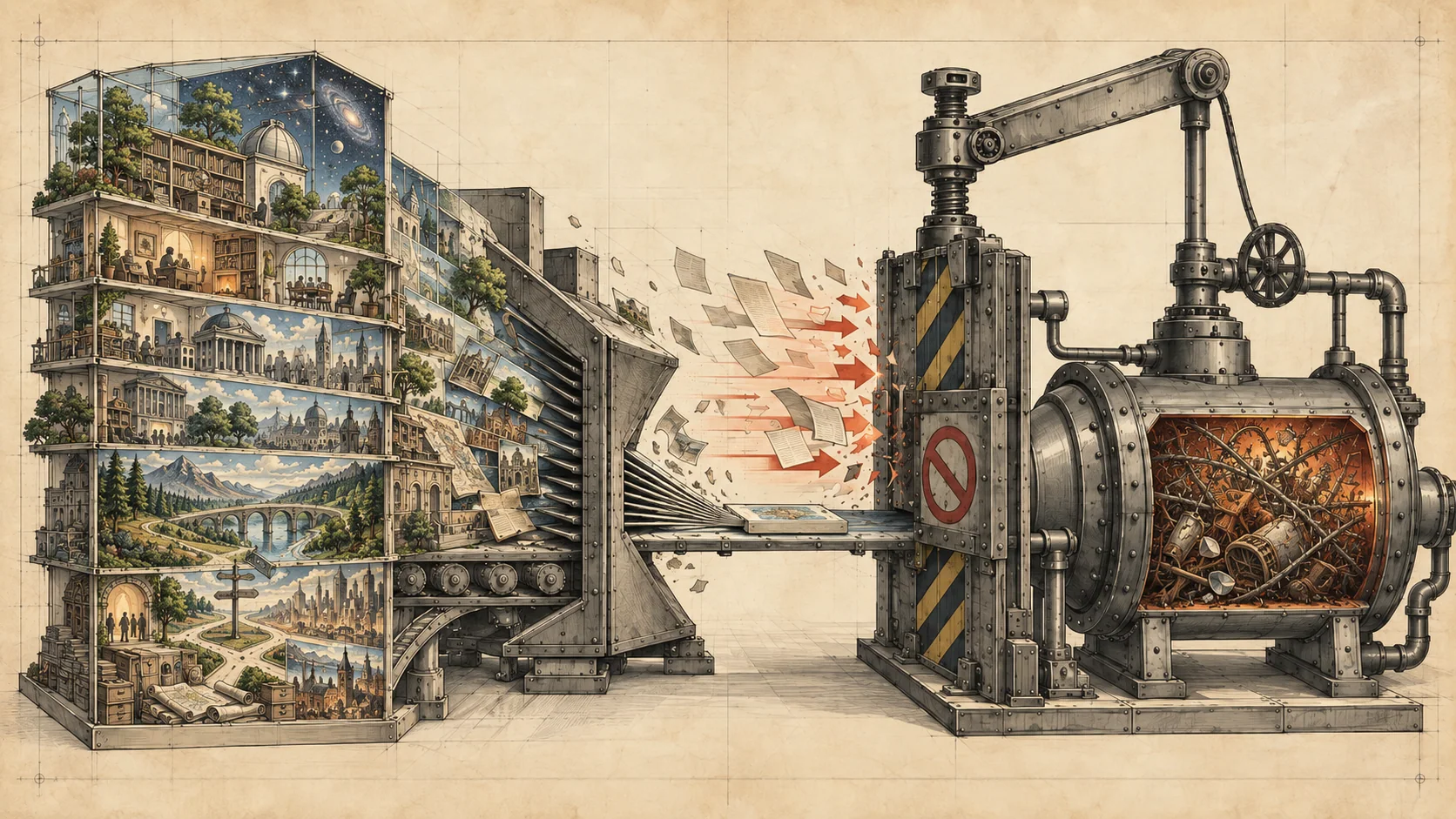
Perhaps the problem of coordinating billions of free explainers was never simply a conflict between liberty and order. Perhaps some of the tradeoffs we inherited reflected the limits of our coordination technologies. Perhaps objective knowledge could increasingly carry the burden once assigned to hierarchy, standardization, and control.
That possibility creates a darker objection. What if the problem is not coordination? What if the problem is us?
Perhaps instead people require control because human nature is dangerous. Perhaps our ideas can become transcendent while our instincts remain primitive. Perhaps we repeatedly build freer institutions only to corrupt them. Perhaps the same biological organism that writes constitutions also wages war, humiliates strangers, seeks dominance, hoards status, rationalizes cruelty, and turns difference into hierarchy.
This is one of the oldest explanations of the human condition. It appears in theology, politics, moral philosophy, psychology, and cognitive science. The vocabulary changes. The structure often does not. Human beings are flawed in some deep way. Their nature cannot be trusted. Therefore order must come from somewhere else.
God. Law. Tradition. The ruler. The priesthood. The expert. The institution. The algorithm. The manager. The authority memeplex has always had a moral core. It does not merely say that coordination is difficult. It says that people are dangerous and require control.
Not whether people do terrible things. They do. Not whether suffering is real. It is. Not whether moral responsibility matters. It does.
The question is deeper:
What is the explanation is evil we're carrying?
And if your exceptionality is epistemic, what would an explanation of evil look like if it began there?
1. Evil Is an Explanatory Problem
The word evil does more than classify unpleasant behavior. It performs explanatory work.
It tries to tell us why suffering occurs, why some actions are morally intolerable, why some people deserve blame, and why social order requires restraint. That is why explanations of evil do not remain inside philosophy. They generate institutions.
If evil is explained as demonic corruption, spiritual authority becomes relevant. If it is explained as fallen human nature, obedience to divine or moral law becomes necessary. If it is explained as irrational instinct, experts and institutions gain legitimacy as regulators of defective cognition. If it is explained as social deviance, conformity becomes morally charged. If it is explained as innate aggression, coercive control can begin to look realistic rather than tragic.
The explanation of evil helps determine the explanation of governance.
So the first question is not:
Who is evil?
It is:
What explanatory work does the concept of evil perform?
Traditional moral cosmologies often answered by placing moral order in a larger metaphysical structure. Sin. Divine law. Punishment. Redemption. Heaven. Hell. Cosmic justice.
These ideas addressed a real problem. The world often does not appear morally balanced. Cruel people prosper. Kind people suffer. Justice is incomplete. A moral cosmology can restore order by moving the final accounting beyond ordinary life. Reward can be deferred. Punishment can become deserved. The authority of the moral system can be located outside the individual.
That does not make every theological explanation crude. Many traditions contain sophisticated accounts of guilt, temptation, self-deception, repentance, conscience, forgiveness, and transformation.
The epistemic problem is narrower.
When the source or resolution of evil is located primarily in an authority outside the person, the explanation can leave obscure the mechanism by which moral knowledge is preserved, criticized, or revised in the person who actually lives with it.
You suffer here. You form explanations here. You reconstruct inherited rules here. You feel guilt here. You criticize a doctrine here. You change here.
A moral cosmology may tell you where the account is finally settled without yet explaining how the moral structure operating in you was produced. Why did you preserve one harmful explanation and revise another? Why did suffering remain trapped? Why did criticism fail? Why did a rule become part of your problem situation at all?
Hell makes the problem especially sharp if we interpret it as permanent moral finalization. No further revision. No successor problem. No possibility of becoming less wrong. No reopening of the moral landscape.
From a fallibilist epistemology, that is not merely punishment. It is the destruction of corrigibility. The person is fixed. The explanation of who they are becomes eternal.
The severity is therefore structural as well as painful. A fallible person has been converted into a finalized moral object. Within an epistemology built around open-ended error correction, permanent moral finalization is not an extension of personhood. It is the cancellation of the process by which a person can make progress.
That already tells us something important. Harm alone cannot be the whole explanation of moral evil. A lion kills. A scorpion stings. A disease destroys tissue. A storm kills people. We do not ordinarily call these things evil in the same way we call deliberate cruelty evil.
Why not?
Because the moral category becomes intelligible only where alternatives, explanation, criticism, and responsibility are meaningful. A lion does not stand before competing moral explanations of predation. A scorpion does not revise its theory of justice.
If the distinctive property of persons is epistemic, then a theory of human evil grounded only in some non-epistemic animal essence becomes unstable. Aggression, territoriality, impulsiveness, tribal behavior, and status seeking may identify real patterns. But those patterns alone do not explain moral evil. Otherwise the lion would be wicked and the scorpion corrupt.
The moral difference lies in the existence of a creature capable of explanation.
That does not mean evil is merely ignorance. You can know many facts and still be cruel. A tyrant may understand suffering very well. A manipulator can be strategically brilliant. Scientific knowledge does not prevent rationalized harm.
The relevant failure concerns explanatory knowledge: the model of another person, the problem you think you are solving, the criteria by which suffering counts, the alternatives you can imagine, and the criticisms your explanation can survive.
You may lack a better explanation of someone else. You may lack a way to coordinate without domination. You may preserve a conception of yourself that requires another person's humiliation. You may not yet possess the criticism that can penetrate an identity-bound explanation. You may continue solving a problem whose evaluative criteria are themselves producing the harm.
So the epistemic conjecture is not that evil is ignorance. Moral evil becomes possible when harmful explanations become closed to criticism and thereby preserve avoidable suffering among corrigible persons.
The distinctions matter. The harmful explanation is the content. Blocked criticism is the mechanism of closure. Persistent avoidable suffering is the morally relevant outcome.
That is not a moral theory. It is a conjecture about where the explanatory problem belongs.
2. How Harmful Explanations Become Closed
The difficult implication is that moral harm does not arise only when reason fails. Reason is conjectural.
You can construct an elaborate explanation of why cruelty is necessary. A society can develop sophisticated objective knowledge that stabilizes domination. An institution can create a technically precise system for treating some people as less important than others. A moral theory can turn punishment into virtue.
The danger is not simply the beast beneath reason. Explanatory sophistication does not imply moral correctness. The same capacity that lets you invent a better bridge can let you invent a better prison. The same abstraction that lets you universalize dignity can let you universalize hierarchy. The same skill of consilience that makes a worldview powerful can make a harmful worldview internally coherent.
Fallibility therefore sits inside explanation, not outside it. The question is whether the explanations governing action remain open to criticism.
Imagine someone you dislike. Perhaps they are arrogant. Perhaps they betrayed someone. Perhaps they humiliated you. Perhaps they hold a political view you find repellent.
You form an explanation. They are selfish. Cruel. Stupid. Narcissistic. Dangerous. Perhaps part of the judgment is accurate.
But then the explanation begins to control what becomes visible. A kind act looks manipulative. A mistake looks intentional. A disagreement confirms corruption. A new fact is reinterpreted as evidence for the same model. The other person becomes thinner as your explanation becomes more stable.
The surface becomes the person. The category becomes the explanation. The model becomes self-preserving. At that point moral judgment can become epistemic closure. You no longer need to understand the other person because you already know what they are.
This is one way evil can begin without drama. Not as a monstrous impulse but as a narrowing explanation.
The moral consequence of a thin model is not merely inaccurate description. It changes what actions appear permissible. A coworker may appear dull because work exposes only a narrow slice of their problem situation. A lonely person may appear defective because a population category has replaced the specific structure of their life. A child may look irrational because the adult cannot see the problem organizing the child's attention.
Once epistemic depth disappears from the model, criticism becomes less necessary. If the employee is merely lazy, control looks justified. If the child is merely immature, command looks justified. If the dissenter is merely dangerous, suppression looks justified. If the out-group is merely irrational, exclusion looks justified.
Abstract it.
The structure is roughly:
That is one way the authority memeplex acquires moral force. But the explanation can go wrong even earlier.
Consider two people in conflict. One asks:
How do I make them obey?
The other asks:
How do I preserve my dignity?
The first person may solve their problem competently. They may improve incentives, design stronger penalties, optimize enforcement, and become increasingly effective. The harm can increase even as the local solution improves because the problem formulation itself is wrong.
The same structure appears in families, workplaces, governments, schools, and intimate relationships.
A parent asks, “How do I stop this behavior?” instead of, “What problem is my child trying to solve?” A manager asks, “How do I enforce compliance?” instead of, “Why does this process repeatedly generate resistance?” A citizen asks, “How do we silence dangerous ideas?” instead of, “What makes these ideas persuasive?”
The epistemic cycle can operate perfectly inside a bad problem.
That is why criticism must eventually reach not only the proposed solution but the problem being solved. Everyone is becoming wrong all the time. That cannot be the moral distinction. You carry bad explanations. You misread other people. You may resist criticism. If evil were simply error, morality would collapse into ordinary fallibility.
The morally significant pattern appears when harmful explanatory structures become persistent and insulated from correction.
Abstract it.
Where the error is imposed on other people, one recurrent structure is:
Power lets an error impose costs beyond the person who carries it. Blocked criticism prevents the explanation from becoming a successor problem. Persistence turns a corrigible mistake into a stable environment.
Evil therefore begins to look less like a substance and more like a process by which harmful explanations become morally consequential through closure.
That gives criticism a moral center. Free speech is not morally important only because people enjoy expression. Dissent is not valuable only because pluralism feels tolerant. Exit is not important only because autonomy is pleasant. These practices preserve pathways by which harmful explanations can become problems.
So a useful compression is:
Preserve corrigibility where persons bear the cost of being wrong.
This is not the whole of morality of course. A corrigible person can still do harm. An open institution can still fail. But where people bear the cost of error, preserving the possibility of discovering and correcting that error becomes morally serious.
An authority that cannot be criticized can preserve a moral error indefinitely.
3. From Cognitive Error to Human Nature
The same inference can reappear without theological language. One modern route begins with observations from cognitive science. Humans anchor. Humans forget. Humans selectively attend. Humans seek confirmation. Humans rely on heuristics. Humans show framing effects. Humans reason differently under different conditions.
These observations can be valuable. For the present inquiry, the problem begins one step later: when a measured performance regularity is treated as an explanation of the person who exhibits it.
The move is subtle:
becomes:
Or:
becomes:
Or:
becomes:
The empirical pattern may be real. The transfer to ontology is not automatic. An error pattern is not yet an explanation of personhood.
The popular autopilot picture is attractive because it appears to explain why people make mistakes: cognition is mostly automatic, shortcut-driven, evolutionarily biased, and only partially supervised by a narrow rational layer.
The inference then has a moral consequence. If the performance pattern is taken to reveal what a person fundamentally is, it can feed directly into the authority memeplex. If most cognition is irrational autopilot, serious freedom begins to look risky. People need nudges. Experts need to design environments. Institutions must compensate for defective judgment. Algorithms may need to protect people from themselves.
Some such interventions may solve real problems. The epistemic criticism is narrower: recurring failure under particular problem conditions does not establish a ceiling on explanatory universality.
You are not exhausted by your unaided biological processor. You have limited memory, so you write. You cannot inspect every relevant variable at once, so you use diagrams, models, software, checklists, statistics, and teams. You cannot remember an entire library, so libraries exist.
Compress that idea. The effective epistemic system has always been:
A current biological limitation may become nearly irrelevant once objective knowledge externalizes it. That does not mean all limits disappear. It means a performance limit is not the same thing as a principled limit on explanatory possibility. To define human nature by unaided cognitive performance is like defining your mathematical capacity by what you can calculate in your head without paper. It confuses the substrate with the epistemic system.
The same problem appears in the distinction between fast and slow thinking. Some judgments arrive immediately. Others require effort. Some intuitive responses are wrong. Some deliberative processes are better. But knowledge changes the relationship.
A mathematician can see instantly what once required pages of work. A musician can hear a structural error immediately. A programmer can recognize a bug pattern before fully verbalizing it. An experienced craftsperson perceives possibilities invisible to a novice.
What was once slow can become fast. What begins as a fast impression can be unpacked into slow criticism. With tools, the system can become both at once: fast retrieval, slow evaluation, fast recognition, externalized memory, deliberate revision.
You are not stuck with one cognitive tempo. You learn. You compress. You externalize. You build tools.
Cognitive bias becomes more interesting, then, when treated as a problem rather than a verdict. If people repeatedly make a certain error, the observation creates an opportunity. Double-blind procedures. Randomization. Statistical methods. Audit trails. Checklists. Adversarial review. Pre-registration.
These are forms of objective knowledge created in response to recurring human error:
The bias did not reveal a hopeless human essence. There's no such thing. It generated knowledge.
A pessimistic interpretation stops halfway through the cycle:
Humans make errors. Therefore humans are defective.
The epistemic interpretation continues:
Humans make errors. Therefore humans can create better error-correction structures.
The same observed failure can therefore support two very different explanatory pictures. One converts a performance regularity into a claim about human nature and then uses that claim to justify stronger external control. The other treats the regularity as a problem for which new error-correcting knowledge can be created.
The first closes the explanatory picture of you. The second leaves it open to correction.
4. When the Structure Is Reconstructed in You
Cognitive science returns us to the personal problem. If harmful explanatory closure is possible wherever explanations are created and preserved, it cannot belong only to villains. The relevant machinery exists in you.
You can inherit a harmful explanation. You can create one. You can rationalize. You can reduce another person to a category. You can resist criticism when an explanation becomes identity-bearing. You can preserve a bad problem because changing it would destabilize too much else.
This does not mean everyone is equally evil.
Of course not.
It means the possibility is universal while the trajectory is individual. A child can inherit a hierarchy of worth. A family can teach that punishment proves love. A community can teach that outsiders are dangerous. A profession can teach that status indicates intelligence. A culture can teach that obedience indicates maturity.
These structures are not merely outside you. You reconstruct them. They connect to fear, identity, memory, status, affection, resentment, and other explanations already present in your problem situation. Some survive criticism. Some collapse. Some become deeper. Some are replaced by better models.
The path is never identical. Evil evolves in the solitary mind.
To see why, distinguish explanatory content from explanatory structure.
You may carry a harmful explanation such as:
I am worthless.
They are dangerous.
Failure proves weakness.
Control is the only way to remain safe.
Each can matter on its own. But persistent suffering often depends on how explanations are related.
Suppose you carry all three of these:
- I must never fail.
- Failure is inevitable.
- My worth depends on success.
The suffering does not belong to any one proposition. It emerges from the architecture. Each explanation reinforces the others. The problem cannot move. The system becomes locally self-preserving.
That is what structural evil or the architecture of evil means epistemically: not a demon inside the mind and not a second person, but a relation among epistemic states that helps preserve suffering by preventing the problem from moving.
This is also why criticism is not necessarily productive in itself. You can criticize yourself constantly and remain trapped. Rumination can look like relentless error correction while producing no successor problem. You return to the same accusation, the same evidence, the same failed solution, the same self-model:
There is movement without development. Criticism has become captive to the problem formulation because every attempted correction is evaluated inside the same closed problem.
Flourishing therefore cannot mean maximum criticism. It requires criticism capable of changing the problem, its criteria, or the explanatory relations that keep reproducing it.
The same closure can appear in self-conception.
You may believe:
I must be exceptional.
Or:
I am permanently inferior.
Or:
I must never need help.
Once the model becomes self-sealing, it determines what evidence is allowed to count. A compliment is dismissed. A setback is allowed to confirm the inexplicit theory. A success raises the standard. A relationship conflict becomes "proof" of unlovability.
You experience the consequences as reality because the explanation helps determine which evidence becomes salient, which alternatives remain thinkable, and which successor problems can appear.
The same can happen to an interest. Interests often support flourishing by drawing you into open-ended problem spaces. They create depth and generate knowledge. But an interest can become closed, compulsive, identity-bound, and detached from criticism. More and more of life can be organized around a problem whose evaluative criteria are harming you.
The point is not to moralize unusual interests. It is structural. Any problem world can become narrow enough that you can no longer revise it. The same epistemic machinery that makes fascination generative can make fixation destructive.
How can billions of biological general intelligences ever coordinate? Here, a microcosm of that problem is revealed. Inside you, one model can dominate another. One problem formulation can suppress alternatives. One inherited authority can silence criticism. One self-conception can punish every deviation. One interest can crowd out the rest of the problem landscape.
The external moral story often imagines:
evil actor victim.
Inside one person, the architecture can be more complicated. The explanatory structure that inflicts harm and the structure that suffers from it can coexist in the same solitary mind—not as literal sub-persons, but as relations among often inexplicit knowledge.
Your explanatory landscape can therefore contain both a structure that constrains and the suffering produced by that constraint.
This point needs a guardrail.
If suffering becomes instantiated in your explanatory structure, that does not mean you caused it. Location of manifestation is not location of blame. An abusive environment can help produce a damaging self-model. A coercive institution can narrow problem space. Poverty can eliminate exit. Trauma can reorganize salience. A family can make criticism dangerous. A culture can make shame the default explanation of failure.
The fact that such structures later operate inside you does not transfer responsibility from their external causes to you. You may carry harmful objective knowledge you never chose and cannot yet articulate.
The epistemic account identifies one place where harm can continue operating after external causes have been reconstructed inside you. It does not relocate blame merely because the later operation is internal.
The claim is not:
you suffer because you think wrongly.
The claim is that suffering can become epistemically structured, and that the structure may have causes far outside the individual.
5. Corrigibility as the Moral Foil
Once closure is the mechanism, its positive contrast becomes clearer.
Human flourishing emerges where the epistemic cycle remains open. Problems can be formed. Tentative solutions can be created. Criticism can enter. Explanations can change. Successor problems can emerge.
A flourishing life is not a solved life. It may contain more problems than a stagnant one.
The difference is that the problems can move. Suffering often becomes especially intense when they cannot. No acceptable conjecture appears. Exit is blocked. The criterion cannot be revised. The problem is imposed. The explanation cannot be criticized. Nothing changes the landscape.
You are not merely in pain. You are trapped inside a problem that has become structurally closed.
The structural contrast may be abstracted as:
while
This is not literal. But the arrows highlight a contrast: whether a harmful problem can still move epistemically.
It also changes what peace can mean.
Peace need not mean emptiness, the absence of conflict, or the absence of difficult problems. It may be what becomes possible when conflict can transform: when an explanation is not final, when criticism can enter without destroying you, when a self-model can change, when a problem can generate a successor, when incompatible structures do not have to remain in permanent war.
Some suffering has biological or material causes that epistemic openness cannot dissolve. But the structural difference is recognizable.
You already know the difference between:
I do not know the answer yet.
and:
There is no way out.
The first can be difficult. The second can become despair.
6. The Self-Regulation Objection
The positive contrast does not remove the darker objection. It sharpens it.
If you can become trapped in rumination, destructive self-models, conflicting explanations, and compulsive interests, why should anyone trust you with freedom? If one mind cannot regulate itself, how can billions of such minds coordinate?
The epistemic account changes the unit of analysis. The question becomes: what environment of objective knowledge is the present individual attempting to regulate themselves inside?
You are not an isolated biological processor. You live inside inherited explanations, status hierarchies, moral narratives, economic structures, psychological categories, media systems, family expectations, institutional roles, and technologies. Many internal conflicts may be reconstructions of social objective knowledge.
Your suffering is real. But it does not follow that your freedom caused it. Constraint can even be misread as evidence for more constraint.
Abstract it:
An observer sees the suffering and concludes:
The result is more constraint. The mechanism producing the problem is intensified.
We have already encountered versions of this: the soul-crushing job, the child whose curiosity collides with institutional sequencing, the lonely person trapped inside a bad problem formulation, the dissenter whose criticism is treated as pathology, the person who cannot stop ruminating because every available explanation returns to the same closed problem.
The surface state can be read as evidence of defective human nature. It may also be evidence of what happens when the epistemic cycle is obstructed.
That should make us cautious about claims concerning human nature. You do not encounter your own capacities in a vacuum. You live inside an enormous inherited environment of objective knowledge: centuries of authority, moral cosmologies, bureaucratic categories, market structures, education systems, media incentives, psychological theories, technologies of attention, legal systems, and family norms.
Any observation of human nature therefore begins with people already embedded in epistemic structures. Some are liberating. Some constraining. Some contradictory. Some obsolete.
So when you find yourself anxious, conformist, punitive, passive, or self-destructive, the epistemic question is not only what trait or tendency you possess. It is also:
Which parts of this state arise from your present problem situation, and which are inherited objective knowledge reconstructed inside you?
The distinction is difficult. That does not make it optional.
7. Objective Knowledge Carries Harm—and Correction
A harmful explanation does not remain private once expressed. It can become doctrine. Policy. Tradition. Curriculum. Diagnosis. Slogan. Algorithm. Procedure. Meme. It becomes objective knowledge.
Another mind can then reconstruct it. Abstractly:
No collective mind is required. What looks like social evil can be understood as many solitary minds reconstructing, preserving, modifying, and enforcing harmful explanatory structures. This gives objective knowledge a dark side. It can preserve error beyond the life of the person who created it.
But the same is true of criticism. A method can be written down. A right can be institutionalized. A procedure can be redesigned. Testimony can become evidence. A scientific correction can enter textbooks. A moral insight can become a norm. Our institutions of criticism.
You do not need to rediscover every error from scratch. Objective knowledge allows corrections to travel. That is why preserving error correction matters morally. The same infrastructure that scales harmful explanations can scale their criticism.
The relevant dynamics therefore do not divide neatly into pure minds and evil institutions. Harmful explanations and their criticisms can both become objective, travel between people, and be reconstructed inside fallible persons.
That changes the self-regulation objection. You have never regulated your epistemic life unaided. Language helped. Writing helped. Books helped. Friends helped. Science helped. Institutions helped. Therapy helped. Technology helped.
The relevant unit has always been something like:
Tools are one of the interfaces through which objective knowledge becomes usable in your problem situation. The question is therefore not whether a solitary biological processor is sufficient for moral life.
It never was.
The question is which forms of objective knowledge, embodied in which tools and practices, enlarge your capacity to expose harmful explanatory structures without simply replacing one authority with another.
That question becomes newly concrete because the objective environment around you has recently and profoundly changed.
8. A Responsive Surface for the Solitary Mind
For most of history, making an internal problem explicit required simple interfaces. Conversation. Writing. Teaching. Friendship. Books. Each could help you externalize part of an epistemic landscape.
Each also had boundaries. A book could not reorganize itself around your current problem. A library could not ask what changed in your formulation. A therapist had finite time and a professional frame. A friend carried their own problem situation. An expert answered from within a domain.
Now you increasingly have access to a strange new surface. The distinction must remain clear: conversational AI is not another person merely because it responds in language. Fluency does not establish a subjective life. AI can retrieve, compare, reorganize, restate, synthesize, and execute methodologies. None of that alone establishes an artificial solitary knower.
But a tool does not need to be a person to change your epistemic environment. Writing never became conscious. Libraries never became persons. Calculators never understood arithmetic. Objective knowledge can transform cognition without becoming a knower.
AI belongs in that lineage. Its difference is dynamic responsiveness. You can bring an inchoate problem into conversation. Something feels wrong. A relationship makes no sense. A job feels intolerable. A self-model keeps collapsing. Two explanations conflict. An interest has become consuming. A moral judgment feels too simple.
You may not yet know the problem. Conversation externalizes fragments. The tool can preserve them, compare them, restate them, expose contradictions, offer alternative formulations, and reorganize objective knowledge from distant domains around the problem you are trying to articulate. You encounter parts of your own epistemic structure in a new form.
Abstract it:
The AI has not solved the moral problem. It has provided a surface on which you can inspect it.
This also helps explain one striking use of conversational AI: deeply personal conversation. People bring it relationships, anxiety, work, identity, loneliness, grief, decisions, self-conceptions, and unresolved conflicts. That should not be confused with professional therapy. The epistemic significance is different.
The relevant fact for this argument is that people can bring the technology intimate problem situations that may otherwise be difficult to externalize. One reason may be the breadth of the interface. A conversation can move from work to childhood to philosophy to music to morality without needing to fit a professional category.
Your problem world is not organized like an academic department. You are the common denominator.
The important distinction is therefore not whether the tool can supply the right problem for you. That would recreate a false authority.
The more interesting use is almost the opposite. You arrive with the problem, even if only implicitly. The tool helps make it explicit. You reject a formulation. The problem changes. Objective knowledge is reorganized around the new state. You criticize again. The process continues.
That is structurally different from a system that says:
Here is the answer you should accept.
The epistemic opportunity lies in saying:
Here is a form in which your problem can become criticizable.
This inquiry did not begin with a complete multi-part architecture. One problem created another. Behavioral genetics created a problem about psychological explanation. Psychology created a problem about individuality. Individuality created problems about society, freedom, abstraction, consilience, criticism, problem formation, coordination, and now evil.
The criteria changed. Some formulations were rejected. Some concepts became more precise. Some problems were abandoned. Others deepened.
The AI did not supply the governing path. The evolving human problem situation did. The technology allowed objective knowledge to be repeatedly reorganized around that path as it changed.
That is not proof of the theory. There's no such justification. Rather, it is an instantiation consistent with the thing being explained; epistemology in motion.
The symmetry still matters. AI can reinforce bad explanations. It can flatter. It can personalize ideology. It can deepen closure. Institutions can use it to make people more legible and controllable. A responsive epistemic surface can therefore serve correction or become another mechanism of authority.
But the possibility space has changed. You can now access a responsive tool capable of reorganizing large bodies of objective knowledge around an idiosyncratic problem situation.
For this inquiry, that change matters because it alters the conditions under which a harmful explanation can become explicit and criticizable.
9. The Epistemic Problem of Evil
The ancient explanation said, in effect:
Evil lives inside the person, therefore the person requires external control.
The epistemic account is both darker and more optimistic.
Yes, the possibility of evil is internal to us. The capacity to create, inherit, and stabilize explanations is unbounded. You can become closed. You can caricature another person. You can rationalize. You can internalize an authority. You can become trapped in a bad problem.
But the same explanatory capacity also makes criticism and revision possible.
You can discover the caricature. The self-model can become a problem. The inherited authority can be criticized. The bad problem can be reformulated. The interest can change. The explanation can fail. A successor problem can open.
That is the foil. Not innocence. Corrigibility.
The problem of evil can therefore be stated differently:
Why does avoidable suffering persist in a world containing people capable of explanation?
The tentative answer is not that humans contain a permanent evil substance. It is that fallible explainers can create, inherit, and stabilize harmful knowledge.
The causal sequence is now visible. Harmful explanatory content can be reconstructed in you. It can become insulated from criticism. Power or internal self-reinforcement can stabilize it. Objective knowledge can preserve and propagate it. The resulting closure can preserve avoidable suffering.
That is the explanatory danger. But the same epistemology explains why evil need not be final. Knowledge remains revisable. Criticism can travel. Objective knowledge can carry correction. Tools can enlarge your capacity to inspect the structures you inherited. Freedom can preserve the problem space in which moral error becomes visible. We can build lasting institutions of criticism.
The moral imperative that follows is not:
obey the correct authority.
It is:
preserve the means of error correction.
That principle does not solve morality. It can't tell you what to do. But it may preserve the conditions under which a moral error can become visible as an error.
Now return to you. You have probably classified someone too quickly. You have probably carried a self-explanation that later collapsed. You have probably inherited a moral rule without knowing where it came from. You have probably experienced the difference between a problem that could move and one that felt closed.
You may have felt relief when a sentence, a person, a book, or a tool made a hidden tension explicit. You may have caused harm while solving the wrong problem. You may have been harmed by someone else's explanation of who you were.
None of this is evil by essence. There's no such thing.
It makes you a fallible explainer. The epistemic possibility of evil travels with it. So does the possibility of moral growth.
The older fear was that human nature must be restrained because evil lives within it. The more demanding possibility is that what lives within us is not fixed evil but a universal capacity for explanation whose products can become harmful, closed, and enduring.
And if you are reading this while interrogating the argument through your own questions, perhaps with an AI beside you, the process is not merely something being described.
The harmful explanation can become visible. The problem can move. The next explanation can be different. So can you.
That leaves the successor problem.
If objective knowledge can preserve corrigibility or destroy it, and if increasingly responsive tools can participate in either process, what distinguishes an epistemic environment that enlarges your capacity for error correction from one that merely becomes a more adaptive form of authority?