What Moves You
XVII. The Arrows of Knowledge
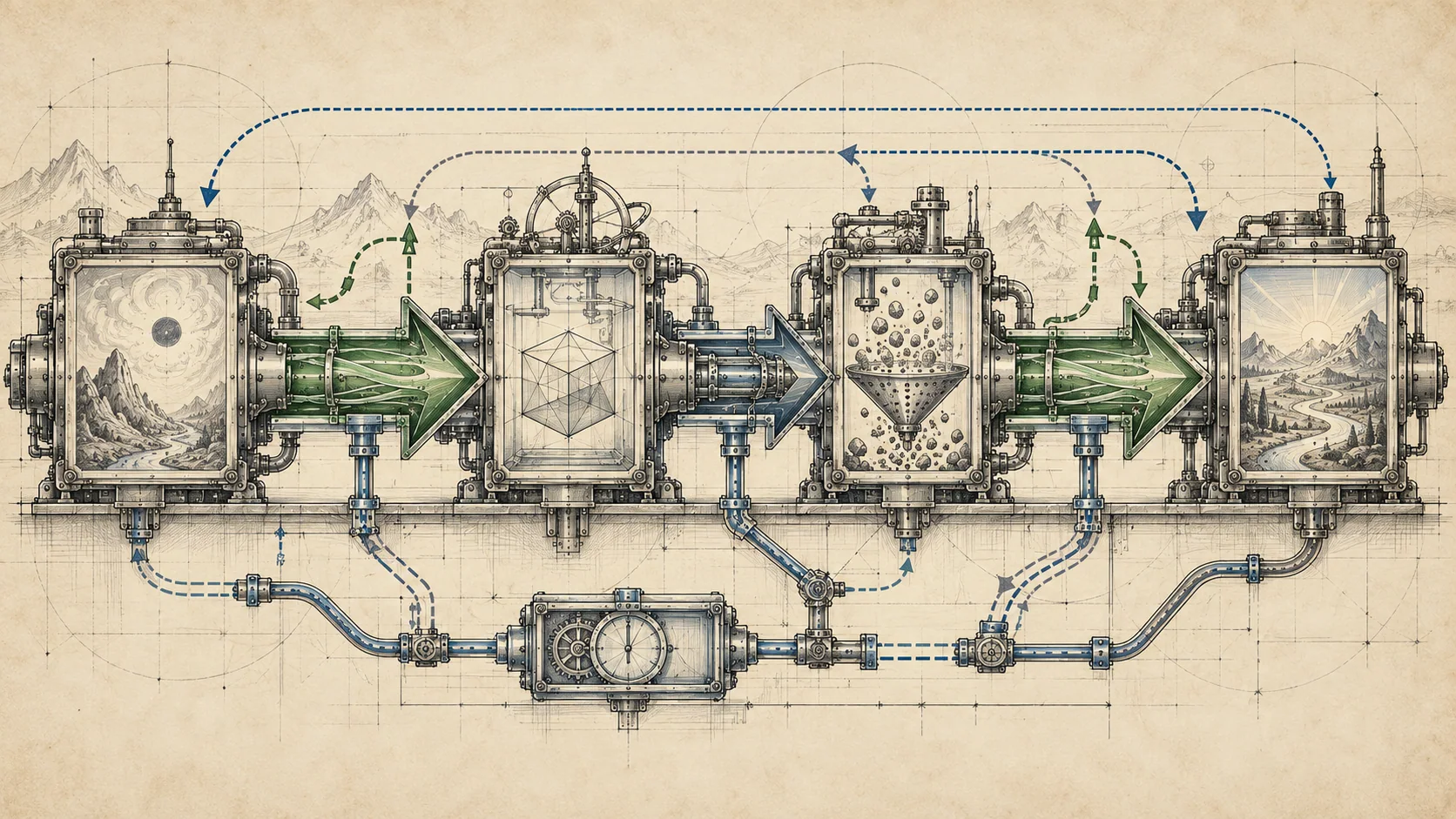
One schematic has endured:
A problem. A tentative solution. Error elimination. A successor problem.
The cycle is useful because it is compressed. It can describe a scientific discovery, a child's learning, an argument failing under criticism, or the reconstruction of an explanation inside one solitary mind.
But compression hides things. Our attention repeatedly falls on the states. What is a problem? What makes a tentative solution explanatory? What does criticism do? How does a successor problem differ from the problem that came before it?
Now return to the schematic. What are the most neglected parts? The arrows.
What moves you from one explanatory state to another? Why does a problem suddenly feel sufficiently formed that a tentative solution becomes possible? Why does a conjecture that felt promising an hour ago suddenly demand criticism? Why does one criticism reorganize the problem while another disappears? Why do you abandon one problem and become fascinated by another? Why does a solution arrive during a walk? Why can you stare at the same problem for hours and feel no movement at all?
We do not know. The arrows are compressed too. They are not proposed here as neural mechanisms, cognitive modules, neurotransmitter flows, or literal structures inside the brain. They are epistemic abstractions. They make visible something that has been present throughout but remained almost typographically invisible:
You do not merely inhabit explanatory states. You move among them in mysterious ways.
That movement may be as important as the states themselves. And we may have built psychological, educational, institutional, and moral vocabularies around the states while neglecting the arrows.
1. The Arrows Are Not a Clock
The obvious mistake would be to read the epistemic cycle as a temporal schedule or linear sequence.
can look like:
- finish defining the problem;
- generate a solution;
- criticize the solution;
- formulate the next problem;
- repeat.
No one lives like that.
A scientist can criticize a tentative solution before the original problem is fully articulate. A programmer can abandon a bug, return two days later, and discover that the original problem has changed. You can carry incompatible explanations for years before some event makes their conflict explicit, or wake with a candidate solution to a problem you had stopped consciously thinking about.
So the arrows are not instructions. They do not say:
now proceed from state A to state B.
The diagram is a map of epistemic relations. It identifies recognizable conditions in the growth of knowledge. Your lived process can move forward, backward, sideways, recursively, intermittently, and sometimes apparently nowhere at all.
You do not owe the diagram linearity. The diagram provides explanatory usefulness.
This distinction matters because states are easier to see than transitions. A problem can be written down, an explanation modeled, a criticism recorded, and a successor problem articulated. Objective knowledge favors these states.
The arrows are harder to capture. What moves you from I don't understand to maybe this explains it, or from this explanation seems good to something here is wrong?
You may not know. The observer may see only a jump. The biological machinery remains hidden. The epistemic movement may become visible only after it has occurred.
That asymmetry creates a bias. States look like the serious intellectual content because they can be inspected after they have been externalized; transitions look incidental because much of what produced them remains hidden. Call this the state-transition bias.
Imagine, only as an analogy, a computational architecture in which one agent processed the current state while another orchestrated movement among states. The first might solve equations, inspect evidence, compare alternatives, or refine an explicit explanation. The second might determine that the problem has changed, that the present solution should be criticized, that a different problem deserves attention, or that the system should stop processing entirely and wait.
We would not say:
the first agent is intelligent; the second is merely distracted.
The architecture would depend upon both. There is no claim that your brain contains a state processor and an orchestration processor. The point is conceptual. We readily value processing once the problem frame is stable. We have much less vocabulary for valuing the movement that changes the frame.
2. Your Arrows Are Harder to See
The state-transition bias becomes socially important because your own transitions and another person's transitions are not equally legible to you.
Suppose someone receives a well-defined problem and processes it rapidly. They calculate quickly, remember relevant facts, write clearly, and produce many correct transformations without leaving the problem frame. We call them intelligent.
Now suppose another person moves rapidly across states. A problem suggests a conjecture. The conjecture reveals a contradiction. The contradiction makes another problem salient. That problem connects to something apparently distant. The person leaves the original subject, returns later, and produces an explanation whose path nobody else followed. We call them scattered.
The difference is not necessarily that one mind is doing more epistemic work. One person's work remains legible inside a state the observer already understands. The other repeatedly destroys the observer's anchor.
Externally, the observer keeps having to ask:
Wait. What are we talking about now?
Internally, the transitions may feel obvious.
That difference matters because social judgments are made from outside. You inhabit the epistemic mind that makes your own transitions intelligible. Another person sees only the surface: a change of subject, a criticism, a pause, a sudden enthusiasm.
They have to reconstruct the road. Sometimes they can. Sometimes they cannot. You may then appear less coherent than you are. Or more coherent than you are. The visible transition is underdetermined by the invisible epistemic landscape that produced it.
Inner speech gives one unusually accessible example. Not everyone reports a continuous inner monologue, so inner speech cannot be treated as universal machinery of thought. But where it is present, its structure is revealing.
It rarely sounds like a clean essay. It may sound more like:
I need to finish this. Why am I avoiding it? Actually, the problem is not the work. It is that I don't believe the premise. Wait, that is the same issue from yesterday. No. Maybe the issue is that I am solving the wrong problem. I should write this down. I'm hungry. That reminds me—
The words are not merely processing one stable state. They are traces of transitions. Problems are reformulated. Candidate explanations appear. Criticism interrupts them. Memories become relevant. Evaluative criteria change. Attention moves.
For you, where inner speech is present, the monologue can be arrow-laden. Where it is absent, the same movement may appear differently: a shift in bodily orientation, a sudden certainty that the present direction is wrong, or a new explicit conclusion appearing without a narrated path.
The implementation can differ. The arrow remains a deliberately abstract description of movement.
3. The Epistemic Mind Moves
The metaphor of an epistemic landscape is useful. Your epistemic mind contains explicit explanations, inexplicit knowledge, memories, skills, interests, abstractions, values, expectations, unfinished problems, and inherited objective knowledge.
But landscapes sound static. The arrows change that. Your epistemic mind is not merely a place through which you travel. The travel changes the place. A criticism can make an old path unusable. A new explanation can connect regions that previously seemed unrelated. A skill can make new problems visible. A failed project can reorganize years of prior experience.
The difference need not come from acquiring a new explicit proposition. Movement itself can reshape the problem field. Perhaps the epistemic landscape is better imagined as landscaping: not a finished terrain, but an evolving one. You move through it while continuously altering the conditions of later movement. That is path dependence made dynamic.
The same shift makes an old question sharper.
Earlier we asked:
where does the problem come from?
Here we ask:
why this arrow? why now?
Why does one problem release its grip while another suddenly becomes alive? Why does a criticism that was available yesterday become devastating today? Why do you finally feel ready to stop criticizing and construct again? Why does an irrelevant memory become relevant? Why can boredom suddenly become curiosity?
We do not possess an explanation. And the notation should not be mistaken for one.
To write:
does not explain the causal machinery by which a problem becomes a conjecture. It makes the transition explicit enough to become a problem.
That is already useful. The unknown becomes more visible.
Sometimes what becomes intelligible first is not the destination but the need to move.
You may think:
I understand the problem well enough. I need to start constructing something.
Or:
I have spent long enough decorating this explanation. It is failing. I need to criticize it.
Or:
I know the solution failed, but I do not yet know what the successor problem is.
Or simply:
I cannot productively inhabit this problem right now.
The state is not resolved in the sense of closure. But direction has become intelligible.
You may still be confused. You may have no solution. You may not even know what problem comes next. Yet something fits:
I need to move.
The arrow can become consilient before the destination does.
4. When Direction Feels Alive
That brings us to a deliberately unserious-sounding meme.
Fun.
Modern intellectual culture does not usually grant fun much epistemic dignity. Fun belongs to leisure. Serious work belongs to effort. A difficult activity is respectable because it is difficult. A pleasurable activity is suspect because pleasure seems to explain why you are doing it.
We inherit slogans such as:
no pain, no gain.
The slogan contains a truth in some problem situations. Bodies adapt to load. Skills often require repetition. Difficult knowledge cannot always be acquired without discomfort.
But the meme can quietly acquire a much broader moral meaning:
and:
That deserves criticism. Suppose fun is not treated as pleasure alone. Suppose we use it provisionally to name the experience of an epistemic direction becoming alive. A child follows a question because it is fun. A scientist cannot stop thinking about an anomaly. A conversation runs for hours because each criticism creates another problem.
The common element is not ease. These activities can be difficult, exhausting, frustrating, even painful. You continue because the next arrow feels available. Call this provisional signal the fun criterion.
So the conjecture is not:
fun is truth.
Nor:
fun is always good.
Nor:
you should only do what is fun.
It is narrower:
Fun may sometimes be the conscious surface of a much larger inexplicit epistemic process drawing you toward a transition.
It is not a utility function. You are not necessarily calculating which option will maximize fun. The relevant option may not have existed a moment earlier because the problem, the criteria, or the landscape may itself be changing. Fun may be one way the movement becomes experientially visible.
Childhood makes the possibility hard to ignore. A small child moves constantly among problems: touch this, ask why, stack the blocks, lose interest, return, invent a game, change the rules, become absorbed in something the adult did not notice.
We usually interpret much of this generously. The child is learning, exploring, developing, playing. We do not require the child to explain the epistemic value of every transition. We assume that an enormous amount of development is occurring beneath explicit articulation.
Then something changes. At some poorly explained point, the cultural model shifts. The same kind of movement becomes distraction. Remain seated. Follow the assigned problem. Finish before switching. Do not follow the unrelated question. Fun becomes a reward after work rather than a possible feature of knowledge creation.
The epistemology has not obviously changed. The child remains a problem-generating, conjecture-forming, criticism-sensitive person. So what explanation licenses the boundary? Why should self-directed epistemic movement count as development at six and indiscipline at sixteen?
The problem is narrow. Externally ordered learning can become so dominant that your own arrows are interpreted only as interference, or evidence of distraction. That interpretation requires more explanation than it usually receives.
5. When Attention and Direction Diverge
The screen-time problem now looks different.
The conventional observation is easy:
the child has spent too long on the screen.
The adult sees duration, stillness, perhaps inactivity.
But what does the child experience? Perhaps nothing worthwhile. Perhaps compulsive repetition or escape. Perhaps a social or technical problem. Perhaps a creative project or a game containing nested problems and rapidly changing criteria. Perhaps several of these at once.
Removing the screen may abruptly terminate a dense epistemic landscape whose arrows the adult cannot see.
The earlier error was to infer psychological content from the medium. The arrow adds another caution:
The observer may see a static screen while the child experiences rapid epistemic movement.
Physical stillness can contain cognitive travel. Visible activity can contain epistemic stasis. The external form does not settle the explanatory question.
The same issue appears in bureaucracy, repetitive workflow, and the classroom exercise whose answer everyone already knows. A process may specify the problem, the acceptable solution, the sequence, the language of failure, and the next task.
The arrow makes the mechanism of epistemic confinement more tangible.
The process does not merely assign a state. It assigns the transition:
You are expected to remain on the prescribed sequence. When the required transition and your live epistemic direction diverge, the process creates what we can call a forced arrow.
But your epistemic mind may have moved. You may see that is badly formulated. You may have generated . You may have encountered criticism the process does not permit. You may already be at . Or no arrow may presently exist.
The institution nevertheless demands:
continue.
This can create a distinctive form of disorientation. You experience one epistemic direction while being required to enact another. The conflict may feel like boredom, restlessness, confusion, irritation, or even shame. The authority may then interpret the symptoms as defects in you.
Why can't you focus? Why can't you just finish? Why do you keep changing the subject? Why are you making this complicated? Why are you so unmotivated?
You may not know. Your own arrows are not necessarily available to introspection. You simply know that remaining here feels increasingly difficult.
Creative blockage gives the inverse case. You have a problem. You want the solution. You sit down. Nothing comes. So you push harder. Think harder. Concentrate. Force yourself to remain. But the next epistemic transition is not available. The problem remains a problem. No conjecture feels alive. No criticism opens anything. No successor problem becomes visible.
It can feel like pushing a rope. The effort acts upon the present state without producing the transition. Then you stop. You walk, talk to someone, sleep, or do something apparently irrelevant. Later the arrow appears.
The image should not be romanticized. A walk is not a magical creativity technology. Sometimes the problem remains stuck. Sometimes disciplined persistence is exactly what produces the breakthrough.
The narrower point is that explicit effort does not seem to control every transition. Your inexplicit epistemic mind continues changing outside the narrow surface of conscious problem-solving. When the arrow finally appears, you may experience it as sudden.
We should not infer causal discontinuity from conscious suddenness. Perhaps the conscious arrival of the arrow is itself one of the things you experience as creative movement.
Attention makes the stakes higher. Difficulty sustaining attention can cause real suffering. It can damage education, work, relationships, safety, and self-esteem. You may desperately want to remain with a problem and find that you cannot. Nothing here diminishes that. Nor does it diminish the value of a serene mind. The ability to hold a difficult problem steadily can be extraordinary. Some lives are enlarged by deep concentration. Some problems require years of patient work.
The question is not whether sustained attention is good. It is whether every departure from an externally preferred state should be interpreted first as failure.
Suppose the externally imposed sequence says:
You repeatedly move elsewhere. The observable behavior is real. But several explanations remain possible.
Perhaps you cannot control attention in a way you yourself find harmful. Perhaps the assigned problem is insufficiently salient or conflicts with an active criticism. Perhaps another problem has become more urgent, or the present state has already been exhausted for you. Perhaps the difficulty is physiological. Perhaps several mechanisms interact.
The behavioral surface does not decide among them. That is the epistemic point.
Attention-deficit/hyperactivity disorder makes the distinction especially important. The category refers to real patterns of difficulty and, for many people, real suffering. Interventions can help. Medication can help. Behavioral and environmental changes can help. Successful treatment matters.
Compare it:
If a medication helps you remain with work you care about, that is important knowledge about the intervention. It does not, by itself, prove why your prior experience had the structure it did.
Observations of arrows offer no clinical explanation of ADHD. It suggests an epistemic conjecture that may reveal how much remains compressed inside the observable category.
Imagine being required to remain in an epistemic state after the live arrows of your mind have moved elsewhere. As the imposed state becomes less inhabitable, concentration on it deteriorates. Other transitions keep surfacing.
From outside:
inattentive.
You are required to suppress those transitions. You become restless. The movement surfaces behaviorally.
From outside:
hyperactive.
Again, this is only a conjecture. It cannot explain the clinical condition. It may be false. Its purpose is narrower: to show that the same observable pattern can be compatible with an epistemically richer interpretation than:
the person fails to sustain proper attention.
That possibility is morally relevant because it changes what we believe may be happening inside the person we are judging. The same caution applies to treatment itself. Psychological categories can become most convincing when treatment works. The reasoning can become:
this person has difficulty concentrating; medication improves concentration; therefore the diagnosis has captured the mechanism; therefore the prior mode of attention was defective in the way the diagnosis implies.
The last two moves do not follow automatically. A painkiller can relieve pain without revealing the cause of the injury. A breathing technique can reduce panic without proving that every panic episode has the same explanatory history. A stimulant can alter cognition without explaining the full epistemic structure of the person before treatment.
Efficacy is not ontology. Useful technology does not automatically settle the explanatory question. You may be genuinely better off. That can be true without converting the intervention into a theory of personhood.
This is not skepticism about interventions. It is a reminder that successful intervention not be asked to perform explanatory work it has not earned.
6. Fast and Slow Thinking, Reversed
A familiar distinction also looks different from the perspective of the arrows. We often contrast fast and slow thinking. Fast cognition is associated with immediacy, intuition, heuristics, and automaticity. Slow cognition is associated with deliberation, reflection, and care.
Whatever empirical distinctions lie beneath those descriptions, the ordinary interpretation usually assumes a relatively stable task or problem frame. You are thinking fast or slowly about this. Observations of arrows adds another dimension.
Suppose you remain inside a problem for a long time:
To an observer sharing the frame, this looks like slow, careful thought.
Now consider:
The transitions may occur rapidly. Your epistemic mind is moving. But the observer has to rebuild the frame at every step. The observer experiences:
slow down.
So the conventional intuition can invert.
For the transitory thinker, rapid state transition can feel fast while appearing slow to the state-anchored observer.
And:
For the state-oriented thinker, sustained processing can feel appropriately slow while appearing painfully slow to someone whose arrows have already moved.
The difference reveals an anchoring bias. We measure cognitive speed against the state we understand. When another person leaves that state, some of what we call their slowness may be our own reconstruction cost.
This does not eliminate useful distinctions between impulsive and reflective cognition. It makes the moral ranking less secure. Legibility is not intelligence. Nor should an argument about arrows romanticize movement.
Some people love deep continuity. They can remain with one problem for hours, years, even a lifetime. The arrow may point inward rather than away: a tentative solution becomes a world of criticism and refinement; routine produces skill; discipline preserves a problem long enough for something difficult to become possible.
The point is not:
movement good; stasis bad.
It is:
Your epistemic direction should not be inferred from an externally preferred pattern of movement or stillness.
Freedom of arrows includes the freedom to remain.
7. The Moral Weight of Invisible Arrows
A familiar compression now deserves the same treatment as the epistemic cycle.
All life is problem-solving.
Life persists through solutions to problems. Organisms embody knowledge. People create explanations.
But the grammar favors the nouns. Problem. Solving. We picture a problem state and a solution state. The hyphen disappears.
Perhaps the hyphen matters as much as either side. Problem-solving includes recognizing, trying, criticizing, abandoning, returning, reframing, becoming interested or bored, and discovering that the problem itself changed. The hyphen is movement.
If epistemic states are places you temporarily inhabit, the arrows are part of the journey of your epistemic life. A life cannot be reduced to its destinations. Neither can epistemology.
The journey is not an error between destinations. The transition is not empty space between achievements. It may contain much of the inexplicit transformation from which the achievement becomes possible.
Abstractly:
is not the same epistemic object as:
The arrow remains mysterious and compressed, but it exists.
The hidden depth of people should change how we interpret them. The visible person is a shallow interface. Behind it lies a vast and largely inaccessible epistemic mind. Arrows add a dynamic consequence. The movements inside that mind deserve moral consideration.
Suppose an arrow carries an emerging criticism, a new problem becoming salient, a connection not yet explicit, the impulse to leave an exhausted problem, or the need to remain with a difficult one. Neither you nor the observer may yet be able to explain it.
If the movement is interrupted, perhaps nothing important was lost. Perhaps the interruption itself creates the better problem. But perhaps a real epistemic transition was interrupted.
We do not know. That ignorance should matter.
The conclusion is not:
never interrupt.
Life is interruption. Reality interrupts us. Criticism interrupts explanations. Other people expose problems we did not choose. Some interruptions are the arrow. The stronger concern arises where an authority systematically decides that only externally prescribed transitions are legitimate.
The burden then shifts from:
why should we allow this movement?
Toward:
what explanation makes suppressing it necessary?
This is not a presumption that every movement is valuable. A transition can lead toward error. A mind can cycle without development. A harmful explanation can redirect an entire life. A self-sealing worldview can turn every criticism into another reason to remain inside it.
Fun does not certify truth. Movement does not certify progress. The epistemology remains fallibilist. Arrows deserve criticism precisely because they are mysterious and ubiquitous.
8. Other Minds Are Expensive to Follow
Why do institutions prefer stable states?
One reason is simple. Transitions are costly for other people. A shared problem frame compresses communication. Everyone knows the terms. The project has a scope. The procedure has steps. As long as everyone stays in the state, coordination is cheap.
Now let one person move. They question the problem. Change the criterion. Introduce another domain. Reject the premise. The others must reconstruct. The transition may be valuable. It may also consume enormous attention.
Historically, one solution has been to require the transitory person to become more state-like.
Stay on topic. Be concise. Follow the process. Finish the task. Do not reopen the question. Don't overthink it.
That can be a reasonable local coordination rule. It becomes dangerous when the coordination cost is converted into an ontology:
this person's way of thinking is defective because it is expensive for us to follow.
The burden of legibility has been placed entirely on one side.
Technology may allow another arrangement. The human-AI dyad is a way to extend your epistemic reach. AI can help you externalize, translate, preserve, compare, reformat, decompress, and explicate.
Arrows suggest another use:
AI can compact the trail of epistemic arrows.
Imagine working through a problem over days. You jump between notes. Return to old arguments. Introduce examples. Reject them. Recover something from another project. Change terminology. Reformulate the problem. To another human following synchronously, the trajectory may be exhausting.
AI can preserve much more of the evolving context. It can recover earlier states, make transitions explicit, compact repetition, and reorganize a highly dynamic process into a stable artifact.
You do not need to become more state-like. The interface becomes better at preserving the movement.
This does not make the AI the originator of your epistemic direction. It performs an objective-knowledge function. You move. The technology helps preserve the trail.
Abstract it.
This can transform a difficult-to-follow epistemic journey into something another mind can reconstruct:
The objective artifact may be an essay, a diagram, a piece of software, or a theory.
The recipient does not have to reproduce the creator's entire journey. That has always been true of objective knowledge. AI can make the transformation from private movement to stable surface cheaper and more continuous.
That may have a moral consequence. People whose cognitive transitions were historically expensive for others to follow may gain new ways to make those transitions legible without suppressing them. The playing field changes not by normalizing the person but by improving the bridge.
9. Institutions Route the Arrows of Persons
Groups do not possess a collective subjective arrow. Society does not think. The corporation does not become curious. The bureaucracy does not experience boredom.
People do.
Institutions nevertheless create structures that route our arrows. They specify which problems count, who may define them, which tentative solutions are admissible, what criticism is permitted, when the discussion is over, and which successor problems receive resources.
This is unavoidable to some extent. Coordination requires interfaces. A hospital cannot allow every worker to reinterpret a safety protocol during an emergency. A flight crew cannot spontaneously reinvent landing procedure. A factory cannot permit every operator to change product specifications. Constraints can enlarge freedom by making complex cooperation possible.
The epistemic criterion remains:
which constraints make more independent explanatory lives possible?
Arrows suggest a dynamic version:
Which constraints coordinate necessary states while leaving arrows open?
Top-down systems are attractive because they simplify coordination. The authority defines the problem, selects the solution, assigns roles, specifies sequence, and measures compliance. Where the required transformation is already known, this can work extremely well. Known transformations can be standardized, and objective knowledge can be embodied in procedure.
But knowledge creation introduces another problem. The authority does not merely need the correct state. It must know where the system should move next. That requires knowledge the authority may not possess.
Worse, the relevant knowledge may not yet exist. A worker may notice a problem no manager has formulated. A scientist may challenge the premise of the research program. A dissenter may expose a problem in the official explanation.
Command-and-control can therefore fail for a reason deeper than incomplete information. It can suppress the process by which missing knowledge would have been created. It imposes not only static structure on a dynamic epistemic landscape. It can impose static arrows on the persons capable of changing that landscape.
Organizations often recognize the resulting disorientation. Employees seem disengaged. Teams lack alignment. People resist change.
The proposed solution is frequently more communication. Leadership must explain the reality, share the facts, clarify priorities, align everyone around the problem. Sometimes this is exactly what is needed. Miscommunication is real. Missing objective knowledge can create unnecessary conflict.
But the solution can reproduce the original mistake.
It assumes:
The same objective knowledge enters different . People reconstruct it through different histories, problems, skills, obligations, fears, interests, and inexplicit criteria.
Corporate facts do not comprise a corporate mind. More information can improve coordination without producing the arrows management wants. When leadership interprets continued divergence as failure to understand reality, the system begins to confuse its own problem formulation with reality itself.
The same issue appears in economic and political institutions. Free markets remain an interesting epistemic conjecture not because markets are infallible, prices explain everything, or economic value equals epistemic value. Markets can concentrate power. Exit can be expensive. Competition can reward triviality. Firms operating inside markets can be profoundly hierarchical.
The narrower observation is that decentralized economic systems can permit many problem situations and many arrows to coexist. One person sees a problem, another sees a different one, a third builds a substitute, and another changes the problem entirely. No central authority needs to know in advance which transition will matter.
The epistemic content of the arrows strengthens an old criticism of command economies. The difficulty is not merely that the planner lacks distributed information. The planner lacks uncreated knowledge. If the planning system tightly controls which problems may be pursued, which experiments may occur, and which criticisms may alter direction, it can impair the generation of the very knowledge it lacks.
This does not prove liberal economics. It identifies another point of consilience between decentralized institutions and an epistemology of fallible, problem-generating persons.
The same idea applies more broadly to liberal institutions. Freedom of speech matters partly because criticism must be able to enter. Freedom of association matters partly because people need to form new problem-solving arrangements. Exit matters because you may need to leave one imposed problem situation for another. Freedom of conscience matters because inherited explanations must remain criticizable inside you. Political liberty matters because authorities are fallible.
Liberty is therefore not merely permission to occupy different states. It is also permission to move.
To change your mind. To abandon a theory. To form a new problem. To pursue an interest others find strange. To criticize the official sequence. To become someone whose future problem situation was not predictable from the present one.
That does not eliminate coordination. It changes the problem from:
how do we make everyone follow the right arrows?
To:
how do we build interfaces through which many different arrows can coexist without destroying the shared conditions that make movement possible?
10. The Open Future Arrives One Arrow at a Time
The failure of forced arrows is not only economic. It can be psychological, moral, and creative.
If you are repeatedly required to follow prescribed transitions, you may become less able to recognize your own. The signals become inconvenient. Boredom must be ignored. Curiosity must wait. Criticism must be softened. The alternative problem must be suppressed.
Eventually you may become good at staying in the permitted state. That can look like maturity, professionalism, discipline, or reliability. Sometimes it is. Sometimes it is the successful internalization of epistemic control.
The distinction cannot be read from compliance alone. An institution may obtain predictable behavior while reducing the number of independent explanatory trajectories available inside it. That tradeoff may be necessary. It may also be far more expensive than the institution can see.
Lost knowledge does not produce a report. The problem that was never formed leaves no metric. The conjecture that never became explicit cannot appear in the retrospective. Suppressed arrows are difficult to count because their products do not exist. That is precisely why they are hard to value.
Freedom preserves an open future. Arrows give that abstraction a local form. The open future is not encountered all at once. It arrives through proximate transitions. This problem becomes that conjecture. This criticism becomes that new problem. This interest becomes that skill. This mistake becomes that explanation.
Your future remains open because the next arrow is not fully specified by the present state. Causal history, biology, objective knowledge, institutions, and physical possibility all matter. But the explanatory future is not already contained as a semantic script inside any of them.
The next problem may not yet exist. The next criterion may not yet exist. The next explanation may not yet exist.
The next person you become may depend upon arrows nobody could presently name.
That is one reason control should make us epistemically cautious. To prescribe every arrow is to presume knowledge of a future that has not been created.
The same point appears in the ordinary experience of being stuck. You cannot think. Nothing is moving. So you stop trying to force a destination. You walk. The mind drifts. A memory appears; something unrelated becomes irritating; a connection forms. Perhaps nothing useful happens. Perhaps the entire afternoon is wasted. Or perhaps the successor problem appears.
The important point is not that wandering is secretly efficient. That would convert freedom into another productivity technique.
The point is that sometimes you know only this:
The current state is not where I should remain.
That is already an epistemic orientation. The arrow can become consilient before the destination does. Movement itself can be the next thing that makes sense.
11. Coordinate the Interface, Not the Arrows
This clarifies why the institutional problem is so difficult. A command system is not merely trying to coordinate many people. It is trying to coordinate many moving epistemic worlds.
Abstract it:
Each epistemic mind contains different problems, histories, inexplicit structures, transitions, rhythms, and ways of becoming stuck or interested and of externalizing what has changed.
The system then imposes:
The mismatch is structural. A static representation of the organization is applied to dynamic explanatory agents. The more complex the problem environment becomes, the more expensive that mismatch can become.
The irony is that the system may respond by increasing control: more process, more reporting, more standardized problem definitions, more prescribed arrows. The attempted solution can intensify the original epistemic failure. People become easier to administer and less able to generate the knowledge the system cannot anticipate.
Perhaps coordination does not require a mind above minds. Perhaps it requires better bridges among them. Arrows strengthen the point. The bridge must accommodate movement.
It is not enough to connect static representations of people. People will change. Their problems will change. Their criteria will change. Their explanations will change. Their next useful direction may not yet be knowable.
Objective knowledge can help. Contracts can define thin interfaces. Standards can stabilize what must remain shared. Markets can coordinate differently motivated agents. Liberal institutions can preserve criticism and exit. AI can reduce the cost of following complicated epistemic trajectories.
None solves the problem. But all suggest a direction:
Coordinate the interface without trying to own the arrows.
That may be one of the deepest design principles available to a civilization of solitary, changing explainers.
12. The Arrows Between People
There is also a gentler version of the same problem. One person speaks. Another listens. The first person's explanation moves somewhere unexpected. The second becomes lost.
Ordinarily, this is frustrating. But if you are to take another person's explanation seriously, sometimes you must reconstruct not only the state but the transition.
Why did that objection follow? Why did that memory become relevant? Why did they abandon the previous line?
You may never know fully. The road through another remains partial. But asking about the arrow changes the interaction.
Instead of:
you're off topic,
you can sometimes ask:
what moved for you there?
Not because every transition deserves indulgence. Because it may contain the problem you are missing.
This is not only intellectual. To know another person over years is partly to learn their arrows: the subjects that light them up, the problems they cannot release, the criticisms that wound, the bait that rages, the silences that mean a transition is occurring, the need to remain, the need to leave.
You still do not occupy their mind. The solitude remains. But familiarity can reduce the reconstruction cost. A loved one's strange transition becomes less strange because you know more of the landscape.
Perhaps this is one meaning of being known. Not that another person possesses your internal state. They begin to recognize your arrows. A form sees the state. A relationship can sometimes intuit the arrow.
13. What Arrows Do Not Explain
The abstraction of arrows should not be mistaken for biology. Nothing here establishes that the brain contains discrete epistemic components connected by literal transition mechanisms corresponding to the notation.
The states are abstractions. The arrows are abstractions. Even the distinction between state and transition may carve the underlying physical process in a way that is useful for epistemology without mapping neatly onto biological machinery.
That is acceptable. An explanation need not instantiate the vocabulary of a different level. But it must not pretend the physical mechanism has already been explained.
So the position remains deliberately modest:
people appear to move among distinguishable epistemic states; those movements carry epistemic significance; the causal machinery remains inexplicit and unexplained.
The abstraction earns its place if making the movement visible creates better problems.
Observations of arrows has not explained the causal machinery that moves people among epistemic states. It has not explained attention, ADHD, creativity, or fun. It has not shown that decentralized systems always outperform centralized ones or that every spontaneous transition deserves protection.
You remain vast and solitary. Other people reconstruct you incompletely. Institutions see interfaces. Even you may notice the direction only after it has begun to change. But the transition need not be treated as empty space between the states we name.
There may be knowledge in the arrow. And sometimes, the only thing you know is that it is time to move.
So how do we know where to go next?
If future knowledge depends on creative transitions that have not yet occurred, what can we possibly know about the person you will become?